
The Hidden Economic Engine Changing How Businesses Grow
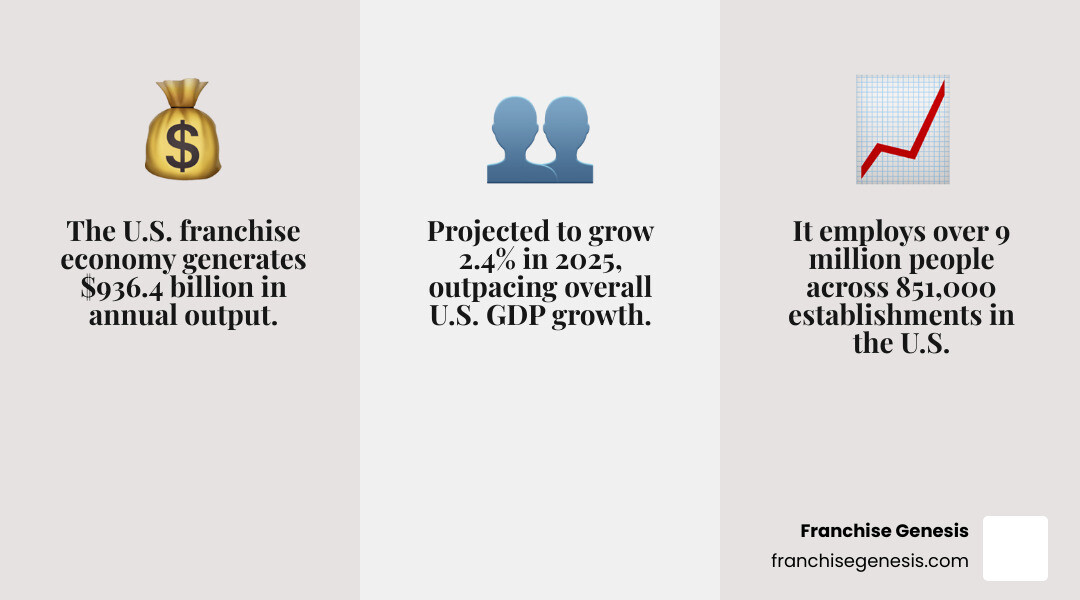
The franchise economy is a multi-trillion dollar ecosystem where established brands license their business models, trademarks, and operational systems to independent owner-operators. It’s a powerhouse, accounting for over 851,000 establishments and more than 9 million jobs in the U.S. alone, with a projected $936.4 billion output in 2025. It’s also growing faster than the broader economy.
If you’ve built a successful business and wondered how to expand without draining your capital or managing every location yourself, you’ve stumbled onto franchising’s secret: it’s the most efficient growth model for proven concepts.
Most business owners think franchising is just about fast food. That’s wrong. The franchise economy includes fitness studios, cleaning services, healthcare providers, and practically every service-based business imaginable. It’s not just a growth strategy—it’s an economic framework that quietly powers entrepreneurship.
Here’s what most people miss: for business owners like you, franchising is about turning your proven concept into a scalable empire without the massive capital requirements of traditional expansion.
In 2025, franchising will add over 20,000 new establishments and create more than 210,000 jobs. While headlines focus on uncertainty, the franchise sector continues to outperform because it pairs entrepreneurial ambition with proven systems—a nearly recession-proof combination.
I’m Monique Pelle Kunkle, Vice President of Operations at Franchise Genesis. I’ve spent years helping business owners transform their concepts into thriving franchise systems, guiding companies from single locations to over 100 franchised units. I’ve seen how the right structure creates wealth for both franchisors and their franchisee partners.
Franchise economy terminology:
The Architecture of the Modern Franchise Economy
Think of the franchise economy as a sophisticated partnership. You, the franchisor, have a proven business model. On the other side, franchisees are motivated entrepreneurs who want your blueprint for success. This isn’t just a simple licensing deal; it’s a relationship built on trust, proven systems, and shared success.
You license your brand, processes, and intellectual property to franchisees for an initial fee and ongoing royalties. In return, they operate under your brand with your tested business model. The beauty of this structure is that you expand your footprint without emptying your bank account. Your franchisees bring the capital and local market knowledge; you provide the system that gives them the best shot at success. It’s one of the smartest shortcuts to scaling a business ever invented.
What is the fundamental structure of franchising?
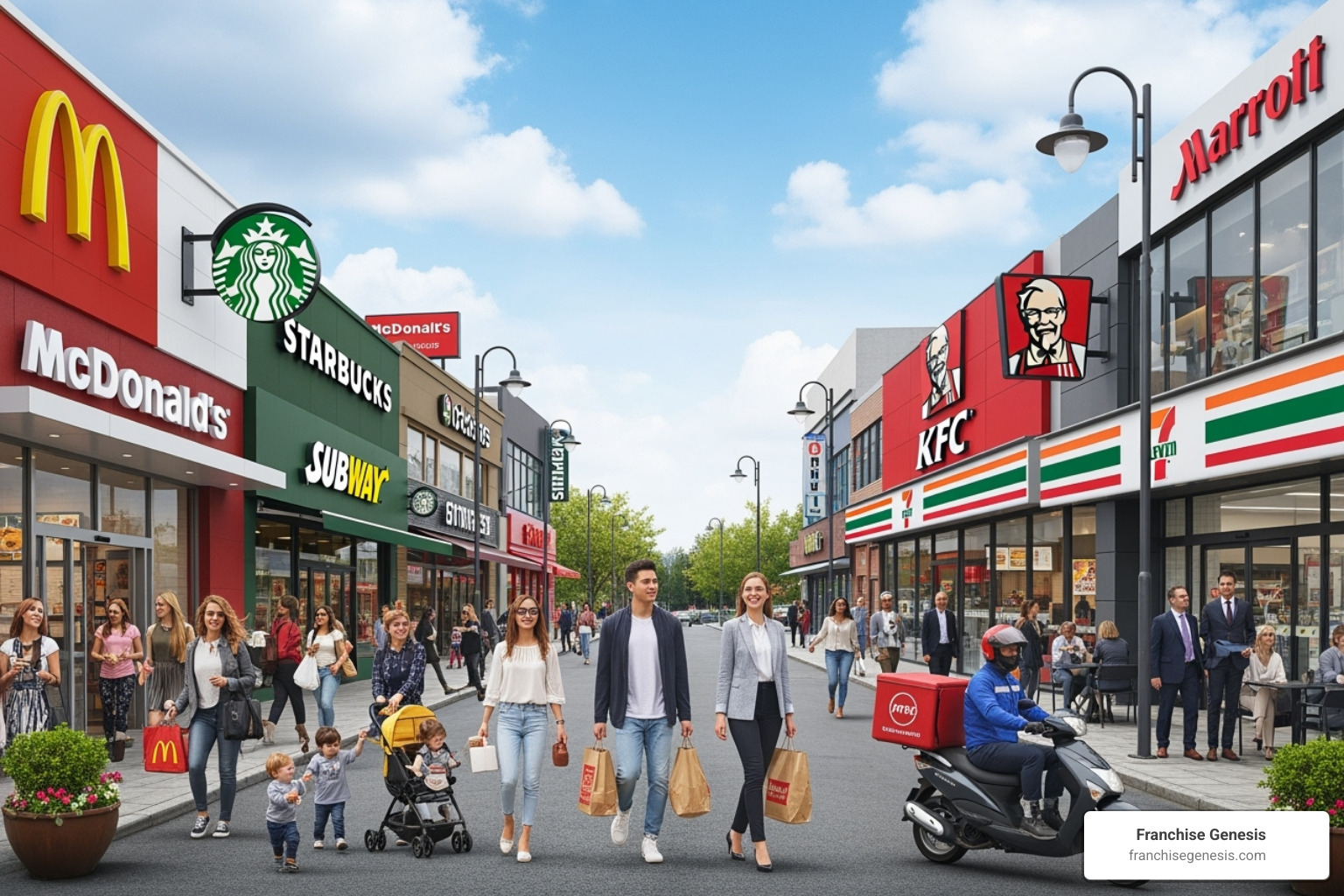
Most successful franchises today use business format franchising. This is a comprehensive approach where you’re not just licensing a product; you’re handing over your entire business playbook. Franchisees get your brand name, operating procedures, marketing strategies, and ongoing support. They are essentially running a clone of your successful business. The alternative, product distribution franchising (like car dealerships), offers more operational autonomy but less brand control.
For most service-based businesses, business format franchising is the path forward because it protects quality and consistency. Every successful system needs several key components: a trusted brand, a comprehensive operations manual, initial and ongoing training and support, and collective marketing programs. This synergistic dynamic creates a powerful partnership where franchisees get a tested system and you get motivated owner-operators who are personally invested in their locations. It’s a win-win built on clear contractual obligations.
Want to understand more about how this foundation works? Check out more info about what franchising is.
How does brand recognition drive the franchise model?
In the franchise economy, your brand is everything. I’m not talking about a logo, but the brand equity you’ve built by delivering consistent quality and earning customer trust. This trust attracts quality franchisees and brings customers through their doors from day one.
When customers see your brand, they know what to expect. Your franchisees don’t have to spend years building that credibility—you’ve already done it. As a franchisor, you protect and amplify this power. Most manage national advertising campaigns funded by the franchise network to build widespread awareness.
At the same time, you equip franchisees with local marketing tools to connect with their community while maintaining brand consistency. This dual approach—national brand building combined with local adaptation—creates maximum impact. Strong brand recognition also reduces marketing costs for individual locations, leading to faster ramp-up times and better unit economics.
The covenant you make with consumers is that every location delivers the same quality. Maintain it, and you create a self-reinforcing cycle where brand strength attracts better franchisees, who deliver better experiences, which strengthens the brand further. We dive deeper into these strategies in our guide on Franchise Sales & Marketing strategies.
Why Franchising is a Global Economic Powerhouse
The franchise economy is consistently outperforming the broader economy. The numbers tell a clear story. In the U.S., franchised businesses are on track for nearly $936.4 billion in total output in 2025. For you as a business owner, what matters is what’s happening now.
In 2025, the franchise economy is projected to grow by 2.4%, outpacing the broader U.S. economy’s 1.9% GDP growth. This translates to 210,000 new jobs, over 20,000 new franchise establishments, and a total output exceeding $936.4 billion. These aren’t just statistics; they represent real people building careers and communities thriving. They represent opportunity.
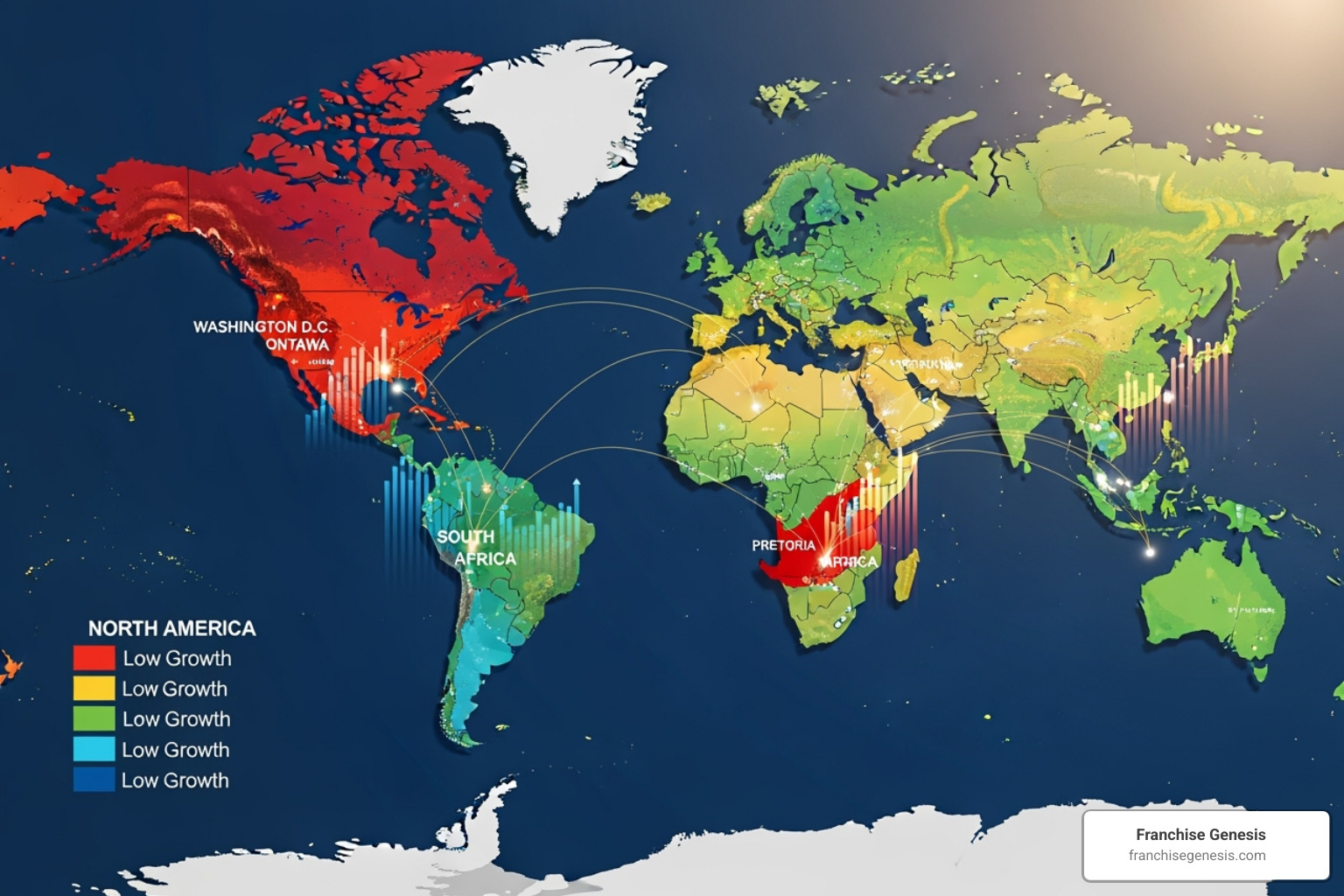
This isn’t just an American phenomenon. Globally, franchising creates millions of jobs and economic stability. The model’s adaptability makes it a cornerstone of economic growth worldwide. For a deeper look at these projections, check out the 2025 Franchising Economic Outlook.
How does the franchise economy fuel job creation and growth?
The franchise economy doesn’t just create jobs—it creates opportunity. The 210,000 jobs expected in 2025 span all levels, from entry-level to management. More importantly, franchising democratizes entrepreneurship, giving people a proven pathway to ownership without the risk of starting from scratch.
This impact is global. In South Africa, over 811 franchise systems contribute R734 billion annually and employ nearly 500,000 people, serving as a reliable engine for wealth building. In Canada, the sector’s projected 4% growth in 2025 outpaces most other industries, driven by its ability to adapt to economic and technological trends.
Franchised businesses also become pillars in their communities, supporting local charities and providing essential services. When you franchise your business, you’re not just expanding your brand—you’re creating opportunities for other entrepreneurs to build wealth while strengthening their communities. This is the real power of How Franchising Helps the Economy.
How does the franchise model steer external economic pressures?
Independent businesses often struggle to weather economic storms alone. The franchise economy is different. It’s built for resilience.
Franchising creates a distributed network of owner-operators who provide real-time intelligence on changing market conditions. This ground-level insight is something corporate-owned chains can’t replicate. Your established brand recognition also provides a buffer, as customers gravitate toward trusted names during uncertain times.
When facing pressures like rising interest rates or supply chain disruptions, the collective power of a franchise system matters. As a franchisor, you can leverage the network’s buying power to negotiate better terms with suppliers. You can share best practices for optimizing costs and retaining talent across the system, so when one franchisee finds a solution, everyone benefits.
During economic uncertainty, capable professionals often turn to franchising, seeking a structured path to business ownership. This provides a steady stream of qualified candidates. The franchise model’s strength lies in its ability to adapt, evolve, and thrive regardless of external pressures. We’re constantly refining our Franchise Growth Strategies to build systems resilient enough to weather whatever comes next.
Franchising Your Business: The Ultimate Growth Engine
If you’ve built a successful business and are ready to scale, franchising is the smartest move you can make. Traditional expansion drains capital and multiplies management headaches. Franchising flips this model on its head.

Instead of you funding each new location, your franchisees bring their own capital. Instead of hiring managers, you partner with owner-operators who have skin in the game. This is what makes the franchise economy so powerful. You achieve rapid market penetration while your franchisees handle day-to-day operations, freeing you to focus on growing the brand.
Franchising also creates an innovation advantage. Your network of engaged owner-operators becomes a testing ground for new ideas, allowing you to improve the entire system based on real-world feedback. If you’re wondering whether your business is ready, we’ve mapped out the journey in our guide on How to Make My Business a Franchise.
Franchising vs. Corporate Expansion: A Comparison
When you’re at a crossroads of growth, you have two paths: open more company-owned locations or franchise. Both can work, but they are fundamentally different journeys.
| Factor | Franchising (as an expansion strategy) | Corporate Expansion (company-owned stores) |
|---|---|---|
| Speed of Growth | Rapid: Leverages franchisee capital and motivation for faster market penetration. | Slower: Limited by your available capital and internal management capacity. |
| Capital Investment | Low for Franchisor: Franchisees provide the capital for new units, reducing your financial risk. | High for Company: You bear all costs for new locations (real estate, build-out, inventory, staffing). |
| Local Market Knowledge | High: Franchisees are local owner-operators with vested interest and deep community ties. | Moderate: Relies on hired managers who may lack the same local insight or personal investment. |
| Operational Management | Reduced Burden: Franchisees handle day-to-day operations, freeing your corporate team for strategic growth. | High Burden: Requires extensive corporate oversight and management of all locations. |
| Motivation | High: Franchisees are owner-operators, personally invested in their unit’s success. | Moderate: Hired managers are employees, often with less direct financial stake in individual unit performance. |
| Risk Profile | Lower: Spreads financial risk across multiple independent business owners. | Higher: All financial and operational risks are concentrated within your company. |
Franchising within the franchise economy trades some direct control for speed, capital efficiency, and a network of motivated partners. For proven concepts, it’s often the fastest path to market dominance.
What are the advantages of becoming a franchisor?
Becoming a franchisor offers tangible shifts in how your business grows.
- Grow faster without going broke. Franchisees fund their own locations, allowing your brand to expand into multiple markets simultaneously.
- Achieve brand dominance. More locations mean more visibility, establishing you as a major player in your industry.
- Create predictable revenue streams. You collect initial franchise fees and ongoing royalties, providing steady, recurring income.
- Get partners who actually care. Franchisees are owners, not employees. They’ve invested their savings and are committed to success.
- Escape the operational quicksand. Franchisees manage their own day-to-day operations, allowing you to focus on supporting the network and growing the brand.
These advantages compound over time, changing your business into a recognized name. Explore these benefits in our breakdown of the Benefits of Franchising for your business.
What makes a franchise opportunity attractive to partners?
To attract quality entrepreneurs, your franchise opportunity must be compelling.
- A proven business model. Prospective franchisees need to see that your concept works and that the unit economics are strong.
- A strong, recognizable brand. This gives franchisees a massive head start, inheriting the credibility you’ve already built.
- Comprehensive training and ongoing support. Partners need to feel prepared and know they’ll have access to guidance throughout their journey.
- Financial transparency. Providing clear financial performance representations in your Franchise Disclosure Document builds trust.
- Protected territories. Offering exclusive territories gives franchisees the confidence that you’re invested in their success, not just collecting fees.
Nailing these elements creates an opportunity that attracts ambitious partners. See how we help you Explore different franchise opportunities across all industries.
The Legal and Financial Framework for Franchisors
Franchising your business is thrilling, but the legal and financial framework is the foundation that protects everything you’ve built. Get this right, and you set yourself up for sustainable growth. Get it wrong, and you expose your brand to unnecessary risk.

This framework creates transparency and defines expectations for everyone in your franchise economy. It protects both you and your future franchisees. This is where expert guidance is crucial, and our Franchise Consulting Complete Guide can help you steer these complexities.
What is the legal scaffold of the franchise economy?
The legal structure of franchising exists to create transparency and fairness. The cornerstone is the Franchise Disclosure Document (FDD). Mandated by the Federal Trade Commission’s FTC Franchise Rule, this document provides prospective franchisees with 23 specific items of information about your opportunity, from costs to your company’s financial health. You must provide it at least 14 days before any money changes hands. For federal guidance, the Franchise Rule Compliance Guide is a key resource.
Beyond federal law, many states have their own registration and disclosure laws, requiring you to register your FDD before offering franchises there. The Franchise Agreement is the binding contract that outlines the terms of your partnership, from fees and obligations to renewal and termination. Finally, the legal framework protects your intellectual property—your brand name, logos, and proprietary methods—through trademark registration and confidentiality agreements.
Understanding the financial implications of franchising your business
Your financial model must be structured to generate the revenue needed to support your franchisees while remaining attractive to new partners. As a franchisor, your revenue comes from several streams.
- The franchise fee is a one-time, upfront payment (typically $25,000 to $75,000) that grants the right to use your system. This fee often covers your costs for recruiting and training.
- Royalties are your ongoing revenue, typically a percentage of a franchisee’s gross sales (4% to 12.5%). This funds your corporate operations, support, and profit.
- An advertising fund, usually 1% to 3% of gross sales, pools resources for system-wide marketing campaigns.
From the franchisee’s perspective, they’ll evaluate the total initial investment you are required to estimate in Item 7 of your FDD. These numbers must be realistic. You may also choose to provide profitability projections in Item 19. While optional, this transparency can be a powerful tool for attracting qualified candidates. For a detailed breakdown, see our guide on Franchise Startup Costs explained.
Frequently Asked Questions about Building a Franchise
How do franchises foster innovation and adapt to technology?
One of the surprising strengths of the franchise economy is its ability to innovate. The model creates a unique ecosystem that corporate structures struggle to replicate. Your franchisees are your eyes and ears, creating a natural feedback loop with insights from the front lines. This allows you to pilot innovations like new software or services in a few locations, reducing risk before a system-wide rollout.
As the franchisor, you handle centralized research and development, identifying emerging technologies that give your network a competitive edge. Because the franchise model is built for knowledge transfer, you can efficiently train your entire network on new systems, ensuring rapid and consistent adoption. This combination of ground-level feedback and centralized implementation keeps your brand nimble and competitive.
What due diligence should I expect from prospective franchisees?
The due diligence process runs both ways. Smart candidates will investigate you thoroughly, and you want them to. Franchisees who dig deep and ask tough questions become the best partners in the franchise economy.
Expect a serious candidate to scrutinize your Franchise Disclosure Document (FDD). A key step is making validation calls to your existing franchisees to ask about profitability, support, and challenges. They should also provide financial documentation to prove they have the necessary capital. Finally, you should expect them to hire a franchise attorney to review the agreement. A candidate who takes these steps is making an informed decision and is serious about becoming a strategic partner.
How does franchising contribute to my brand’s long-term legacy?
When you build a successful business, you create something valuable. When you franchise, you build something that can outlive you—a legacy.
Franchising allows your brand to achieve a geographic footprint that would be impossible through corporate expansion alone. More importantly, you’re creating opportunities for other entrepreneurs to achieve their dreams of business ownership, building wealth for their families and creating jobs in their communities. Your proven system becomes the vehicle for their success.
A well-structured franchise ensures brand consistency for generations to come, changing your business into an institution. From a financial perspective, a thriving franchise system with recurring royalty income becomes a highly valuable asset, dramatically increasing your enterprise value. You’re not just scaling a business—you’re creating something that endures.
Conclusion: Your Future in the Franchise Economy
You’ve built something special—a business that works and a brand people trust. Now you’re looking at the next chapter. The franchise economy is a proven pathway for business owners like you to transform a successful local operation into a scalable empire.
Instead of draining your capital, you partner with motivated entrepreneurs who invest their own resources. Instead of managing every detail, you build systems and support a network of dedicated owner-operators. This is how you build a legacy—a brand that touches more communities, creates more opportunities, and outlasts any single founder.
But franchising your business the right way requires expertise. The legal framework, financial structures, and operational systems must be built with a clear roadmap. At Franchise Genesis, we’ve guided countless business owners through this exact journey, helping them turn proven concepts into scalable systems that create wealth for everyone involved.
Your business has already proven it works. The question is whether you’re ready to take that step. Are you ready to see your brand on storefronts across the country and join the ranks of the franchise economy?
If the answer is yes, then let’s talk. Your proven business is ready for the next level. Contact Franchise Genesis to start your journey today, and let’s build your legacy together.