
The First Step to Building Your Franchise Empire
A franchise feasibility study is your roadmap to determining whether your business can successfully expand through franchising. This comprehensive analysis evaluates your business model’s potential for replication, profitability for future franchisees, and your readiness as a franchisor.
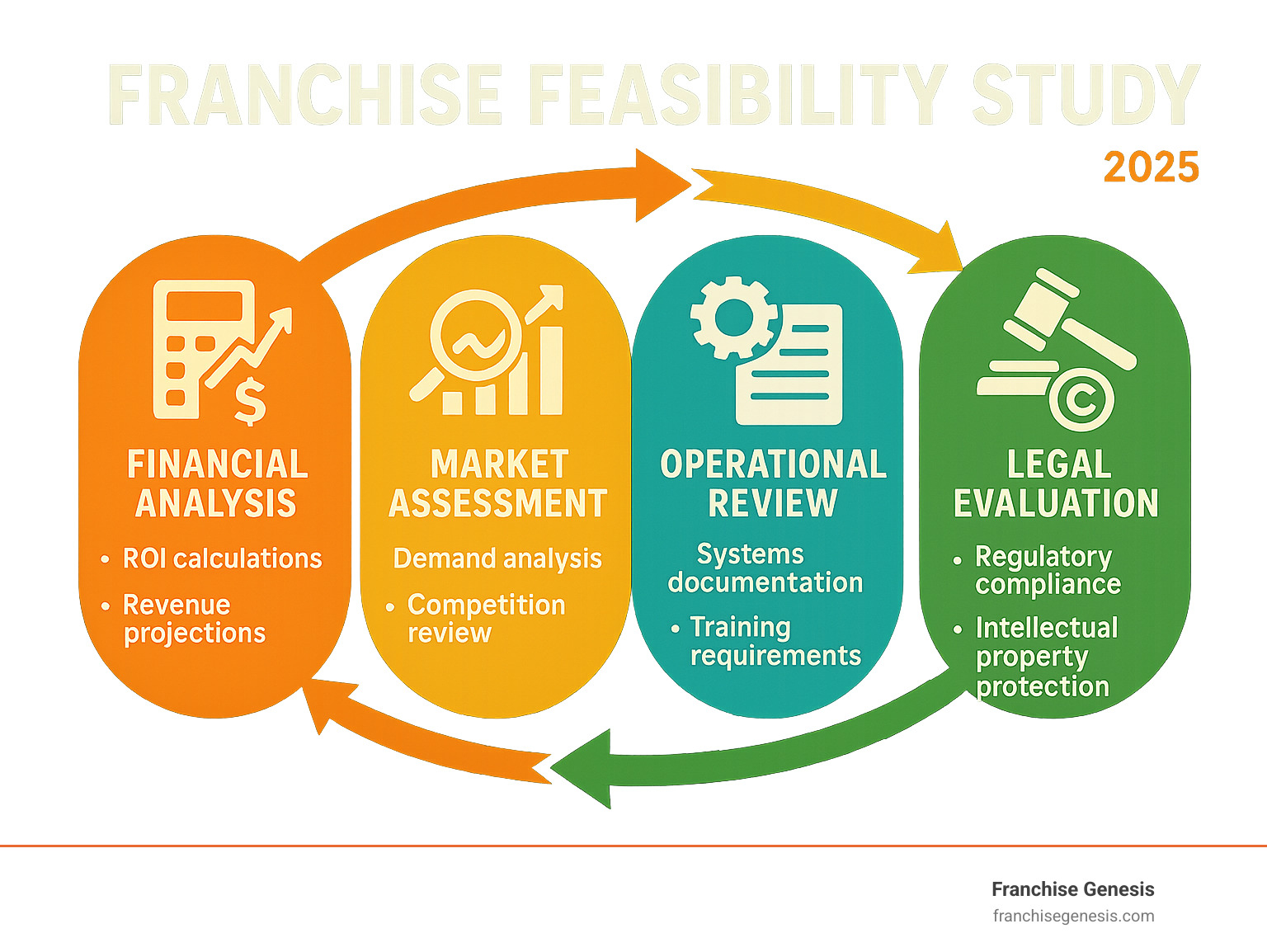
Key components of a franchise feasibility study include:
- Financial analysis – Can franchisees achieve a 20% ROI plus reasonable salary?
- Market assessment – Is there demand for your concept in new markets?
- Operational review – Are your systems documented and teachable?
- Legal evaluation – What regulatory requirements must you meet?
- Scalability testing – Can your business succeed without your direct involvement?
Many business owners think franchising is simply licensing their brand to others. It’s not. Franchising transforms you from a business operator into a business mentor – supporting dozens or hundreds of franchisees across multiple markets. This shift requires different skills, systems, and mindset than running a single location.
The stakes are high. Companies that skip proper feasibility assessment often struggle with franchisee failures, legal issues, or unsustainable business models. But those who invest in thorough analysis – typically costing $10,000 to $20,000 and taking 2-3 months – build stronger foundations for long-term success.
As Monique Pelle-Kunkle, Vice President of Operations at Franchise Genesis, I’ve guided hundreds of business owners through franchise feasibility studies, helping them scale from single locations to thriving multi-unit networks. My experience has shown that the most successful franchisors are those who thoroughly understand their readiness before taking the leap.
Important Franchise feasibility study terms:
Are You Sitting on a Franchise Goldmine? Key Feasibility Factors

Not every successful business is suitable for franchising. A franchise feasibility study is a critical first step to determine if your concept can be successfully replicated and scaled. It assesses several key factors to see if you’re sitting on a franchise goldmine.
Profitability & Financial Viability
A franchise must be profitable for both the franchisee and the franchisor. A key part of the franchise feasibility study is determining if the business can generate a strong Return on Investment (ROI) for franchisees. A common benchmark is a 20% ROI plus a reasonable salary for the owner after the second year. As a franchisor, your income will come from initial franchise fees, ongoing royalties, and other potential fees. These must cover your support costs and generate a profit. A thorough financial analysis will project revenues, expenses, and capital requirements for both parties. Franchise Financing Options Complete Guide
Scalability & Replicability
Scalability is about whether your business model can be easily taught and duplicated across various locations without losing its quality. This means your business model needs to be teachable, with documented operating procedures captured in a comprehensive manual. If your business relies heavily on your unique, irreplaceable skills, it may not be easily franchiseable. The goal is a system that can be replicated by others with reasonable training, ensuring brand consistency. Franchise Operations Manual
Market Demand & Brand Strength
Even a profitable and scalable business needs market demand to succeed as a franchise. A franchise feasibility study assesses this by looking at your unique selling proposition (USP), competitive advantages, and brand recognition. The “magic of the brand” is in delivering a consistent, quality experience everywhere. We also analyze the competition in potential new markets to ensure your franchise can thrive. Franchise Sales & Marketing
Your Blueprint for Success: Conducting a Franchise Feasibility Study

A franchise feasibility study is your strategic blueprint for expansion. It helps identify potential challenges and opportunities before you invest significant time and money. This process typically takes two to three months and provides the data-driven insights needed to build a successful franchise system. Guide to Franchising
The Four Lenses of a Franchise Feasibility Study
We examine your business through four critical lenses to assess its franchise potential:
- Economic Feasibility: Can franchisees earn a strong ROI while paying royalties? Can you generate enough revenue to support the network? We create realistic financial models to answer these questions.
- Operational Feasibility: Can someone else run your business as effectively as you do? We assess if your processes can be taught, replicated, and managed by others.
- Legal Feasibility: Franchising is heavily regulated. We review intellectual property, disclosure requirements, and compliance with federal and state laws.
- Technical Feasibility: Do you have the technology and infrastructure to support a franchise network, including training and ongoing support systems?
Franchise Feasibility Studies: Understanding Their Importance
The Step-by-Step Process
A thorough franchise feasibility study involves several key steps:
- Internal Business Analysis: We analyze your business’s history, profitability, and operational systems to assess its stability and readiness for franchising.
- Market & Competitor Research: We explore potential new markets, analyzing demand, demographics, and the competitive landscape.
- Financial Modeling & Projections: We create detailed financial forecasts, including investment costs, operating expenses, and revenue potential, to ensure the model is attractive for both you and your franchisees.
- Legal & Regulatory Review: We identify all legal requirements, from trademark protection to the Franchise Disclosure Document (FDD), to ensure you’re on solid legal ground.
- Strategic Planning: We synthesize all findings into a comprehensive strategy, outlining your franchise model, expansion timeline, and support systems.
Legal and Regulatory Considerations
Navigating the legal landscape of franchising is crucial.
- Trademark Protection: Your brand name and logos are valuable assets. We ensure they are properly registered and protected.
- Franchise Disclosure Document (FDD): This is a mandatory legal document in the United States that provides prospective franchisees with detailed information about your franchise system. You can learn more about the specific requirements from the Federal Trade Commission’s Franchise Rule page.
- State and Federal Laws: Different states have specific regulations for franchise sales and relationships. We help you steer this complex legal landscape to avoid costly mistakes.
Franchise Legal Considerations
The Realities of Becoming a Franchisor

Transitioning from a business owner to a franchisor is a meaningful shift. Your role moves from running day-to-day operations to mentoring and supporting a network of owners. Your growth depends on theirs, so building a support system that scales is essential. Franchise Growth Strategies
Understanding the Costs and Revenue Streams
A franchise feasibility study typically costs $10,000 to $20,000 and helps you avoid costly missteps. Full franchise development (legal, manuals, training, and marketing) often ranges from $150,000 to $400,000.
As a franchisor, common revenue streams include:
- Initial Franchise Fees
- Ongoing Royalties
- Marketing Fund Contributions
- Other fees (e.g., proprietary products, technology, or training)
Building a World-Class Franchisee Support System
Support starts with comprehensive onboarding and continues with ongoing coaching, field visits, marketing assistance, and shared technology (POS, inventory, communication tools). Strong systems drive consistency and results across locations. Franchise Business Opportunities Guide
Managing Expectations: The Franchisor-Franchisee Relationship
Clear expectations build trust and performance.
| Franchisor Expectations | Franchisee Expectations |
|---|---|
| Adherence to brand standards and operating procedures. | Comprehensive initial and ongoing training. |
| Timely payment of royalties and fees. | Strong marketing and brand support. |
| Active participation in marketing and promotional activities. | A profitable and sustainable business model. |
| Open communication and reporting. | A supportive and responsive franchisor relationship. |
| Commitment to growing the brand. | A clear path to success and growth. |
The First Step to Building Your Franchise Empire
A franchise feasibility study is the roadmap to determine if your business can scale via franchising. It evaluates your model’s replicability, franchisee profitability, and your readiness to lead a network.
Key components of a franchise feasibility study include:
- Financial analysis – Can franchisees achieve a 20% ROI plus reasonable salary?
- Market assessment – Is there demand for your concept in new markets?
- Operational review – Are your systems documented and teachable?
- Legal evaluation – What regulatory requirements must you meet?
- Scalability testing – Can your business succeed without your direct involvement?
Franchising isn’t just licensing a brand. It’s a shift from operator to mentor, supporting owners across multiple markets. A thorough study—often $10,000 to $20,000 over 2-3 months—helps you avoid legal, financial, and operational missteps and build a solid foundation.
As Monique Pelle-Kunkle, Vice President of Operations at Franchise Genesis, I’ve helped hundreds of owners use franchise feasibility studies to confidently scale.
Important Franchise feasibility study terms:
Are You Sitting on a Franchise Goldmine? Key Feasibility Factors
Before you consider franchising, confirm your model can be replicated, supported, and scaled by others—not just by you. A franchise feasibility study is your pre-flight check. What is Franchising?
Profitability & Financial Viability
Franchising must work financially for both parties. A common benchmark is a 20% ROI plus a reasonable owner salary by year two for franchisees. Your revenue as franchisor typically comes from initial fees, ongoing royalties, and potentially marketing or technology fees—enough to fund robust support and still generate profit. Capital needs to launch your system commonly total $150,000 to $400,000. Franchise Financing Options Complete Guide
Scalability & Replicability
Your business must be teachable and documented in an operations manual, with training ideally under three months. If the model depends on your unique skills or relationships, it’s harder to franchise. The goal is a system others can run well with clear playbooks and measurable standards. Franchise Operations Manual
Market Demand & Brand Strength
Even a profitable, systemized concept needs proven demand in new markets. Assess your USP, competitive positioning, and ability to deliver consistent quality across locations. Analyze competitors and local dynamics to confirm your brand can stand out and scale. Franchise Sales & Marketing
Your Blueprint for Success: Conducting a Franchise Feasibility Study
A franchise feasibility study is a strategic blueprint that surfaces challenges early and validates your pathway to scale. Most studies take 2–3 months and often inform your business plan. Guide to Franchising
The Four Lenses of a Franchise Feasibility Study
- Economic Feasibility: Financial viability for both franchisor and franchisees (revenues, margins, ROI, break-even).
- Operational Feasibility: Can processes, supply chains, and training be replicated efficiently by others?
- Legal Feasibility: IP protection and compliance with federal and state franchise laws and disclosures.
- Technical Feasibility: Systems and skills to support training, data, and ongoing network operations.
The Step-by-Step Process
- Internal Business Analysis: Track record, profitability, differentiation, and systemization.
- Market & Competitor Research: Demand, demographics, regulations, and competitive landscape.
- Financial Modeling & Projections: Investments, working capital, revenues, margins, ROI, and unit economics.
- Legal & Regulatory Review: Trademarks, disclosure planning, and state-by-state requirements.
- Strategic Planning: Franchise model, rollout, fees, support, and growth roadmap.
Legal and Regulatory Considerations
Protect your trademarks and proprietary systems. Prepare required disclosures and align with state and federal franchise rules. Address industry-specific constraints where applicable. Careful legal planning now prevents costly issues later. Franchise Your Business
The Realities of Becoming a Franchisor
Transitioning from operator to franchisor means building systems that help others succeed—training, coaching, marketing, and technology—while you protect the brand and drive growth. Franchise Growth Strategies
Understanding the Costs and Revenue Streams
A feasibility study often runs under $20,000 and can prevent much larger mistakes. Full development (FDD, agreements, manuals, training, and marketing) typically totals $150,000–$400,000. Revenue streams usually include initial fees, royalties, and marketing fund contributions, with potential add-ons like tech or product fees.
Building a World-Class Franchisee Support System
Deliver strong onboarding, field and help-desk support, marketing assistance, and standardized tech (POS, inventory, communications) to ensure consistency and performance. Franchise Business Opportunities Guide
Managing Expectations: The Franchisor-Franchisee Relationship
Set expectations early and clearly.
| Franchisor Focus | Franchisee Focus |
|---|---|
| Brand standards and system compliance | Training, tools, and responsive support |
| Timely fees and transparent reporting | Clear path to profitability and growth |
| Participating in system-wide marketing | Strong brand-building and lead generation |