
Navigating Franchise Business Loans for Your Future Franchisees
From local success to a national brand, you’ve built something remarkable. Now, you’re ready to expand by allowing other entrepreneurs to replicate your proven model. But turning that dream into a multi-unit reality hinges on a critical factor: how your prospective franchisees secure funding. Understanding franchise business loans isn’t just about helping your candidates; it’s about structuring your brand for sustainable, widespread growth.
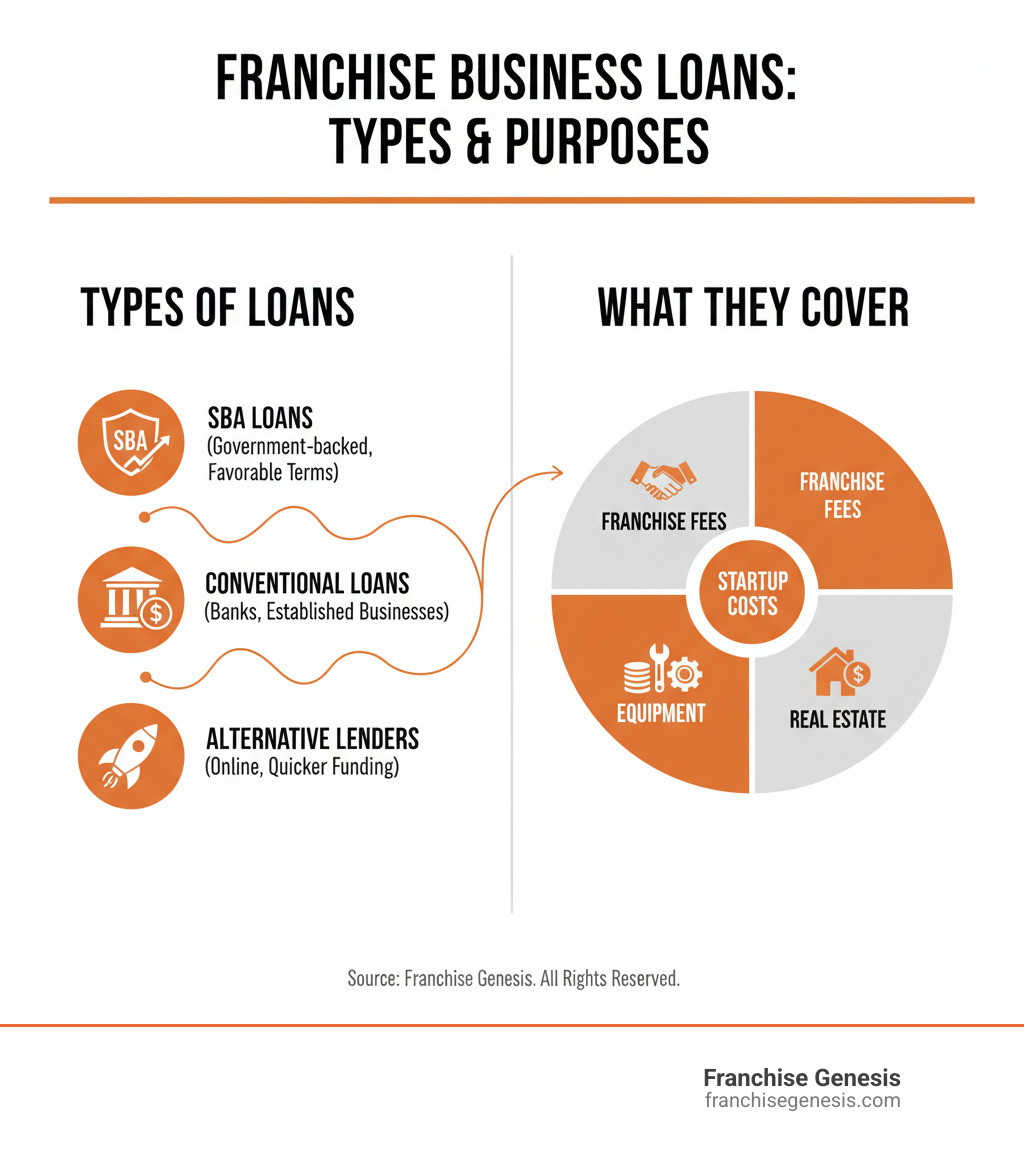
Here’s a quick overview of what franchise business loans are:
- Definition: Specialized financing designed to help individuals acquire, open, and operate a franchise unit.
- Purpose: Covers initial franchise fees, startup costs, equipment, real estate, and working capital.
- Key Types:
- SBA Loans: Government-backed loans (e.g., 7(a), 504) with favorable terms.
- Conventional Bank Loans: Traditional loans from banks, often for established businesses.
- Alternative Lenders: Online platforms or specialized lenders for quicker funding, sometimes with higher costs.
- Franchisor Financing: Direct or indirect financing support offered by the franchise brand itself.
- Importance for Franchisors: A clear understanding helps you guide prospective franchisees, making your brand more “bankable” and attractive to serious investors.
I’m Monique Pelle Kunkle, Vice President of Operations at Franchise Genesis. My expertise in scaling businesses, particularly in helping entrepreneurs launch and grow successful franchise models, deeply involves navigating effective franchise business loans to ensure their success. Let’s explore how you can make your franchise system a financing magnet.
Franchise business loans terms to learn:
Why a Strong Franchisee Financing Program is Your Key to Growth
You’ve built a special business with a solid model, and you’re ready to scale. But your growth hinges on whether your future franchisees can actually afford to join you. Every prospective franchisee who can’t secure funding is a missed opportunity, and every unit that opens undercapitalized is a potential liability. Franchise business loans aren’t just your candidates’ concern—they’re fundamentally tied to your expansion strategy and brand reputation.
According to franchise growth statistics, the franchise sector was projected to grow to 821,000 locations in 2024, supporting 8.9 million jobs and contributing significantly to the U.S. GDP. This growth represents a real opportunity for your brand, but only if your franchisees can access the capital they need.
Lenders are watching you. When your franchisees successfully secure and repay franchise business loans, their units hit projections, and they demonstrate strong unit economics, it builds credibility for your entire system. Banks begin to view your brand as a smart investment rather than a risky bet.
Conversely, if franchisees struggle financially or units fail due to inadequate funding, your brand’s reputation suffers, and future candidates will have a harder time getting approved. This is especially true for emerging brands that need to build a track record. Those early success stories, built by well-capitalized franchisees, become your calling card to lenders.
This positive reputation is built intentionally. When you support your candidates through the financing process and connect them with the right lending partners, you’re building your brand’s credibility as a bankable, reliable franchise system. The good news? You don’t have to do it alone. Franchise Capital Solutions can help you structure your brand to attract both qualified candidates and the lenders who want to fund them.
The Main Types of Franchise Business Loans Your Candidates Will Seek

As a franchisor, understanding the financing options your candidates will explore is essential for your brand’s growth. If qualified candidates can’t access the right franchise business loans, your expansion stalls. Your franchisees will typically pursue one of four main paths: SBA loans, conventional bank loans, alternative lenders, or franchisor-assisted financing. Each option serves a different type of borrower and comes with its own set of advantages and trade-offs.
Here’s what these options look like side by side:
| Loan Type | Typical Borrower | Pros | Cons |
|---|---|---|---|
| SBA Loans | New franchisees, those with less collateral | Lower down payments, longer terms, competitive rates, government-backed | Longer approval process, strict eligibility, extensive paperwork |
| Conventional Bank Loans | Established businesses, strong credit history | Lower interest rates, flexible terms (for proven businesses), strong relationship with bank | Stricter requirements, higher down payments, shorter terms for startups, less flexible for new ventures |
| Alternative Lenders | Speed-focused, less-than-perfect credit | Faster approval, less stringent requirements, more flexible for niche needs | Higher interest rates, shorter repayment periods, potentially less favorable terms |
| Franchisor-Assisted | New franchisees within your system | Direct support, understanding of your brand, potentially discounted fees | Limited availability, potential for franchisor control, may require personal guarantee |
The key is matching candidates with the right path. For a comprehensive look, explore our Franchise Financing Options Complete Guide.
SBA Loans: The Government-Backed Advantage
The Small Business Administration (SBA) guarantees a portion of loans made by approved lenders, reducing their risk and enabling them to offer better terms. This has made SBA loans a cornerstone of franchise financing.
- SBA 7(a) loans are the most versatile, covering everything from franchise fees and equipment to working capital. They offer long repayment terms (up to 25 years for real estate), which means lower monthly payments for your franchisees. You can learn more at the SBA 7(a) loan program details.
- SBA 504 loans are for major fixed assets like real estate or heavy equipment. They offer long-term, fixed-rate financing but cannot be used for working capital or initial franchise fees.
The biggest advantage of SBA loans is the lower down payment, often around 10%, which can be the deciding factor for many candidates. To see how this can benefit your system, check out Franchise Financing SBA.
Conventional Bank Loans
For candidates with a strong financial profile, a conventional loan from a bank or credit union can be a cost-effective path to funding. These loans often feature competitive interest rates and a faster closing process than SBA loans, especially if the bank already knows and trusts your franchise system.
However, the bar is higher. Lenders typically require a down payment of 20% or more and will closely scrutinize credit scores, net worth, and the business plan. As a franchisor, building relationships with banks that value the franchise model can create a competitive advantage for your entire system. Learn more in our guide on Best Franchise Financing.
Alternative Funding Sources
Alternative funding can be a lifeline for candidates who need speed or don’t fit the traditional mold, but these options often involve trade-offs between cost and risk.
- Online lenders offer streamlined applications and rapid funding but typically have higher interest rates and shorter repayment terms.
- Rollovers as Business Startups (ROBS) allow franchisees to use retirement funds (401(k)s, IRAs) without tax penalties. It’s not a loan, so there’s no debt, but it’s a high-stakes move that puts their retirement savings at risk. This strategy requires expert legal and financial guidance.
- Crowdfunding and personal assets (savings, home equity loans) are other common sources. Using personal assets provides immediate capital but puts personal wealth on the line. These alternative paths serve a purpose, but it’s crucial that your franchisees understand the dynamics. For more on flexible options, explore Unsecured Franchise Loans.
How to Make Your Franchise “Bankable”: The Franchisor’s Role

Your role as a franchisor extends to inspiring confidence in the lenders who will fund your franchisees. Being “bankable” means presenting your brand as a solid investment opportunity. Lenders look for a proven business model, strong unit economics, and comprehensive operations manuals.
Most importantly, they scrutinize your Franchise Disclosure Document (FDD). A transparent, well-documented FDD is your brand’s financial resume, signaling to lenders that you have a well-structured system. The Guidance from the Federal Trade Commission can help ensure your FDD meets regulatory standards. When lenders see reduced risk, your franchisees get better access to franchise business loans. To learn how successful franchisors position their brands, review The Cost to Start a Franchise and Financing Options.
Getting Listed on the SBA Franchise Directory
Getting your brand listed on the SBA Franchise Directory is a game-changer. This listing acts as a powerful stamp of approval, as the SBA has pre-vetted your franchise system. For lenders, this means the heavy lifting of analyzing your franchise agreement and model is already done.
For your franchisees, this translates into streamlined loan processing, improved credibility with lenders, and wider access to capital. When a candidate compares your SBA-approved brand to another, you’ve already removed a major barrier to their success. You can Check the SBA Franchise Directory to see how it works.
Building a Network of Preferred Lenders
Cultivating a network of preferred lenders who understand franchise financing is a smart investment. When your candidate works with a lender who is already familiar with your FDD, startup costs, and success rate, the conversation shifts from viability to terms and timelines.
These relationships lead to faster approvals and custom financing solutions custom to your model. Your franchisees also benefit from expert guidance, eliminating the frustration of working with a lender who doesn’t understand franchising. Start by identifying Franchise Financing Companies that specialize in your industry and nurture those relationships as you grow.
Considering In-House or Guaranteed Franchise Business Loans
Some franchisors offer direct financial support to accelerate growth. While not for every brand, it can be a powerful differentiator.
- Direct lending involves the franchisor providing a portion of the startup capital. This shows immense confidence in your system.
- Loan guarantee programs involve you guaranteeing a portion of a franchisee’s loan from a third-party lender, reducing the lender’s risk.
- Discounted fees or payment plans lower the upfront cash barrier for qualified candidates.
The primary advantage is attracting more candidates and accelerating growth. However, this approach involves taking on financial risk and administrative complexity, and it requires significant capital reserves. These programs are best suited for established brands with a strong track record. Explore how these options might fit your strategy in How to Finance Franchise.
Frequently Asked Questions for Aspiring Franchisors
As you prepare to franchise your business, it’s natural to have questions about the financial side. Here are answers to some of the most common inquiries we hear from aspiring franchisors.
How much capital do I need to franchise my business?
There’s no single answer, as the investment to franchise your business varies by industry and complexity. This is your corporate budget, not the franchisee’s investment. You will need to fund several key areas:
- Legal Fees: Drafting your Franchise Disclosure Document (FDD) and franchise agreement, plus state registrations. This is often the largest initial cost.
- Marketing Funds: Creating a franchise website, generating leads, and developing materials to attract your first franchisees.
- Operational Infrastructure: Developing comprehensive operations manuals and training programs.
- Working Capital: Covering corporate expenses until franchise fees and royalties create consistent revenue.
Think of it as investing in a new franchising division for your company. For a detailed breakdown, our Cost to Franchise Business Guide is an excellent resource.
How does a franchisee’s poor credit affect my brand?
A franchisee’s poor credit history can significantly harm your brand. Lenders view your franchise system as a whole. If multiple franchisees have shaky credit or default on their franchise business loans, the lending community will see your entire brand as a high-risk venture. This makes it harder and more expensive for all future candidates to secure financing.
Furthermore, a struggling or failed unit damages your brand’s reputation, discouraging new candidates and affecting customer perception. This is why your vetting process is so critical. Establishing strong financial qualification criteria from the beginning is one of the best ways to protect your brand’s long-term health.
What is the most common type of financing for new franchisees?
New franchisees rarely rely on a single funding source; they typically use a combination. However, a few options are particularly common due to their accessibility and favorable terms.
SBA loans are arguably the most popular choice. Their government backing, lower down payment requirements, and longer repayment terms lower the barrier to entry for many entrepreneurs. Another common strategy is Rollovers as Business Startups (ROBS), which allows franchisees to invest their retirement funds without tax penalties. While this avoids debt, it carries the risk of losing their savings if the business fails.
Most franchisees combine these options with personal assets, using savings or a home equity line of credit for their down payment. A typical funding package might mix personal savings with an SBA loan to cover the total investment, spreading risk and ensuring the new unit is well-capitalized from day one.
Conclusion: Building Your Franchise Empire on a Solid Financial Foundation
You’ve built something remarkable. Your business works, your customers love it, and you’re ready to share that success with others through franchising. But as we’ve explored together, turning that vision into reality requires more than just a great concept—it requires understanding how your future franchisees will access the capital they need.
Throughout this guide, we’ve seen that franchise business loans aren’t just your franchisees’ concern. They’re central to your success as a franchisor. When your candidates can secure favorable financing, your brand grows. When lenders view your system as bankable, your expansion accelerates. And when you actively support the financing process, you’re not just selling franchises—you’re building lasting partnerships.
The most successful franchisors don’t leave financing to chance. They get listed on the SBA Franchise Directory. They cultivate relationships with preferred lenders who understand their brand. They structure their systems with transparent FDDs, proven unit economics, and comprehensive support. They make themselves bankable by design, not by accident.
This proactive approach transforms franchise business loans from a potential obstacle into a powerful growth engine. Your franchisees secure better terms. Lenders view your brand favorably. Your system expands on a foundation of financial stability rather than hope.
At Franchise Genesis, we’ve guided countless entrepreneurs through exactly this process. We know that structuring your franchise system for sustainable growth means thinking about financing from day one. It means building a brand that lenders trust and franchisees can confidently invest in. That’s the kind of solid foundation that supports a true franchise empire.
Ready to position your brand for financing success? Contact Franchise Genesis to build your franchise system and let’s work together to create a franchise opportunity that opens doors—both for your future franchisees and for your brand’s unlimited potential.