For successful mobile food businesses, food truck franchising is a proven path to rapid growth. It sidesteps the massive capital investment of traditional restaurant expansion by letting motivated entrepreneurs fund and operate new locations under your brand.
The U.S. food truck industry includes over 51,000 businesses generating more than $2.2 billion annually. The industry has evolved far beyond simple street carts into sophisticated culinary concepts with loyal customer bases and scalable systems.
Key benefits of food truck franchising include:
- Lower startup costs: franchise fees of $20,000 to $50,000 are a fraction of brick and mortar restaurant costs
- Reduced capital requirements: franchisees fund the truck and equipment
- Faster expansion: no real estate delays or construction timelines
- Motivated owner-operators: franchisees are invested stakeholders, not employees
- Flexible operations: trucks target high-traffic events and prime locations
- Mobile marketing: every truck acts as a moving billboard building brand awareness
Food truck franchising allows you to replicate your proven business model across multiple markets. Franchisees assume the operational duties and the initial investment. Unlike independent expansion, which requires your own capital for every new truck, franchising enables growth through other people’s time and money.
I’m Monique Pelle Kunkle, Vice President of Operations at Franchise Genesis. I’ve helped numerous mobile food businesses successfully transition to food truck franchising models, scaling some concepts to over 100 locations in their first year. This guide shares what it takes to build a food truck franchise system that actually works.
The Mobile Advantage: Why Franchising Your Food Truck is a Smart Move
If you have built a successful food truck but are hitting a growth ceiling, franchising is your path forward. Instead of draining your own savings to expand, you partner with motivated entrepreneurs who invest their capital to launch your concept in new markets. They bring the hustle and local knowledge. You provide the brand and systems that already work.
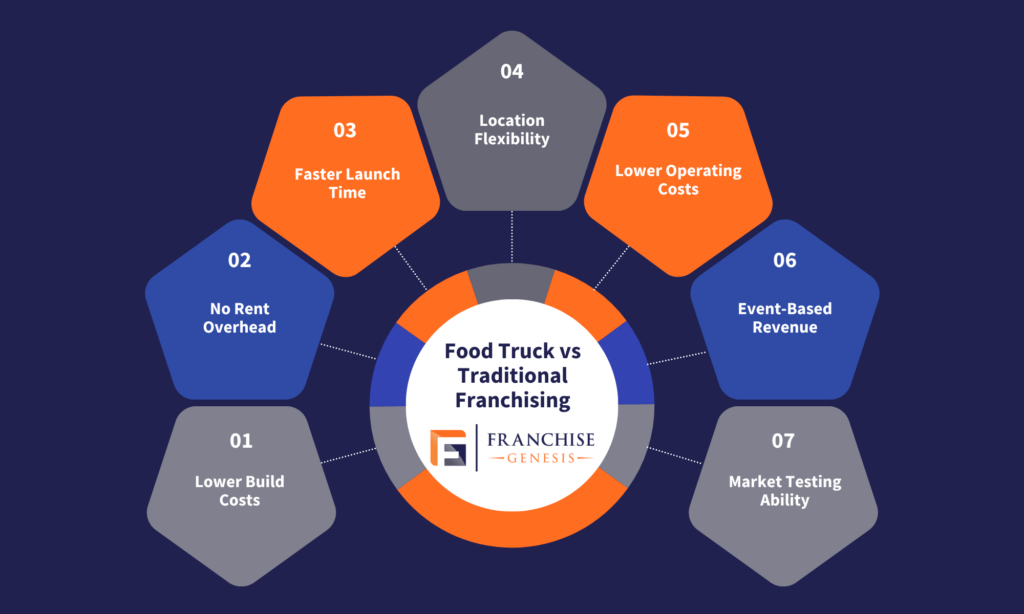
Your food truck has built-in advantages over a traditional restaurant franchise that make it highly attractive to prospective franchisees:
- No monthly rent payments eating into profits
- Lower utility and staffing costs due to a smaller footprint
- Flexibility to chase crowds at events or pivot based on weather and season
The lower overhead makes the path to profitability much clearer for franchisees than a mortar location would. That clarity is a selling point when recruiting.
The biggest advantage is scalability. While you might open one new truck a year on your own, franchising could help you launch five or ten in the same period. Each new truck spreads brand awareness more effectively than traditional advertising. Every franchisee is an invested owner-operator, not just an employee. That personal investment drives a level of commitment that a hired manager simply cannot replicate.
Food Truck Ownership Models: Independent vs. Franchise
Expanding independently means cloning your challenges with every new truck. Franchising means building a system that empowers others to succeed.
Feature | Independent Expansion | Food Truck Franchise Expansion |
Initial Investment | Your money funds every new truck ($75,000 to $200,000 each) | Franchisees invest their own capital |
Scalability | Limited by your bank account and time | Limited only by finding qualified franchisees |
Operational Complexity | You manage staff, inventory, and schedules for all locations | You support franchisees who handle daily operations |
Brand Control | Complete control over every decision | Controlled through franchise agreements and training |
Your role shifts from operator to brand guardian. You trade hands-on control for scalable growth, which is the right exchange for most successful food truck owners ready to build something bigger.
Leveraging Mobility for Rapid Growth
Mobility is your competitive advantage. Your franchisees can go where the customers are, something fixed location restaurants cannot do.
- Event-based revenue: Festivals, concerts, and corporate events provide built-in hungry crowds and high average sale potential
- Catering opportunities: Corporate lunches, weddings, and special events provide steady, high-margin revenue streams
- Testing new markets: A franchisee can test a new town for a week with no long-term risk or lease commitment
- Mobile billboards: Every truck provides organic marketing exposure across different neighborhoods daily
This agility allows franchisees to maximize revenue in ways a mortar restaurant cannot match, which leads to stronger financial performance and more motivated operators across your network.
Is Your Concept Ready? Key Ingredients for a Franchisable Food Truck
A great food truck concept needs a solid foundation before it can be replicated by others. Just because your truck is successful does not automatically mean it is franchisable.
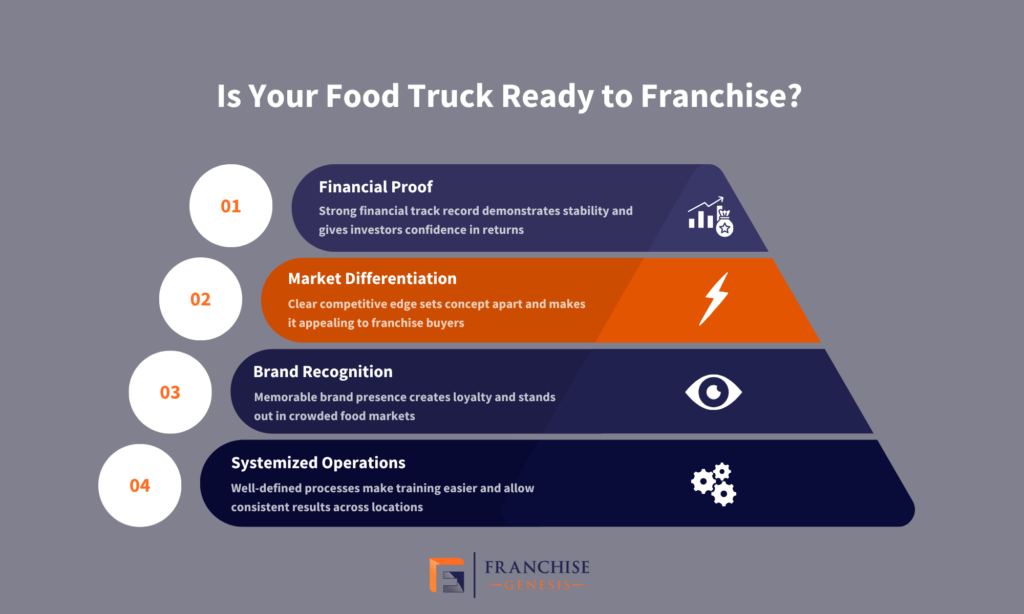
- Proven profitability: Your food truck business must show consistent, strong profits for at least 18 months. Franchisees need to see a clear path to a healthy net profit margin, typically 15% or more.
- Strong brand identity: Your established brand needs to create an emotional connection. It should be instantly recognizable and tell a story that resonates with customers and prospective franchisees alike.
- Unique selling proposition: What makes you different? Whether it is a signature recipe, a specific cuisine like chicken sandwiches or gourmet hot dogs, or a format that stands out from fast food competitors, your USP must be something others cannot easily copy.
- Replicable systems: Your success cannot depend on your personal involvement alone. Every recipe, process, and customer interaction must be documented and teachable.
Developing a Replicable Business Model
Creating a replicable model means turning your operation into a step-by-step instruction manual that any qualified franchisee can follow.
- Operations Manual: This is your franchise bible. It covers everything from prep routines and supplier lists to customer service scripts and cleaning procedures. A well-built franchise operations manual is what separates a franchisable food truck from one that only works with the original owner at the helm.
- Consistent Branding: Beyond the truck wrap, branding covers menu design, staff uniforms, and social media voice. Trademark your brand early to protect your intellectual property and give franchisees confidence they are investing in something legally defensible.
- Supply Chain Management: Reliable suppliers who can serve multiple locations with consistent quality and pricing are non-negotiable. This may mean negotiating with regional or national distributors to secure fresh ingredients at scale. A food truck concept built around quality, whether that means fresh ingredients or a proprietary recipe, needs supply chain infrastructure before it can grow.
If your current truck can run successfully with trained staff while you are away, you are on the right track.
The “Sizzle Factor”: Gauging Franchisee Interest
The sizzle factor is what makes entrepreneurs want to be part of your brand. It is the combination of elements that makes your franchise opportunity hard to pass up.
- Customer loyalty: Do regulars seek you out? Are people willing to wait in line? This signals predictable revenue for a prospective franchisee evaluating your concept.
- Media buzz: Local news features, food blogger reviews, and viral social media posts validate your concept’s appeal to a wider audience.
- Unsolicited inquiries: When people regularly ask about opening their own version of your truck, you have a strong signal the market wants more of what you offer.
- Unique menu: Your menu should be memorable and distinct. A concession trailer serving french fries alongside a signature item nobody else offers is more franchisable than a generic fast food concept.
- Professional design: Your truck is your storefront. An eye-catching, professional design signals quality to both customers and potential franchisees evaluating your franchise program.
The Blueprint for Successful Food Truck Franchising
Once you have confirmed your concept is replicable, it is time to build the legal and financial foundation. Skipping this step creates problems that compound as the franchise grows.
Franchising is a regulated industry with specific legal requirements designed to protect both you and your franchisees. The cornerstone of your franchise system is the franchise disclosure document (FDD). The Federal Trade Commission requires franchisors to provide the FDD to every prospective franchisee at least 14 days before they sign an agreement or pay any fees.
Beyond legal filings, you need to define your financial structure. Franchise fees and royalty rates are the numbers that fuel your network’s growth and profitability. Getting these right from the start is one of the most important decisions you will make as a franchisor.
Legal and Financial Preparations for Food Truck Franchising
Cutting corners on the legal side creates problems that can destroy everything you have built. Here is what you need to do:
- Hire a franchise attorney: You need a specialist in franchise law, not a general business lawyer. At Franchise Genesis, franchise attorney fees for the FDD and franchise agreement are included in the development program, so clients do not need to hire one separately.
- Create the FDD: This legal document contains 23 required items covering business history, investment requirements, and financial performance representations
- Handle state registration: Many following states require you to register or file your FDD before legally offering franchises. A franchise attorney will guide you through the requirements in each market.
- Trademark your brand: Protect your name, logo, and slogans so franchisees know they are investing in a legally defensible and exclusive brand
- Budget for franchisor costs: Expect to invest $75,000 to $150,000 or more to properly launch your franchise program.
Structuring Your Franchise Offer
Your goal is to create an offer that attracts qualified franchisees while building a sustainable franchise model. This is the financial foundation of your entire system.
- Franchise fees: For food trucks, these typically range from $20,000 to $50,000. This fee grants rights to your brand and systems and covers initial training and ongoing support.
- Royalty structures: A percentage of gross sales between 4% and 8% is common. Many food truck franchisors also use a minimum royalty or flat monthly fee to create consistent revenue.
- Marketing fund contributions: A 2% to 4% contribution from gross sales creates a shared pool for brand-building activities that benefit every location in the system.
- Territory rights: For a mobile business this is non-negotiable. Your franchise agreement must clearly define operating zones, rules for catering outside a home territory, and how to handle corporate accounts to prevent franchisee conflicts.
Franchise Genesis Helps You Build the Right System
Most food truck owners who attempt to franchise on their own run into the same problems. Incomplete legal documentation, weak training systems, and franchisee conflicts over territory that were not defined clearly upfront.
Franchise Genesis works with mobile food business owners to build franchise systems that are structured from the start. From FDD preparation and franchise agreement development to training infrastructure and franchisee recruitment, the process is built around your specific concept and growth goals.
We have guided brands from a single truck to networks across the U.S. If your food truck has what it takes, contact Franchise Genesis to find out how to build the system behind it.
FAQs About Food Truck Franchising
How much does it cost to franchise a food truck?
Launching a food truck franchise system typically costs between $75,000 and $150,000. This covers legal fees for the FDD and franchise agreement, operations manual development, training systems, and marketing materials. The cost varies based on complexity and the number of states you plan to offer franchises in.
Is a food truck a good franchise opportunity?
Yes, when the concept is proven, the systems are documented, and the legal foundation is properly built. Food trucks offer lower startup costs than traditional restaurants, built-in mobility, and a growing customer base drawn to unique mobile dining experiences. The franchise opportunity becomes attractive when the franchisor has a strong brand and a support system that sets franchisees up to succeed.
How do I know if my food truck concept is ready to franchise?
Your concept is ready when it is consistently profitable for at least 18 months, can operate successfully without your direct involvement, and people are actively asking you about opening their own version. If your success depends entirely on your personal presence, the systems need more development before franchising is a viable path.