
Why Understanding Franchise Costs Matters for Your Business Growth
The cost to franchise my business is one of the first questions business owners ask when considering expansion—and for good reason. Franchising offers a powerful path to growth without the capital burden of opening every location yourself, but it does require strategic investment upfront.
Quick Answer: What Does It Cost to Franchise Your Business?
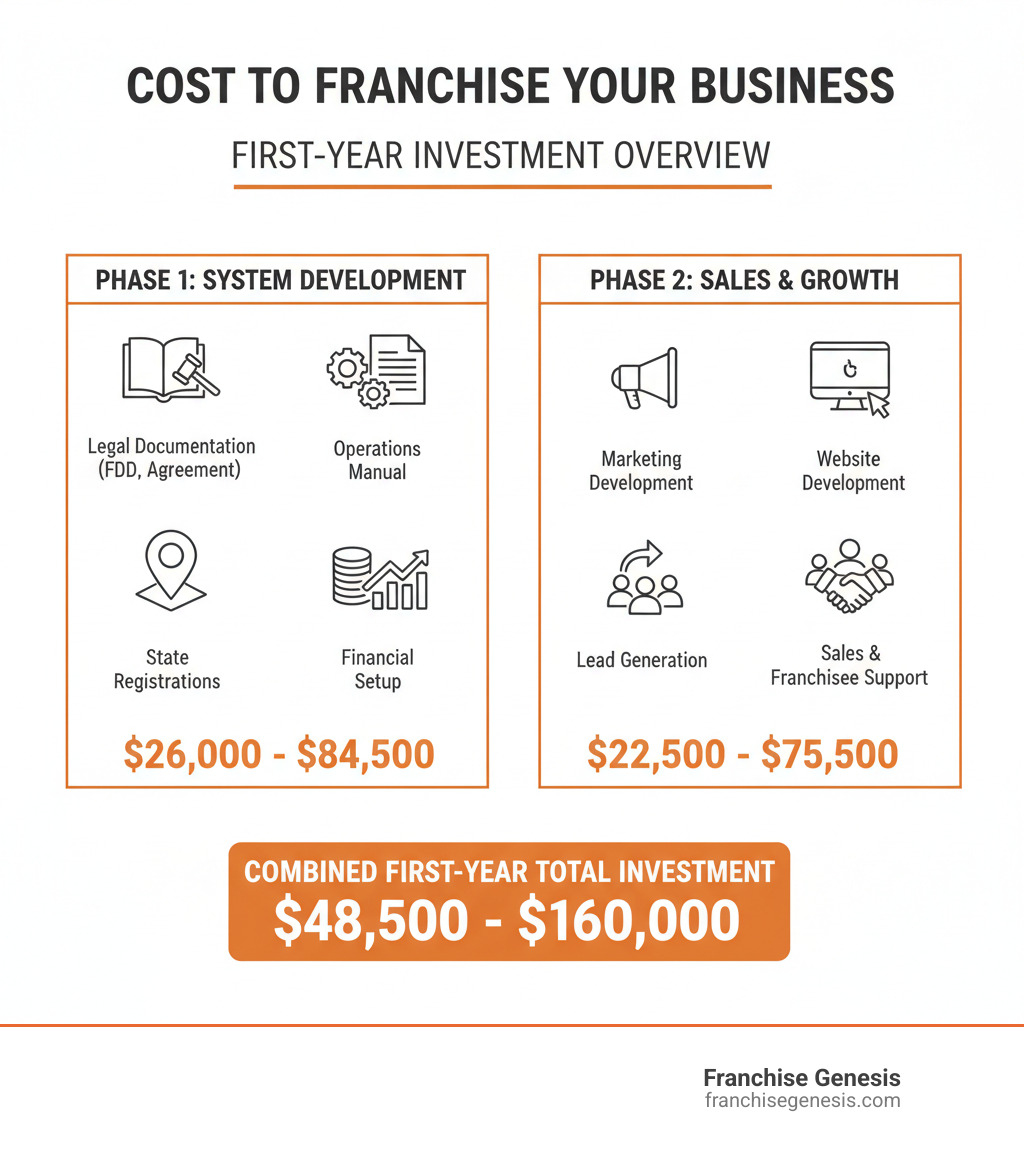
The total investment breaks down into two phases:
-
Legal and System Development: $26,000 – $84,500
- Franchise Disclosure Document (FDD): $15,000 – $45,000
- Operations Manual: $0 – $30,000
- Financial Statements & State Filings: $3,500 – $9,500
-
First-Year Sales and Marketing: $22,500 – $75,500
- Franchise sales website and marketing materials
- Lead generation and advertising campaigns
- Sales support and franchisee recruitment
Total First-Year Investment: $48,500 – $160,000
The wide range reflects your expansion strategy. A conservative, local rollout is at the lower end, while aggressive national growth requires more investment. Unlike buying a franchise, where you’re paying for a proven system, franchising your business means you create that system—and capture ongoing royalties from every franchisee.
Think of this as building infrastructure, not an expense. You’re creating a replicable model, legal protections, and a sales engine to generate revenue for years. Many franchisors recoup their initial investment after selling just a few franchises.
I’m Monique Pelle Kunkle, VP of Operations at Franchise Genesis. I’ve guided dozens of business owners through budgeting for the cost to franchise my business, from ABA therapy practices scaling to 100+ locations to mobile service concepts launching nationwide. Let me walk you through what to expect and how to plan for it.
The Foundational Investment: Building Your Franchise System
Before selling your first franchise, you must build the infrastructure that makes franchising legally possible. This foundational stage is where the cost to franchise my business becomes real, but it’s also where you create genuine value. Think of it as constructing a building’s blueprint and framework.

These one-time investments transform your business into a replicable franchise system. You’re establishing the legal framework to protect your brand, documenting operational consistency, and setting up the administrative processes to scale with confidence.
Legal Documentation: The FDD and Franchise Agreement
You can’t legally franchise without proper documentation. The Franchise Disclosure Document (FDD) is the cornerstone of your franchise system and is mandated by the Federal Trade Commission.
Think of the FDD as your franchise’s complete story. It lays out everything a prospective franchisee needs to know: your company’s history, financial performance, fees, support, and the obligations on both sides. It’s a comprehensive document designed for transparency.
Alongside the FDD, you’ll need a Franchise Agreement—the contract governing your relationship with each franchisee. This document spells out specific terms: territory rights, agreement length, renewal conditions, fees, and what happens if things don’t work out.
Legal fees for these documents typically range from $15,000 to $45,000. While steep, this is not the place to cut corners. Your real estate lawyer cousin isn’t the right fit. You need a specialized franchise attorney who understands FTC regulations and state-specific franchise laws.
A franchise-specific attorney protects you from future compliance nightmares and structures your agreements for long-term growth. Getting the legal foundation right is the best insurance policy you can buy. For a deeper understanding of this critical document, check out more info about the FDD Document.
The Operations Manual: Your Business Blueprint
Once your legal documents are drafted, the next major component of the cost to franchise my business is your Operations Manual. If the FDD is your franchise’s story, the Operations Manual is its instruction book—the guide showing franchisees how to replicate your success.
This manual codifies every procedure that makes your business successful, from opening procedures and customer service approaches to inventory management. The goal is simple: ensuring consistency across all locations.
Your Operations Manual also becomes your primary training tool. This document guides new franchisees through their training and serves as a constant reference.
You have two paths: DIY or professional development. If you’re organized and have the time, you can write this yourself—that’s the $0 option. However, most owners find professional help (up to $30,000) yields a more comprehensive and user-friendly manual.
A professionally developed manual anticipates questions, provides troubleshooting guidance, and creates a quality control framework that makes your life easier as you grow. To learn more, visit more info about the Franchise Operations Manual. This document is the backbone of your franchisees’ success, and therefore, your own.
Financial and Administrative Setup
The final piece of this investment is the financial and administrative infrastructure needed to operate as a legitimate franchisor. This is where the cost to franchise my business extends into regulatory compliance.
First, you’ll need a new franchisor entity—a separate legal structure for franchising. Then comes the requirement for audited financial statements. The FTC requires these in your FDD. Prospective franchisees need to see your financial stability before investing their life savings.
CPA costs for these audited statements typically run between $2,500 and $5,000. This expense builds trust and credibility with potential franchisees, showing you’re a serious, transparent partner.
Next are state registration fees. Many states require franchise registration, and costs add up. Expect to pay between $1,000 and $4,500 in fees, depending on where you plan to sell. We typically recommend starting with 2 to 4 key registration states to balance cost and market reach.
Finally, don’t forget USPTO trademark filings. Protecting your brand name and logo is crucial before licensing them. For guidance on which states require registration, explore more info about Franchise Registration States.
These setup costs may seem like paperwork, but they build credibility and protection. You’re creating a professional, compliant business that franchisees will feel confident joining.
The True Cost to Franchise My Business: First-Year Growth Expenses
Once your legal foundation is set, the next phase of investment focuses on actively selling franchises and supporting new partners. These costs are variable and tied to your growth ambitions. Here, your investment shifts from building the system to expanding it, turning leads into franchisees who carry your brand forward.
Think of this stage as turning on the growth engine. You’ve built the machine—now it’s time to fuel it. This phase involves attracting candidates via strategic marketing, building a team to close deals and support new partners, and providing the hands-on assistance for a successful launch.
Marketing and Lead Generation to Attract Franchisees
A surprising truth about the cost to franchise my business is that a perfect legal structure is useless if qualified candidates don’t know you exist. Your marketing investment fills your pipeline with prospects ready to invest in your brand.
Your franchise sales website is your digital handshake and a potential franchisee’s first impression. A professional, conversion-focused site typically runs between $2,500 and $15,000. This isn’t your customer-facing site; it’s designed to attract entrepreneurs who want to own a piece of your brand.
You’ll also need professional brochures and sales collateral that tell your story. Design work generally costs $7,000 to $10,000, with printing adding another $5,000 to $10,000. These materials are essential for presentations, follow-ups, and findy days.
Digital advertising campaigns on Google Ads and social media can range from minimal spending to $20,000 or more, depending on your growth goals. The beauty of digital is you can start conservatively and scale up with results.
Investing $15,000 to $25,000 in public relations and validation efforts builds credibility. Media coverage, testimonials, and third-party validation are crucial when someone is making a six-figure investment.
Finally, franchise portals and conference participation connect you with a broader audience. Budget $5,000 to $10,000 for listings on popular directories and participation in industry expos.
A realistic first-year marketing budget ranges from $22,500 to $75,500. This is a strategic investment to attract individuals who align with your brand and have the resources to succeed. For more strategies, explore More info about Franchise Sales Marketing.
Building Your Franchise Sales and Support Team
Marketing generates leads, but people close deals. Understanding the cost to franchise my business means recognizing the significant investment in a team that sells franchises and supports new partners.
Hiring a dedicated franchise salesperson changes everything. These professionals know how to qualify candidates, steer the sales cycle, and close deals. A proven salesperson typically commands a low six-figure compensation package. Realistically, you’ll need to fund four to six months of their salary before franchise fee income starts flowing. An executive recruiter’s fee can reach 25% of the first year’s compensation.
For aggressive growth, budgeting around $75,000 in personnel costs before selling the first franchise is smart. While daunting, a skilled salesperson can sell multiple units quickly, recouping the investment faster than expected.
Some franchisors start by outsourcing to franchise broker networks or consulting firms, offering a middle ground between a DIY approach and a full-time team.
Beyond sales, you’ll need comprehensive training programs and onboarding systems to set franchisees up for success. Your FDD outlines basic training, but creating effective programs that prepare franchisees takes ongoing refinement.
For brick-and-mortar concepts, offering site selection assistance adds tremendous value, though it increases operational costs. Helping franchisees find the right location can mean the difference between a thriving and a struggling unit.
This infrastructure is essential for sustainable growth. Your franchisees’ success is your success, and investing in support pays dividends through higher performance and better brand reputation. Learn more about building these systems at More info about Franchise Development Services.
Understanding the total cost to franchise my business
Let’s bring it all together. The total first-year investment to establish your franchise system and launch your growth initiative ranges from approximately $48,500 to $160,000. This figure covers everything from legal documents and operations manuals to marketing campaigns and sales infrastructure.
This isn’t a single check you write at once. Think of it as a phased investment strategy. You start with the legal and operational foundation—your $26,000 to $84,500 initial phase. Once that’s solid, you strategically invest in sales and marketing, adding another $22,500 to $75,500.
This phased approach lets you scale your budget with your sales success rather than requiring a massive upfront outlay. As you sell franchises, the initial fees you collect get reinvested into marketing and support. This creates a powerful, self-sustaining growth cycle.
Many of our clients recoup their initial investment after selling their first two or three franchises. From there, each sale contributes to profitability while funding further expansion. Understanding these costs isn’t about finding the cheapest path, but investing strategically in a system that generates long-term returns. For a comprehensive view, visit More info about Becoming a Franchisor.
Strategic Considerations: How Your Goals Impact Franchising Costs
The total investment to franchise your business isn’t a single number; it’s a range that depends on your expansion strategy and speed. Your growth vision—cautious local expansion or ambitious national rollout—directly influences the resources you’ll need.
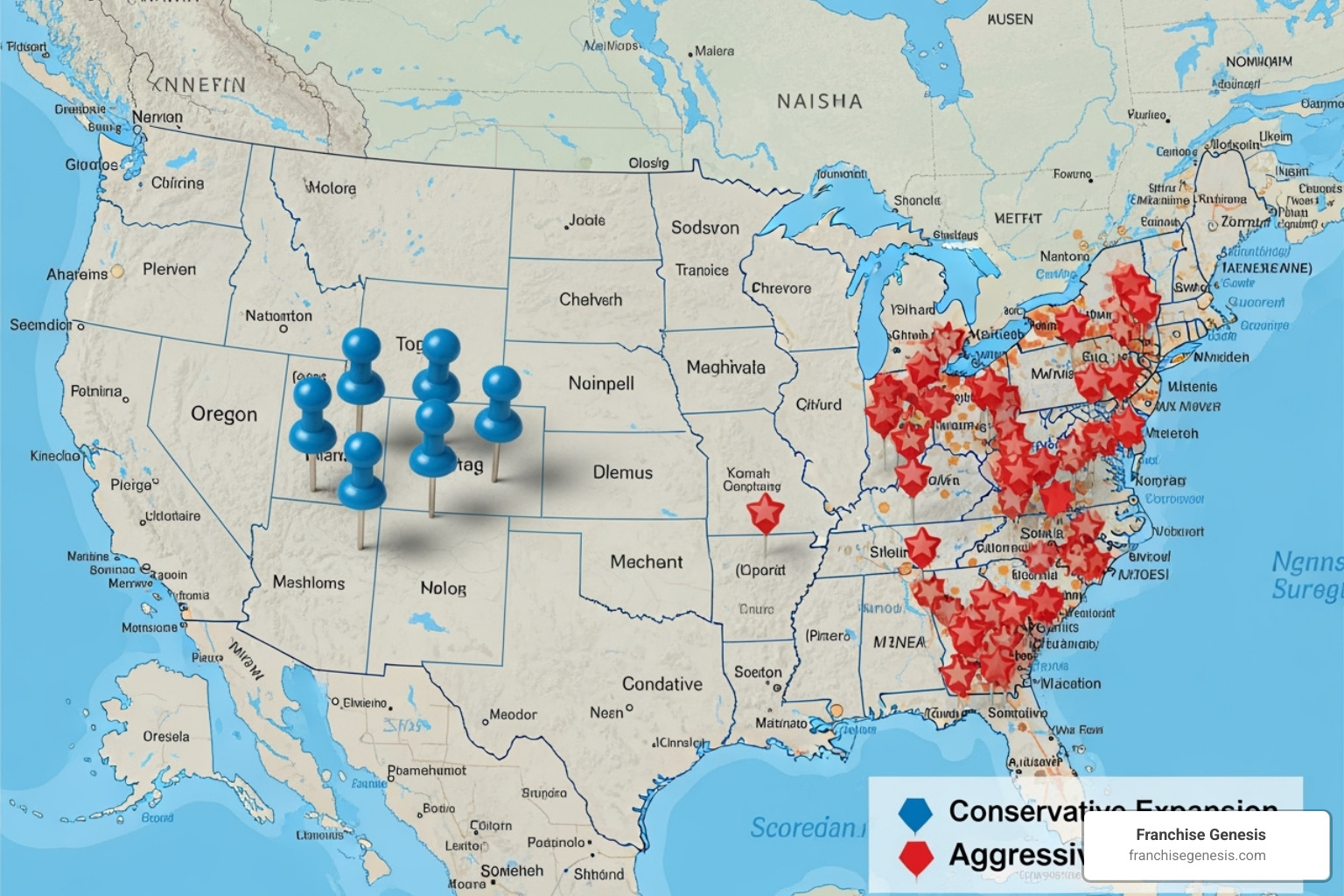
Think of it like planning a road trip. You can take a scenic route through neighboring towns or hit the interstate for coast-to-coast coverage. Both approaches work, but they require different budgets, planning, and resources.
Conservative vs. Aggressive Expansion
Your expansion pace is the single biggest driver of the cost to franchise my business. The difference between a conservative and an aggressive rollout isn’t just a matter of degree; it fundamentally changes your investment profile.
A conservative approach might mean selling a handful of franchises in your region or state in the first year. This keeps things manageable. You’ll register in fewer states, lowering legal fees by avoiding multi-state compliance complexities. Your marketing budget is smaller because you’re targeting a specific geographic area. You might even leverage your local reputation to generate leads organically.
On the flip side, an aggressive growth strategy means you’re ready to hit the ground running. Aiming to sell 12-20 franchises nationally in your first year means your investment scales up significantly. Legal costs can climb to $50,000 or more as you handle more state registrations. Your marketing budget will need to be equally ambitious—$100,000 to $150,000 annually for widespread digital ads, PR, and participation in national expos.
Here’s a critical piece many owners underestimate: cash flow requirements for aggressive growth. A conservative plan may allow you to manage expenses, but an aggressive program demands substantial working capital. You should budget around $250,000 in cash flow to fund development and sustain operations until franchise sales cover your needs. Undercapitalization is a common reason franchising efforts stall, so having sufficient funds to support your ambitions is critical.
The smart approach is phasing in costs strategically. Solidify your legal foundation first—this is non-negotiable. Then, layer in marketing and sales as your confidence and resources grow. This phased approach lets you adapt based on early results and reduces upfront financial risk. For more guidance, explore More info about Franchise Growth Strategies.
Debunking the Million-Dollar Myth
When researching the cost to franchise my business, you’ve likely seen scary numbers suggesting it costs $500,000 or even a million dollars. I’ve seen business owners abandon franchising based on these inflated, misunderstood estimates.
Here’s the truth: while a significant investment, these astronomical numbers are misleading. They often bundle expenses unrelated to the actual cost of becoming a franchisor.
The most common culprit is bundled multi-year expenses. These figures often include long-term operational budgets for PR, staff salaries, and marketing over three to five years. Successful franchisors invest in these as they grow, but they aren’t part of the initial setup cost. They are operational expenses funded by franchise fees and royalties.
Another source of confusion is mixing franchisor costs with franchisee costs. The cost to buy a franchise like McDonald’s can run into the millions. That’s different from what we’re discussing: the cost for your business to become a franchisor.
Finally, many estimates include optional improvements. Advanced technology, training facilities, or specialized consulting can be phased in as your system matures and generates revenue.
The manageable reality is this: the core legal and compliance foundation ranges from $26,000 to $45,000. Your total first-year investment, including initial sales and marketing, generally falls between $48,500 and $160,000. This is a substantial investment, but it’s far from the million-dollar myth.
And here’s some perspective: the franchising industry has nearly 760,000 franchise establishments in the US. That didn’t happen because only mega-corporations can afford it. It happened because a strategic approach makes this growth strategy accessible for businesses of all sizes. With the right guidance, franchising can be a powerful tool in your expansion toolkit.
Frequently Asked Questions about the Cost to Franchise a Business
What is the absolute minimum cost to start franchising my business?
The bare-bones minimum cost to franchise my business focuses on the legal and compliance foundation—the non-negotiables for legally offering franchises. This includes drafting your Franchise Disclosure Document (FDD) and franchise agreement, creating a basic operations manual, and covering initial state registration fees.
This foundational investment typically ranges from $26,000 to $45,000. Could you spend less? Perhaps, but we don’t recommend it. Cutting corners here is like building on a shaky foundation. A weak legal structure or operations manual can lead to legal headaches, compliance issues, and franchisee disputes that cost far more than you initially “saved.”
Think of this minimum investment as the price of admission. It gets you in the game properly, with the legal protections and operational clarity needed to build a thriving franchise network.
Can I use my current business lawyer to franchise my business?
You trust your current business lawyer. They’ve handled your contracts and maybe even your incorporation. But franchising is a highly specialized area of law and requires expertise a general business attorney likely doesn’t possess.
Franchise law involves steering Federal Trade Commission (FTC) requirements, state-specific registration rules, and drafting a compliant FDD. It’s like asking a family doctor to perform neurosurgery; both are doctors, but one has highly specialized training.
Working with an experienced franchise attorney ensures you’re compliant and protected from the start. They know the common pitfalls and how to structure agreements to protect your brand. Your lawyer is a trusted advisor, but for this journey, you need a specialist who lives and breathes franchise law.
How long does it take to recoup the initial franchising investment?
This is a great question, and the answer is often more encouraging than business owners expect. Recouping your investment depends on two factors: the initial franchise fees you charge and how quickly you sell franchises.
With a solid sales strategy, some franchisors recoup their entire initial legal and development costs after selling just one or two franchises. If you charge a $40,000 initial franchise fee and your foundational investment was around $50,000, you’re essentially at break-even after your second sale.
Your profitability is tied to your franchise sales success. The upfront investment is quickly offset by revenue from the first few franchisees. Once you’ve covered initial costs, every subsequent franchise sale and the ongoing royalties become profit that fuels further expansion. It’s a powerful cycle that can accelerate quickly with the right strategy.
Conclusion: Partnering for Successful Franchise Expansion
Understanding the cost to franchise my business is the first step toward strategic expansion, but not the last. With the complete picture—from legal documents to marketing campaigns—you can approach franchising with confidence.
The investment isn’t a mysterious, overwhelming figure. It’s a clear, two-phase process: first, build a solid legal and operational foundation to protect your brand and create a replicable system. Then, make a scalable investment in marketing and growth to bring the right franchisees into your network. Each dollar serves a purpose, from ensuring FTC compliance to attracting qualified candidates.
What makes franchising so powerful is that it’s about building infrastructure that generates ongoing revenue. Initial franchise fees often recoup your development costs, and royalties create a sustainable income stream for continued expansion. You’re not just buying a service; you’re creating an asset that appreciates as your brand grows.
At Franchise Genesis, we’ve walked this path with dozens of business owners who started where you are, wondering if franchising made financial sense. We’ve seen conservative operators sell a few local franchises and aggressive entrepreneurs build national networks in record time. Both approaches work when backed by solid planning and realistic budgeting.
The truth is, you don’t have to figure this out alone. We can help you steer every step, from creating your FDD to recruiting your first franchisee to building systems that support hundreds of locations. We’re here to be your partner, turning the cost to franchise my business from a question into a strategic investment in your brand’s future.
Ready to expand your brand? Explore our complete guide to franchising your business.