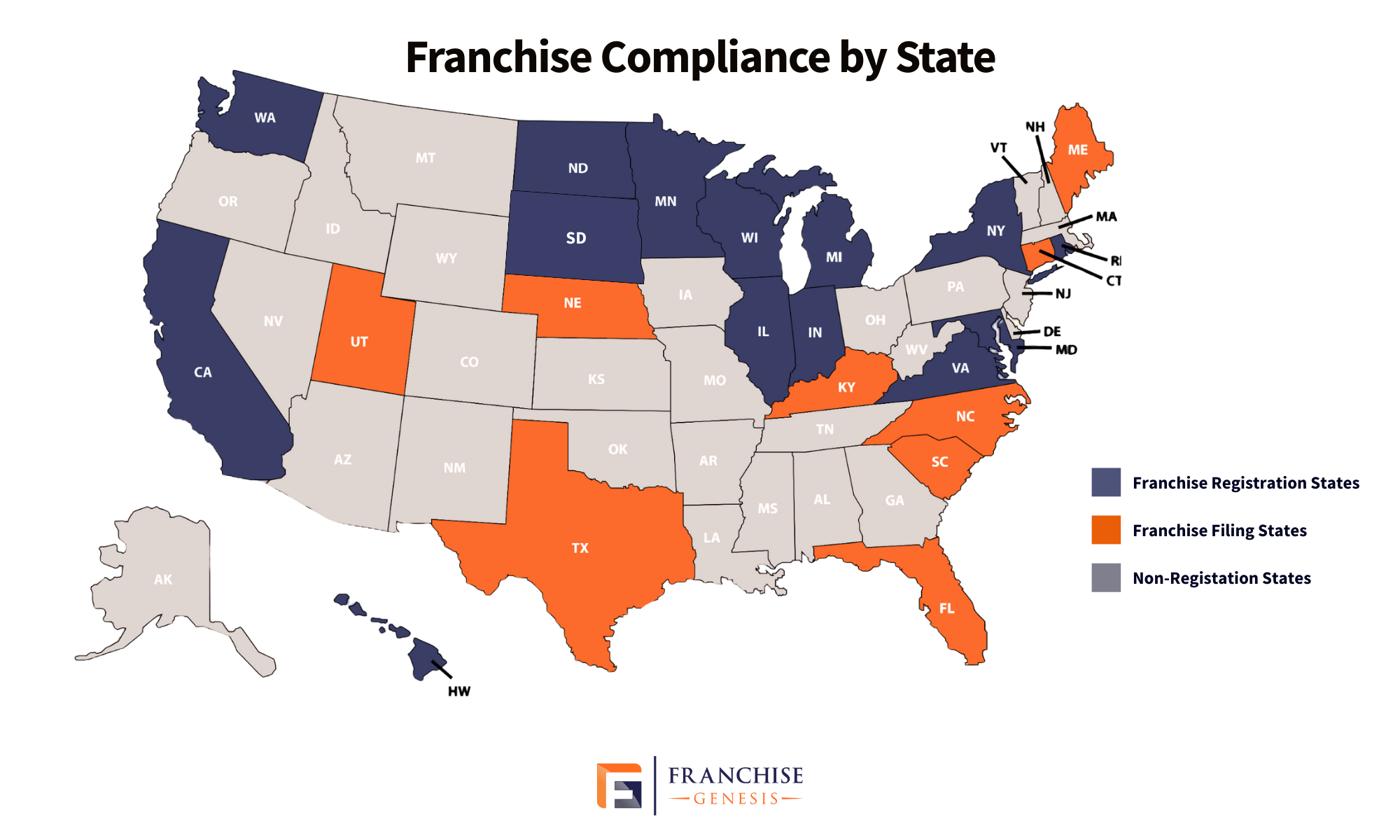
At a Glance: Franchise laws in the United States fall into three categories: registration states, filing states, and non-registration states. Registration states require a full Franchise Disclosure Document (FDD) review and approval. Filing states require notification only. Non-registration states follow federal franchise rule guidelines without additional state requirements.
Difference Between Franchise Registration, Filing, and Non-Registration States
Before launching a franchise offering in any state, franchisors must understand the regulatory requirements that apply. The Federal Trade Commission sets baseline disclosure requirements for all franchise sales nationwide. However, individual states add their own layers of oversight.
State franchise laws generally fall into three categories:
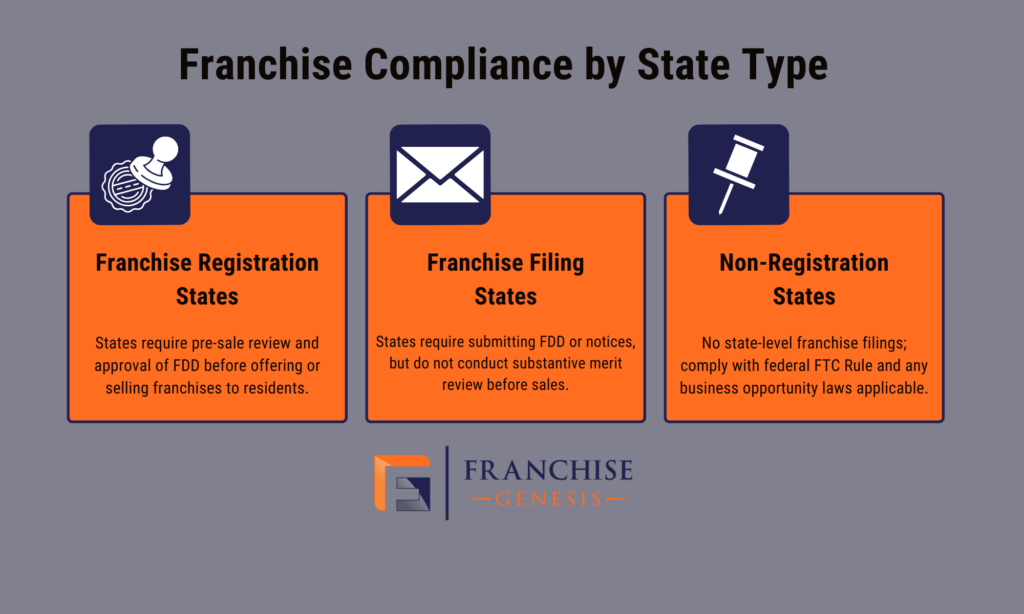
- Registration states require franchisors to submit their FDD for review and approval before any franchise sale can occur
- Filing states require franchisors to file documents with the state, but do not conduct detailed reviews
- Non-registration states have no state-level franchise registration process and rely solely on federal guidelines
Understanding these distinctions helps franchisors plan expansion timelines and budget for filing fees. Each category comes with different costs, timelines, and regulatory requirements.
Franchise Registration States
A franchise registration state requires franchisors to submit a registration application to a state regulator before offering or selling franchises. The state agency reviews the Franchise Disclosure Document for compliance with disclosure guidelines.
The franchise registration process typically involves:
- Submitting the FDD and all required exhibits
- Paying the state registration fee
- Waiting for agency review and approval
- Addressing any deficiency comments from the securities division
- Receiving approval to sell franchises in that state
Registration must be renewed annually. Franchisors must also file amendments for any material change to the FDD within a reasonable time after the change occurs.
Registration States Table
|
State |
Registration Fee |
Agency/Department |
|
California |
$675 |
|
|
Hawaii |
$125 |
|
|
Illinois |
$500 |
|
|
Indiana |
$500 |
|
|
Maryland |
$500 |
|
|
Michigan |
$250 |
|
|
Minnesota |
$400 |
|
|
New York |
$750 |
|
|
North Dakota |
$250 |
|
|
Rhode Island |
$500 |
|
|
South Dakota |
$250 |
|
|
Virginia |
$500 |
|
|
Washington |
$600 |
|
|
Wisconsin |
$400 |
New York charges the highest registration fee at $750. Hawaii offers the lowest at $125. Most states fall in the $250 to $500 range.
A franchise attorney can help navigate the registration requirements in each state and respond to examiner questions.
Franchise Filing States
Franchise filing states require franchisors to submit documents, but do not conduct the same level of review as registration states. The filing requirements serve as notification rather than approval. In some states, filing requirements may differ if you already have a federal trademark.
Filing states offer several advantages:
- Lower filing fees compared to registration states
- Faster processing times
- Simpler renewal application procedures
However, franchisors must still comply with all federal disclosure requirements and provide the FDD to potential franchisees before any franchise sale.
Filing States Table
|
State |
Filing Fee |
Process Overview |
|
Connecticut |
$400 |
Basic filing with the Department of Banking |
|
Florida |
$100 |
Simple filing with the Department of Agriculture |
|
Kentucky |
$0 |
No fee required with the Attorney General’s Office |
|
Maine |
$25 |
Low-cost filing with the Office of Securities |
|
Nebraska |
$100 |
Basic filing with the Department of Banking |
|
North Carolina |
$250 |
Filing with the Secretary of State |
|
South Carolina |
$100 |
Filing with the Secretary of State |
|
Texas |
$25 |
Simple filing with the Secretary of State |
|
Utah |
$100 |
Notification filing with the Division of Securities |
Texas and Maine offer the lowest filing fees at $25 each. Kentucky requires no fee at all, making it the most cost-effective filing state for franchisors.
Franchise Non-Registration States
Franchise non-registration states do not require state-level registration or filing. Franchisors operating in these states must still comply with the federal franchise rule enforced by the Federal Trade Commission.
The following states have no franchise-specific registration laws:
- Alabama
- Alaska
- Arizona
- Arkansas
- Colorado
- Delaware
- District of Columbia
- Georgia
- Idaho
- Iowa
- Kansas
- Louisiana
- Massachusetts
- Mississippi
- Missouri
- Montana
- Nevada
- New Hampshire
- New Jersey
- New Mexico
- Ohio
- Oklahoma
- Oregon
- Pennsylvania
- Tennessee
- Vermont
- West Virginia
- Wyoming
Even in non-registration states, franchisors must provide a compliant FDD to every prospective franchisee at least 14 days before signing a franchise agreement or collecting fees.
Some of these states have separate business opportunity laws that may apply. A franchise attorney can help determine if additional requirements apply.
The Importance of the Franchise Disclosure Document
The Franchise Disclosure Document sits at the center of franchise compliance across all 50 states. The FTC requires every franchisor to prepare and deliver this disclosure document before any franchise sale.
What the FDD Must Include
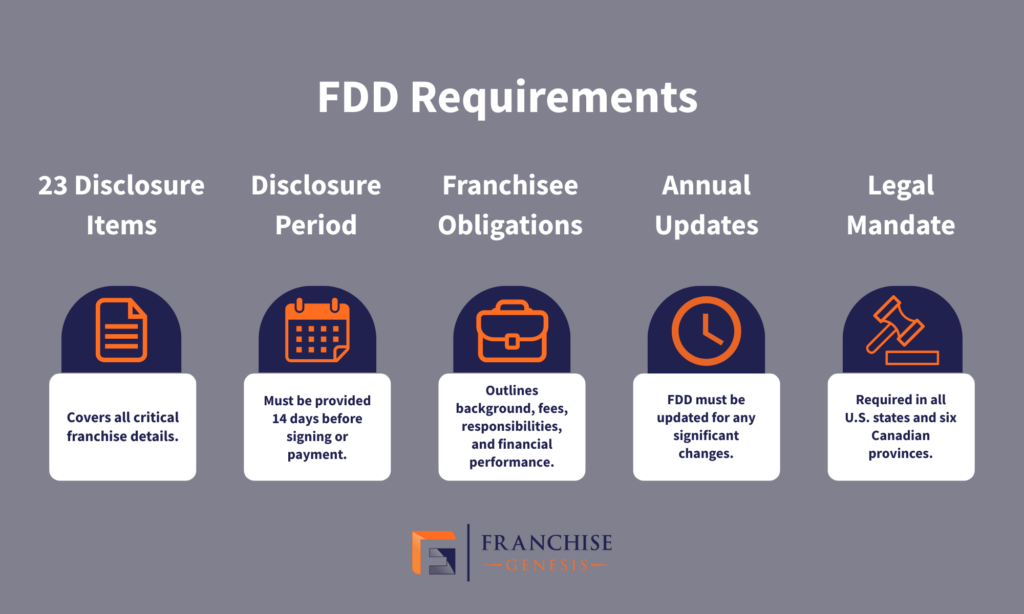
The FDD contains 23 items of required information:
- Franchisor background and litigation history
- Initial and ongoing fees
- Franchisee obligations under the franchise agreement
- Territory rights and restrictions
- Registered trademark information and any federally registered trademark details
- Financial statements audited by an independent accountant
- Contact information for current and former franchisees
FDD Delivery Requirements
Franchisors must provide the FDD to potential franchisees at least 14 calendar days before:
- Signing any franchise agreement or related contract
- Receiving any payment from the prospective franchisee
The document must be updated annually at the end of April each year and whenever material changes occur under state or federal applicable laws. The renewal fee varies by state but is typically lower than the initial application fee.
How Franchise Genesis Helps
Franchise Genesis is a turnkey franchise consulting firm with over 100 years of combined industry experience. Our team has launched thousands of successful franchise brands across food, retail, fitness, health care, and more. We partner with experienced franchise attorneys to draft your Franchise Disclosure Document and franchise agreement, keeping you compliant with federal and state regulations.
Ready to grow faster? Franchising speeds up expansion, attracts motivated investors, and lets you focus on strategy instead of daily operations. Franchise Genesis supports you from concept development through ongoing franchisee management.
Discover how to franchise your business and contact Franchise Genesis to get started.
Frequently Asked Questions
How long does the franchise registration process take?
Processing times vary by state. Most registration states complete their review within 30 to 60 days if no deficiencies are found. States like New York, California, Virginia, and Maryland may take longer during peak seasons.
What is a uniform consent to service of process?
A uniform consent form authorizes a state to accept legal documents on behalf of the franchisor. Most registration states require this form as part of the initial application. It allows the state regulator to receive service of process for any legal actions related to the franchise offering.
Do business opportunity states have different requirements?
Yes. Some states classify certain business opportunity arrangements separately from franchises. Business opportunity laws may apply if the arrangement lacks a federally registered trademark or does not meet the FTC’s franchise definition. Check with a franchise attorney to determine which regulatory requirements apply.
What triggers a material change filing?
A material change is any fact that would reasonably influence a prospective franchisee’s decision. Examples include changes to fees, litigation, or the franchise agreement. Franchisors must file amendments within a reasonable time after any material change occurs.