
Why the Future of Franchising Holds Unprecedented Opportunity
The future of franchising looks brighter than ever, with experts predicting continued growth and innovation. Here’s what business leaders need to know:
Key Trends Shaping 2025 and Beyond:
- Technology Integration: AI, automation, and VR/AR are changing operations.
- Sustainability Focus: Eco-friendly practices are a growing consumer expectation.
- Micro-Franchising Growth: Lower-cost, flexible models are gaining traction.
- Service-Based Expansion: Healthcare, senior care, and wellness are leading growth.
- Digital Change: Training, marketing, and operational systems are improving.
Economic Outlook:
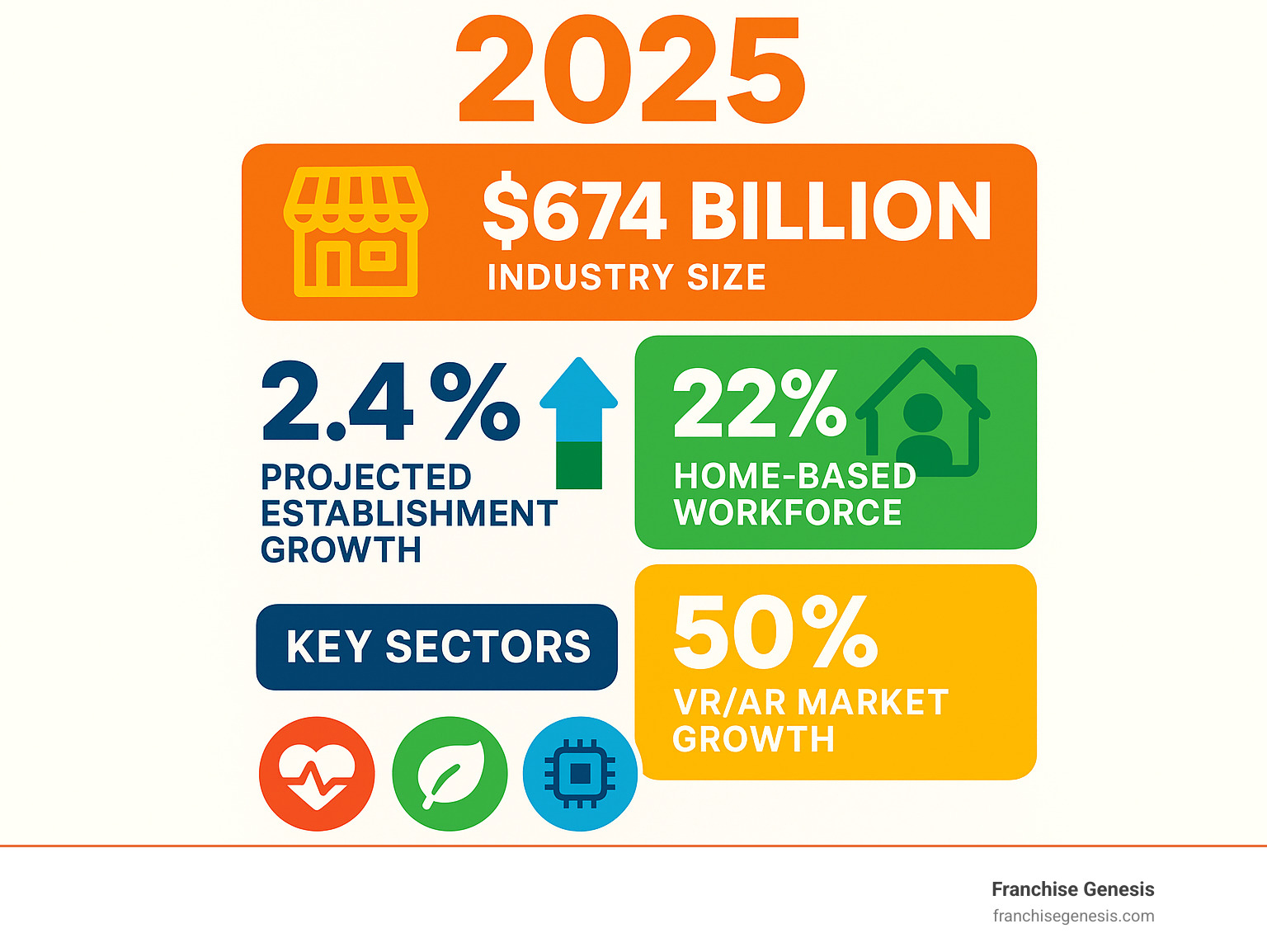
- U.S. franchising generates $674 billion annually.
- 2.4% projected growth in franchise establishments.
- 22% of workforce expected to be home-based by 2025.
- 50%+ annual growth in VR/AR franchise applications through 2030.
The franchising model continues to prove its resilience, as brands with strong systems weathered recent economic challenges better than independent businesses. As one industry veteran noted, “I have been in franchising since 1986, and I see 2025 as a year of great potential for everyone in the industry.”
What’s driving this optimism? Robust consumer demand for essential services, technology, and wellness concepts. The rise of multi-unit operators, surging private equity investment, and trends like sustainability are opening new markets for franchisors.
I’m Monique Pelle-Kunkle, Vice President of Operations at Franchise Genesis. I’ve helped scale franchise systems from startup to over 100 locations, guiding entrepreneurs through the complexities of the future of franchising. My experience gives me unique insights into what makes franchise systems thrive in today’s marketplace.
The Evolving Landscape: Key Trends Shaping the Future of Franchising
The future of franchising is being reshaped by powerful forces. For business owners considering franchising, understanding these trends is essential for creating a thriving franchise system.
Today’s entrepreneurs are tech-savvy, data-driven, and value work-life balance, sustainability, and community impact. This shift creates opportunities for businesses that adapt their franchise models to meet these evolving expectations. Millennials, a key driver of franchising, seek businesses that align with their financial goals and personal values. Integrating sustainability, technology, and flexibility into your franchise model is now a competitive necessity.
For deeper insights into how these changes are impacting franchise development, explore our Franchising Insights. You can also get a broader industry perspective from Entrepreneur’s take on 2025 trends.
The Rise of New Franchise Business Models
Traditional franchise models are making room for innovative approaches that are changing how businesses expand. These new models create opportunities for companies that might have thought franchising was out of reach.
Micro-franchising concepts are gaining serious momentum. These models require lower investments and simpler operations, making them accessible to more franchisees. This allows franchisors to expand faster and tap into new markets.
Home-based franchise models are experiencing explosive growth, with 22% of the U.S. workforce expected to be home-based by 2025. If your business can operate from home, this model offers franchisees lower overhead and the flexibility today’s entrepreneurs desire.
These agile models allow for better scalability and quicker market testing. You can expand into new territories more rapidly and adjust your approach based on real-world feedback. The niche market opportunities created by these flexible models mean you can serve specific customer segments that larger franchise systems might overlook.
Forbes on microfranchising provides valuable insights into how these smaller, more nimble franchise models are reshaping the industry landscape.
Sustainability as a Core Business Principle

Sustainability has evolved from a buzzword to a fundamental business requirement. For businesses considering franchising, incorporating eco-friendly practices builds a competitive advantage that attracts conscious consumers and values-driven franchisees.
Consumers actively seek brands committed to ethical sourcing and a reduced carbon footprint, often paying more for products from companies that share their values. This loyalty boosts franchise performance and unit economics.
Green building practices are becoming standard expectations. Franchisees are interested in systems that help them reduce energy costs while appealing to environmentally conscious customers. Practices like sustainable packaging, energy-efficient equipment, and waste reduction improve your brand reputation while often reducing operational costs.
The beauty of embedding sustainability into your franchise system is that it creates a virtuous cycle: responsible practices lead to cost savings, which improves franchisee profitability and makes your franchise opportunity more attractive.
The Growing Demand for Service-Based and Niche Franchise Industries
The future of franchising is increasingly service-based, especially in essential and niche sectors. These areas offer resilience and growth for businesses ready to franchise.
Home services continue to dominate growth projections. HVAC, plumbing, cleaning, and home improvement services maintain consistent demand regardless of economic conditions. If your business is in this space, you have significant franchise potential.
Senior care is one of the fastest-growing opportunities. An aging population drives unprecedented demand for in-home care, and the recurring revenue model is highly attractive to franchisees.
Pet services are booming as pet ownership rises. Grooming, training, and specialized care services offer numerous franchise opportunities.
The mental health and wellness sector is experiencing explosive growth. Counseling services, therapy practices, and wellness centers are finding strong market demand.
These recession-resistant franchise concepts provide stability that both franchisors and franchisees value. When economic uncertainty strikes, essential services typically maintain their customer base.
To explore how your business might fit into these growing sectors, visit our comprehensive guide to Franchise Opportunities in All Industries.
Technology’s Role in Revolutionizing Franchise Operations
Technology is a transformative force in franchising. For businesses looking to franchise, embracing digital change is critical for efficiency, better customer experiences, and data-driven growth. AI, automation, and VR/AR are profoundly impacting operations. Integrating advanced tech into your franchise system is a key differentiator in the future of franchising.
AI, Automation, and Data Analytics
AI, automation, and data analytics are revolutionizing franchise operations, empowering franchisors to provide unparalleled support and create consistent, high-quality customer experiences.
- AI-powered chatbots and tools: Streamline customer interactions and support, freeing up franchisees to focus on more complex tasks and direct customer engagement.
- Predictive analytics and automated inventory management: AI optimizes inventory, forecasts demand, and reduces waste, leading to significant cost savings for franchisees.
- Personalized marketing and customer experiences: AI and data analytics enable personalized marketing campaigns and unique customer experiences that build loyalty and foster deeper connections.
- Operational efficiencies: AI can integrate into automated support and predictive analysis to optimize franchise performance, enabling more absentee and multi-unit ownership.
- Data-driven decision-making: Data analytics provides franchisors and franchisees with the insights needed to make informed strategic decisions, from optimizing marketing spend to identifying new revenue opportunities.
For more insights into how technology can optimize franchise operations, dig into our resources on Franchise Operations.
Immersive Experiences with VR/AR
Virtual Reality (VR) and Augmented Reality (AR) are creating immersive experiences for both franchisees and customers. The market for VR/AR in franchising is expected to grow at over 50% annually through 2030, indicating a massive opportunity.
- Virtual Reality (VR) training: Franchisors use VR for realistic training simulations of business operations and customer interactions. This reduces costs, improves information retention, and ensures consistency. VR also enables virtual tours of franchise locations, which is ideal for international candidates.
- Augmented Reality (AR) for product visualization and customer engagement: Imagine a home improvement franchise where customers use an AR app to visualize new flooring in their homes. Or a fast-food franchise using AR to improve the in-store experience. These applications create unique, engaging customer journeys that drive satisfaction.
By integrating VR/AR, franchisors can improve training and customer engagement, setting their brand apart. For more on this technology’s growth, refer to Fortune Business Insights on AR market.
The Impact of FinTech and Blockchain
The future of franchising is also being shaped by FinTech and blockchain, which are revolutionizing financial management with improved transparency, security, and efficiency.
- FinTech revolutionizing franchise finance: Digital payments, streamlined royalty collection, and integrated accounting platforms simplify financial management for the entire network, reducing administrative burdens and improving oversight.
- Blockchain for transparency and security: Blockchain offers a secure and transparent ledger for various applications. Uses include securing financial transactions, ensuring supply chain integrity, and managing franchise fees with unparalleled transparency. While still emerging, blockchain can significantly improve operational integrity and financial security. To understand the basics, check out Investopedia on blockchain.
By leveraging these financial technologies, franchisors can build more robust and efficient systems, making their brand more appealing to potential franchisees.
Building a Future-Proof Franchise System
Creating a franchise system that can weather any storm is essential for long-term success. The future of franchising belongs to brands that build resilience and adaptive models into their DNA. Recent global events showed that well-structured franchise systems are far more resilient than independent businesses.
For example, during the pandemic, franchises with robust systems pivoted to ghost kitchens and contactless service while independent businesses struggled. A future-proof system is built on strong, repeatable operating systems, not on a single person. Diversification is your secret weapon. True diversification means building flexibility into operations with adaptive business continuity plans. Your systems must work across various models, from storefronts to home offices.
The brands that thrive will be those that accept strategic growth while maintaining operational excellence. They constantly ask, “How can we do this better?” For guidance on building this kind of resilient system, explore our Franchise Growth Strategies. And if you’re weighing whether franchising is right for your business, our insights on Why You Should Franchise can help.
Modernizing Franchisee Training and Support
Successful franchisors know that empowering franchisees for success requires flexible, engaging, and comprehensive support systems.
Online learning platforms have revolutionized franchisee training. Instead of costly in-person boot camps, on-demand modules allow franchisees to learn at their own pace. This flexibility makes training more accessible and effective.
Beyond technology, successful systems pair digital learning with mentorship programs. Matching new franchisees with experienced ones creates a vital support network for navigating early challenges and fosters real human connections.
Leadership development is also key. You must teach the technical aspects of your business, but franchisees also need to become effective leaders. They need to know how to hire, motivate, and retain great employees and build relationships in their local communities.
This customized training approach recognizes that different locations face different challenges. Smart franchisors build flexibility into their programs, helping franchisees adapt the proven model to their specific situation.
Educational institutions like The Tariq Farid Franchise Institute are raising the bar for professional development. A well-crafted operations manual is the foundation for all training—learn more on our Franchise Operations Manual page.
Crafting a Winning Franchise Sales and Marketing Strategy

The future of franchising belongs to brands that master targeted digital marketing and prioritize quality candidates over quantity.
Multichannel campaigns are essential. Your ideal franchisee may interact with your brand across multiple channels before reaching out. A consistent message adapted to each platform is key to building trust and guiding their decision.
Many franchisors, however, forget to build a compelling brand story. Your story should focus on the change you offer. Share success stories of your franchisees—these resonate deeply and show potential candidates what’s possible.
Candidate fit is the most critical element. While financial requirements are important, money alone doesn’t guarantee success. You’re looking for people who share your values, believe in your mission, and have the entrepreneurial mindset to thrive. A passionate franchisee becomes a true brand ambassador.
Successful franchisors act as matchmakers, finding the perfect fits for their system. For detailed strategies, check out our guide on how to Transform Leads into Loyal Franchisees with a Proven Sales Strategy.
Navigating the Future of Franchising: Legal and Economic Headwinds
Understanding legal and economic headwinds is crucial for building a system that can thrive in any environment.
The economic outlook for franchising is generally positive, but preparation is key. Lower interest rates can make it easier for candidates to secure financing, often boosting multi-unit development. However, you must build flexibility into your financial models to account for rising labor costs and supply chain issues.
On the legal side, compliance builds trust. The Corporate Transparency Act (effective Jan 2024) requires more detailed ownership reporting. While it’s more paperwork, it increases transparency and legitimizes the industry. For details, Thomson Reuters on the Corporate Transparency Act provides comprehensive guidance.
Data privacy laws like GDPR and CCPA are getting stronger, so your system needs robust data protection measures. Think of this as an investment in trust with franchisees and customers.
Intellectual property protection is critical as you expand. Your brand and processes are valuable assets that need legal protection. Franchising provides a framework for protecting and monetizing this IP.
The key is staying informed and working with experienced advisors. For broader economic insights, 1851 Franchise on the 2025 economy offers valuable perspectives.
Frequently Asked Questions about the Future of Franchising
How is technology changing how a business can be franchised?
Technology is making it easier than ever for businesses to scale through franchising. The future of franchising is digital-first, creating incredible opportunities.
AI and automation are game-changers. AI-powered systems can handle routine inquiries, manage inventory, and help identify top franchise candidates. This frees up both you and your franchisees to focus on growth and customer service.
Virtual and augmented reality are revolutionizing franchisee training. Immersive VR training replaces costly travel, teaching your systems consistently and effectively to franchisees anywhere. This ensures high quality across your network.
FinTech solutions are smoothing out the financial side. Digital payments, automated royalty collection, and integrated accounting platforms reduce paperwork and headaches. Some franchisors are even exploring blockchain for total transparency.
Technology makes your franchise system more attractive because it shows you’re modern, efficient, and committed to franchisee success.
What are the most important factors for a business to consider before franchising in the current market?
Several critical factors will determine your success in today’s market.
Your business model must be rock-solid and profitable. You need a proven, profitable, and teachable system. Potential franchisees look for strong financial returns, so your existing locations must demonstrate sustainable profits.
Market positioning matters more than ever. Aligning with consumer demand for sustainability, health and wellness, and personalized experiences gives you a strong advantage. Service-based businesses, especially in home services or senior care, are particularly well-positioned.
Technology readiness is crucial in the future of franchising. Potential franchisees expect modern systems, digital training, and tech-enabled support. You’ll need to modernize if your business relies on outdated processes.
Your commitment to franchisee support will make or break your system. This means investing in comprehensive training, ongoing mentorship, and responsive support.
Finally, financial preparedness is essential. Franchising requires significant upfront investment in legal documents, training materials, and marketing. Ensure you have the resources to do it right.
How can a new franchisor build a resilient system that can withstand future disruptions?
Building a resilient franchise system starts with creating strong, documented processes that don’t depend on any single person. Your operations must be well-defined enough to run smoothly without key individuals. This systems-based approach is a hallmark of successful franchises.
Technology integration is your best friend for building resilience. Cloud-based management systems, virtual training platforms, and automated processes allow your network to operate effectively during disruptions.
Communication and community create strength. Foster a strong community with regular check-ins, peer support, and open feedback channels. A united network is better equipped to overcome challenges together.
Diversification strategies add another layer of protection. This could mean expanding service offerings, exploring different models like micro-franchising, or developing multiple revenue streams.
Staying informed and adaptable is crucial in the future of franchising. Monitor economic trends, regulatory changes, and consumer behavior, and develop contingency plans for different scenarios.
The franchising model itself offers inherent resilience. By building strong systems and relationships with your franchisees, you create a network that’s stronger than the sum of its parts.
Conclusion: Your Next Step in the Future of Franchising
The future of franchising represents a major opportunity for business growth. We’ve explored how technology, sustainability, and new business models are changing this $674 billion industry, making franchising more accessible and profitable than ever.
While other businesses face expansion challenges, franchising offers a proven path to scale. The trends discussed, from AI-powered operations to micro-franchising, are real opportunities for businesses like yours to multiply their impact across new markets.
The adaptability of franchising is its greatest strength. Whether your business is in home services, wellness, or an emerging niche, there’s never been a better time to explore this path. The technology exists to support remote operations, consumer demand for quality service is high, and the financial landscape is favorable for expansion.
My experience shows that success requires more than a great business model; it requires the right partner to steer the complexities of franchise development, legal compliance, and system building.
At Franchise Genesis, we understand what it takes to go from a single location to a thriving franchise network. We’ve watched business owners build legacies bigger than they ever imagined. Your business has already proven it works. Now it’s time to multiply that success.
The future of franchising is bright, and your place in it is waiting.
Ready to explore how your proven business model can become a franchise opportunity? Let’s start this conversation together. Find how we can help you Franchise Your Business and turn your entrepreneurial vision into a lasting legacy.