
Franchise growth strategies are the proven methods businesses use to expand their operations by turning one successful location into a network of many. Instead of facing the massive capital outlay and risk of company-owned outlets, franchising allows you to create royalty streams and partner with motivated entrepreneurs who have skin in the game.
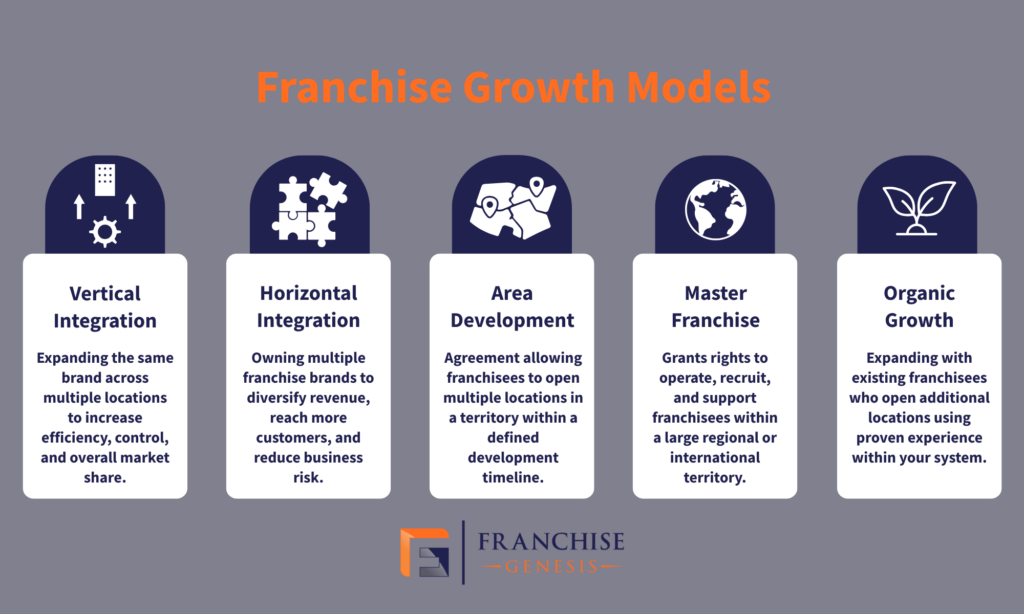
Key franchise growth models include:
- Vertical Integration: Adding multiple locations of the same brand
- Horizontal Integration: Diversifying with complementary franchise brands
- Area Development: Securing rights to open multiple units in a defined region
- Master Franchising: Becoming a regional developer who recruits sub-franchisees
- Organic Growth: Enabling existing franchisees to open additional locations
The United States added 15,000 new franchise units in 2024, bringing the total to 821,000 establishments and nearly $894 billion in economic output. Yet only 16% of franchisors ever reach 100 locations. The difference comes down to strategy.
I’m Monique Pelle Kunkle, Vice President of Operations at Franchise Genesis. I’ve guided businesses through successful franchise launches, including scaling one brand to over 100 locations in its first year. This guide shares the franchise growth strategies that separate thriving networks from stagnant systems.
Is Your Business Ready to Grow?
Before pursuing franchise growth, your existing franchise system needs to be stable. Growth amplifies what is already there. If the foundation has cracks, more locations make them worse.
Signs Your Franchise System Is Ready to Scale
- Consistent cash flow and healthy profit margins at existing locations
- Fully documented operations that do not depend on you personally
- A franchise operations manual that others can follow without hand-holding
- Proven franchisee support infrastructure already in place
- Demonstrated demand for a new location beyond your current market
Signs You Need More Foundation First
- Day-to-day operations rely on your direct involvement
- Franchisee performance varies widely across locations
- No standardized training or onboarding process exists
- Cash flow at existing units is inconsistent
Vertical and Horizontal Integration
Your growth structure is one of the most important decisions you will make as a franchisor. The two primary models are vertical integration and horizontal integration. The right choice depends on your business model, capital, and long-term goals.
Vertical Integration (Multi-Unit Franchising)
Vertical integration means adding multiple locations of the same brand. It is the most focused path to franchise growth and works well when your unit economics are proven and replicable. Multi-unit franchising now represents 50% of all U.S. franchisees and is often the fastest path to network-wide revenue growth.
Horizontal Integration (Portfolio Diversification)
Horizontal integration means diversifying across complementary franchise brands. It provides resilience and a broader customer base but adds management complexity and risks brand confusion.
Feature | Vertical Integration | Horizontal Integration |
Definition | Multiple units of the same brand | Units across complementary brands |
Primary Goal | Market dominance, operational efficiency | Cross-marketing, risk mitigation |
Benefits | Economies of scale, brand penetration | Resilience, broader customer base |
Challenges | Saturation risk, brand over-reliance | Management complexity |
Growth Potential | Rapid, focused growth | Broader growth across segments |
Area Development, Master Franchise, and Organic Growth
Area Development
An area development agreement grants a franchisee the rights to open multiple new units within a defined territory on a set timeline. It makes site selection more strategic and accelerates regional growth. Brands expanding into competitive markets like New York often use area development as a development strategy to move quickly and lock in territory.
Master Franchise
A master franchise arrangement designates a sub-franchisor to recruit and support franchisees within a large region. It works well for expansion into new markets and is commonly used by global brand networks that need regional infrastructure they cannot build centrally.
Organic Growth
Organic growth means enabling your strongest existing franchise owners to open additional locations. It is the lowest-risk path because you are expanding with operators who already know your system. Brands across industries including restaurant brands, spa services, the beverage industry, and brick and mortar retail have used organic growth to scale steadily without overextending support resources.
Core Franchise Growth Strategies for Rapid Expansion
Once your franchise system is stable, the focus shifts to actionable strategies. Effective franchise growth is driven by market demand, the potential for increased revenue, and the opportunity to leverage a proven business model. None of that happens without a clear growth plan.
Start by defining your North Star Metric. This is the single measure that best reflects the value you deliver, such as active franchise locations or average unit volume. Break that vision into SMART goals (Specific, Measurable, Achievable, Relevant, Time-bound) to create accountability. Track leading indicators like lead conversion rates to predict future performance and lagging indicators like revenue growth to confirm past results.
With that foundation in place, pursue these tactical strategies:
- Deepen Market Penetration: Build customer loyalty through loyalty programs and personalized experiences. More profitable locations attract better franchisees.
- Product and Service Development: Innovate to stay relevant. This could mean a new service tier or a complementary offering that meets emerging customer needs.
- Strategic Partnerships: Form alliances with complementary businesses to enter new markets and reach new customer bases. This is one of the most overlooked sources of competitive advantage in franchising.
- Data-Driven Marketing: Use market research to personalize campaigns across social media, email, and in-store marketing strategy. Companies that do this consistently grow two to three times faster.
Execution and Systemization: Building a Thriving Franchise Network
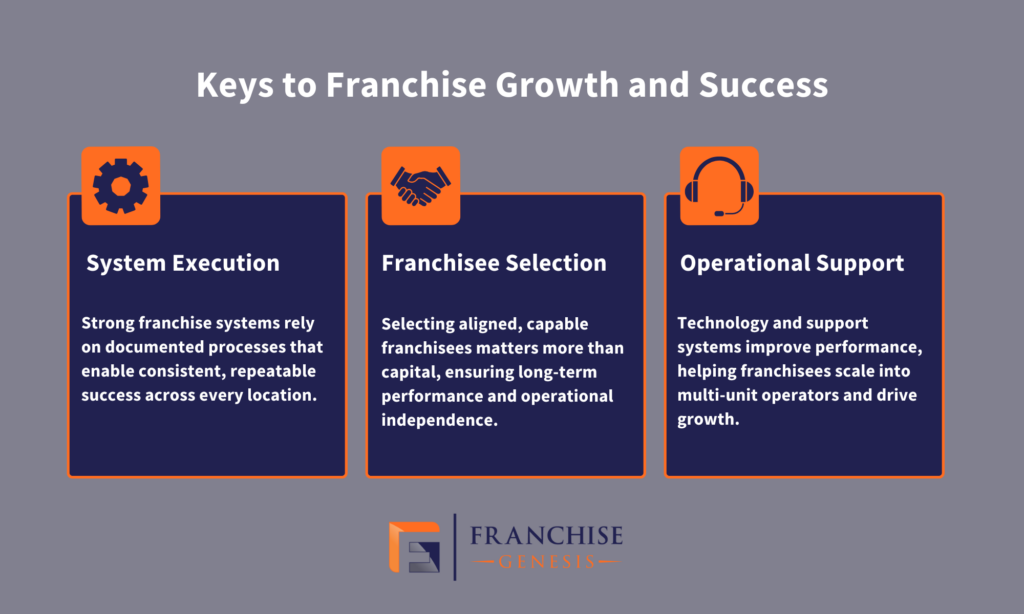
A franchise growth strategy is only as good as its execution. The foundation is operational excellence. Every task needs to be turned into a repeatable, teachable process documented in your franchise operations manual. When done right, any qualified franchise operator can replicate the success of your original location.
Franchisee selection matters as much as franchisee recruitment. Look for partners who share your vision, fit your culture, and have the management skills to run a location without constant oversight. Capital alone is not a qualifier. For product-based systems, a well-managed supply chain also needs to be part of your support infrastructure from day one.
CRM platforms and operational software help monitor financial performance and customer service standards across every location. The franchisees who feel supported perform better and are more likely to become multi-unit operators. That is one of the most cost-effective paths to sustainable growth in any franchise development strategy.
Avoiding Pitfalls and Leveraging Expert Support
Even a well-built franchise growth strategy can break down without discipline. Most of these pitfalls are predictable and avoidable with the right guidance.
- Overexpansion: Scaling too quickly before support infrastructure is ready stretches your team thin and causes quality to slip.
- Poor Franchisee Selection: Choosing new franchisees based only on capital leads to underperforming locations and legal disputes that damage the brand.
- Lack of Adequate Support: Without proper training and ongoing coaching, franchisee failure becomes your brand’s problem.
- Inconsistent Branding: Deviations from brand standards erode customer trust and dilute the value of your franchise agreements over time.
- Cash Flow Blind Spots: Poor planning between signing franchisees and their locations generating revenue leaves franchisors financially exposed.
The Role of Franchise Development in Your Growth Strategy
Navigating franchise expansion without guidance is one of the most common reasons emerging brands stall. A franchise development partner helps you avoid the mistakes that derail growth before it starts.
At Franchise Genesis, we bridge the gap between a successful business and a thriving franchise network across three areas:
- Market Evaluation: We use a data-driven approach to identify markets where your concept will resonate and give each new franchise location the best chance of success.
- Legal Documentation: We help make sure your franchise disclosure document and supporting materials are compliant and protect your interests as you grow.
- Real Estate Strategy: We use analytics to identify prime locations that align with your growth plan and target demographics, making site selection a strategic advantage.
FAQs About Franchise Growth Strategy
How do I know if franchising is the right growth strategy for my business?
Franchising makes sense when your business is consistently profitable, runs on documented systems, and has positive cash flow. If your success depends entirely on your personal involvement, the business needs more foundation before pursuing a franchise opportunity.
What is the biggest mistake franchisors make when growing?
Overexpansion is the most common pitfall. Adding new units before support infrastructure is ready leads to inconsistent franchisee performance and brand damage that is hard to recover from.
What is a multi-unit franchisee and why do they matter for growth?
A multi-unit franchisee operates more than one location and already knows your system. They require less onboarding than new franchisees and can open additional locations faster. Multi-unit operators represent 50% of all U.S. franchisees and are one of the strongest drivers of network-wide growth.
How do forward-looking statements factor into franchise growth planning?
Forward-looking statements in franchise documents outline projected performance and growth expectations. They need to be grounded in real unit economics and reviewed with legal counsel to stay compliant with FTC guidelines.