
Table of Contents
Short Answer: A franchise business plan explains how a proven business will scale into a franchise system. It outlines the franchise model, fees, support structure, operations, and financial projections for both franchisors and franchisees. A well-crafted business plan serves as the roadmap for growth and the proof that your model is replicable and profitable.
What Is a Franchise Business Plan?
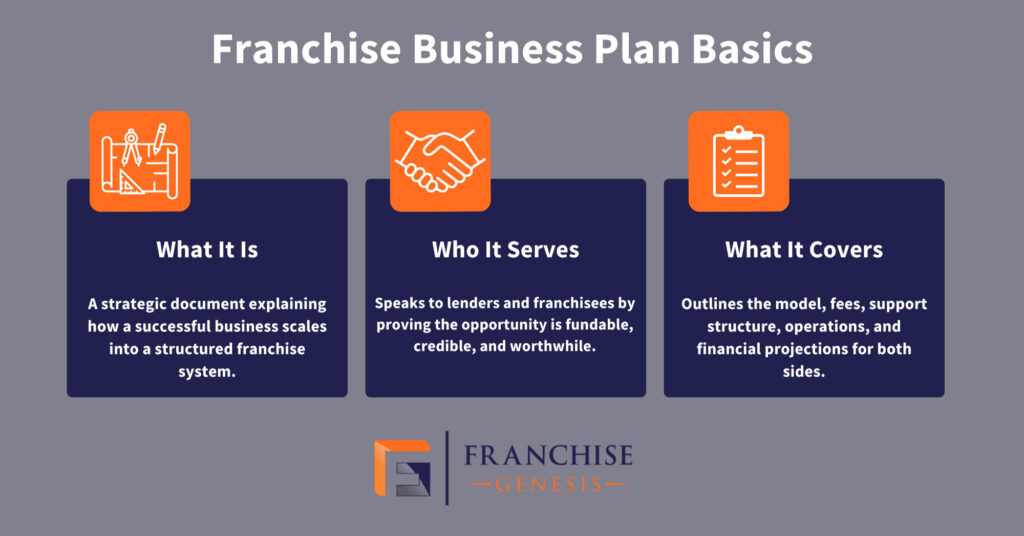
A franchise business plan is a strategic planning document that maps how a successful business will expand through franchising. It is different from a standard business plan in one major way. A standard plan proves that one location can succeed. A franchise business plan proves the business model can be replicated by someone else, in a different market, without the founder running daily operations.
This document speaks to two target audiences at once. Potential investors and lenders need to see that the franchise system is financially sound. Prospective franchisees need proof that the franchise opportunity is worth their initial investment. A solid business plan addresses both.
Why a Franchise Business Plan Is the Foundation of Expansion
Your franchise business plan is the document that turns a working business into a scalable franchise business. Without it, conversations with lenders stall, and franchisee recruitment lacks credibility.
Here is what a strong plan accomplishes:
- Proves your business model is replicable across markets
- Builds investor and lender confidence with clear financial projections
- Forces early strategic planning around operations, legal requirements, and finances
- Creates a roadmap for long-term goals like territory growth and brand recognition
U.S. franchising generates roughly $900 billion or more in annual output. A solid foundation of planning is what separates franchise systems that grow from those that stall after a few units.
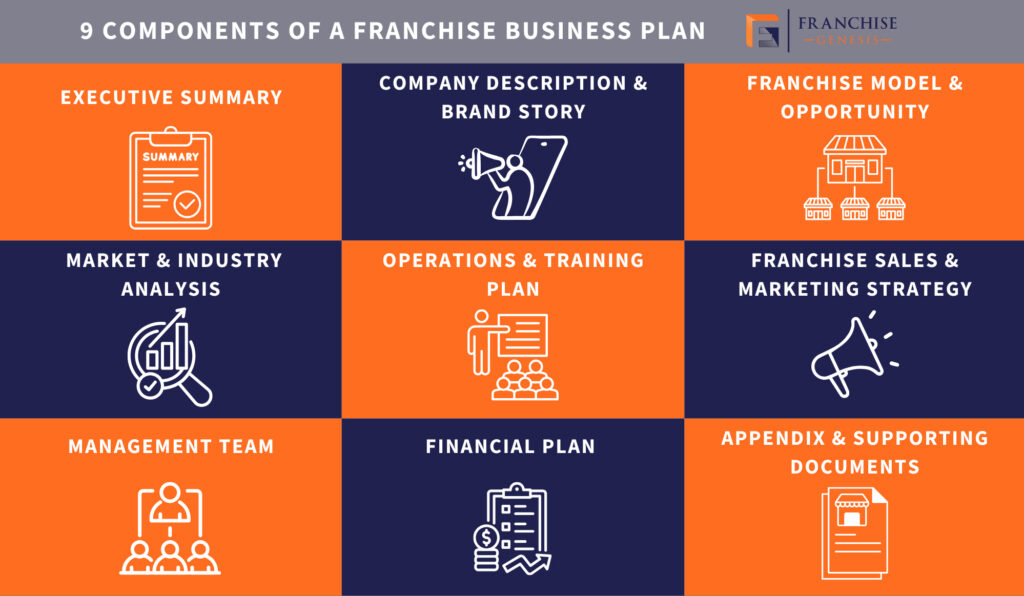
The 9 Core Components of a Franchise Business Plan
Each component works together to prove your system is scalable, fundable, and attractive to franchise buyers.
1. Executive Summary
Written last but read first. This is your elevator pitch. It captures your mission, the franchise opportunity, funding requirements, and the financial highlights that prove your concept works. Keep it tight and compelling.
2. Company Description and Brand Story
Share your business description and origin story. Cover milestones, competitive advantage, and what makes your brand franchise-ready. Your unique selling proposition should be clear and specific.
3. Franchise Model and Opportunity
Explain your franchise structure. Cover the franchise fee, ongoing royalty fees, and the complete initial investment breakdown. Outline whether you are offering single-unit franchises, multi-unit agreements, or area developer models. Include your territory design, such as whether territories are exclusive or protected based on population size, geographic radius, or market demand. This section must show potential franchisees why the opportunity is worth their capital.
4. Market and Industry Analysis
Back your growth plan with data. Include market analysis covering industry size, growth trends, and market conditions in your target territories. Define your target market for both customers and franchise buyers. A thorough competitor analysis adds credibility with potential investors.
5. Operations and Training Plan
This is the backbone of your franchise system. Detail your training programs, operations manual, supply chain, technology requirements, and quality control standards. Ongoing support is what keeps brand consistency strong across every franchise location. Include your field support model, covering opening support, ongoing visits, and escalation procedures for day-to-day operations issues.
6. Franchise Sales and Marketing Strategy
Your marketing strategy needs two layers. First, your sales strategy for recruiting qualified franchisees through digital marketing, expos, and lead generation. Second, the marketing plan and marketing materials you provide to help franchise owners attract potential customers locally. Define your ideal franchisee profile, including experience level, capital requirements, and whether you expect an owner-operator or manager-run model. Include details on your brand marketing fund and any local marketing support.
7. Management Team
Lenders and franchisees are investing in your leadership. Provide bios for founders and executives. Highlight relevant experience and outline the team that will directly support franchise owners. Plan for your support staffing ramp as the network grows. An advisory board with legal or financial expertise adds confidence.
8. Financial Plan for Franchisor and Franchisees
Present two complete financial pictures. Your franchisor revenue projections should cover initial fees, ongoing royalties, and other revenue streams. Include your royalty break-even point, which is the number of units needed before royalty income covers your franchisor’s operational costs.
Your franchisee’s financial plan should include startup costs, operational costs, cash flow projections, and a realistic balance sheet. Include break-even timelines and pro forma statements for 3 to 5 years. Any financial performance representations should be data-backed and properly disclosed through Item 19 of the FDD when offered. This section carries the most weight with lenders reviewing financial details.
9. Appendix and Supporting Documents
Include drafts or outlines of your franchise disclosure document (FDD) and franchise agreement once legal counsel is engaged. Add a legal readiness checklist, financial spreadsheets, market research data, and management team resumes. Define unit-level KPIs, compliance cadence, and required reporting standards. Every document in the appendix should reinforce your credibility.
Financial Projections and Investor Readiness
Lenders want conservative, data-backed financial projections. They need to see the full franchise infrastructure mapped out, including revenue from fees, franchisee support systems, and your startup costs as a franchisor.
Franchisee profitability matters just as much. If your numbers do not show that a franchise owner can build a profitable business, you will struggle to attract quality partners. Under common SBA lending structures, an equity injection of 10% or more may be required for certain startup or ownership-change scenarios. A well-crafted business plan with realistic revenue projections makes those conversations productive.
Using Your Franchise Business Plan to Attract Franchisees
A prospective franchisee is making a major investment. They need proof, not promises. Your franchise business plan provides that proof by showing realistic unit economics, clear support systems, and a track record of results.
Transparency builds trust. When your plan openly addresses potential risks, potential challenges, and the real costs of franchise ownership, it attracts serious operators. These are the franchise owners who will strengthen your network rather than drain your support resources.
Common Franchise Planning Pitfalls to Avoid
Even a strong business concept can stumble during franchising without the right planning. Watch for these common mistakes:
- Underestimating ongoing support costs. Training, operations guidance, and marketing support are not one-time expenses. Your financial plan must account for them, including support staffing as you add units.
- Building a model that is not replicable. If success depends on the founder’s personal talent or one specific market, the franchise model will not scale.
- Cutting corners on legal work. Franchising involves complex federal and state regulations, so working with experienced franchise attorneys is essential. A compliant FDD and protective franchise agreement are not optional.
- Treating the plan as static. A franchise business plan is a living document. Review it annually and update it when your model, fees, or growth strategy changes.
Franchise Genesis Helps You Scale With Confidence
If you’re asking how to franchise my business, start with a franchise business plan that proves your model can be repeated. Document your operations, validate unit economics, and align your franchise model with legal and financial requirements.
Franchise Genesis helps business owners turn a proven concept into a scalable franchise system by building the plan, defining the franchise model and fees, and mapping the support franchisees will need.
Contact Franchise Genesis to build your franchise business plan.
Frequently Asked Questions
How is a franchise business plan different from a regular business plan?
A standard business plan proves that one business can succeed in one market. A franchise business plan proves the business model can be replicated by someone else in a different location. It includes dual financial projections for both the franchisor and the franchisee, along with training systems, support structures, and legal documents like the FDD and franchise agreement.
What financial projections matter most in a franchise business plan?
Lenders and franchisees look at two sets of numbers. Franchisor projections should cover revenue from franchise fees, royalties, and other streams. Franchisee projections should include startup costs, operating expenses, cash flow, and realistic profit timelines. Any earnings representations must be properly disclosed, typically through Item 19 of the FDD. If your plan cannot show that a franchise owner will be profitable, recruiting quality partners becomes difficult.
How often should I update my franchise business plan?
Review your plan at least once a year. Update it sooner if you hit a growth milestone, adjust your fee structure, or respond to shifting market conditions. A franchise business plan that stays current remains a useful strategic planning tool rather than a document that collects dust.
Do investors require a franchise business plan?
Most lenders and potential investors require a detailed plan before committing capital. It is the primary document they use to evaluate risk, assess your business goals, and determine whether the franchise system is worth funding. Without one, most funding conversations will not move forward.