
Franchise Genesis

FDD Item 3: Litigation Explained

Item 3 of the franchise disclosure document requires franchisors to disclose certain pending and past litigation involving the franchise, its management, and related parties. It is governed by 16 CFR 436.5(c).

What Is Item 3 of the FDD?

Item 3 is the litigation section of the franchise disclosure document. It discloses specific legal actions and orders tied to the franchisor and the people and companies connected to it, so prospective franchisees can review the system’s legal history before they invest. The disclosure requirements are codified under 16 CFR 436.5(c) and enforced by the Federal Trade Commission.

Item 3 does not require disclosure of every lawsuit a company has ever faced. It targets defined categories of legal matters that bear on a candidate’s decision, such as actions alleging fraud or violations of franchise law, material cases involving the franchise relationship, and certain convictions and orders. When none of these apply, the franchisor states that no litigation is required to be disclosed in this item.

Because Item 1 sets the context for every section that follows, the information here must be accurate and consistent with the rest of the FDD. A prospective franchisee uses Item 1 to understand the company’s background and history before reviewing its fees, obligations, and financial condition.

Who Item 3 Covers

Item 3 reaches beyond the franchisor itself. The disclosure applies to the franchisor, any predecessor, and the individuals listed in Item 2. It also covers a parent or affiliate that guarantees the franchisor’s performance or that induces franchise sales by agreeing to back the franchisor, along with an affiliate that offers franchises under the franchisor’s principal trademark. Identifying the full set of covered parties is the first step in preparing an accurate Item 3, because a matter involving any of them may need to be disclosed.

What Must Be Disclosed in Item 3?

Item 3 covers four categories of legal matters involving the parties above. Each category has its own standard for what rises to the level of disclosure.

Pending Administrative, Criminal, and Material Civil Actions

Item 3 must disclose pending administrative, criminal, or material civil actions that allege a violation of franchise, antitrust, or securities law, or that allege fraud, unfair or deceptive practices, or comparable claims. It must also disclose other pending civil actions, apart from ordinary routine litigation incidental to the business, that are material given the number of franchisees and the size, nature, or financial condition of the franchise system.

Material Actions Involving the Franchise Relationship

Item 3 must disclose any material civil action involving the franchise relationship that a covered party was part of during the last fiscal year. The franchise relationship refers to contractual obligations between the franchisor and franchisee that relate directly to operating the franchised business, such as royalty and training obligations, among others. It does not include matters involving suppliers or other third parties, or indemnification for tort liability.

The 10-Year History of Convictions and Civil Liability

For the 10-year period before the issuance date of the disclosure document, Item 3 must disclose whether a covered party was convicted of or pleaded no contest to a felony, or was held liable in a civil action involving a franchise, antitrust, or securities law, or involving fraud, unfair or deceptive practices, or comparable claims. Being held liable means the party was required to pay money or other consideration, reduce a debt by the amount of an award, give up the ability to enforce its rights, or take action against its own interests.

Injunctive and Restrictive Orders

Item 3 must disclose whether a covered party is subject to a currently effective injunctive or restrictive order or decree. This applies to orders that resulted from a pending or concluded action brought by a public agency under franchise, securities, antitrust, trade regulation, or trade practice laws, including Federal, State, and Canadian laws.

What Each Litigation Disclosure Must Include

For every action disclosed in Item 3, the franchisor must provide a consistent set of details.

 
The Case Identifiers

The Case Identifiers

Each entry states the case title, the case number or citation, the initial filing date, the names of the parties, the forum, and the relationship of the opposing party to the franchisor, such as a competitor, supplier, lessor, franchisee, former franchisee, or class of franchisees.

 
The Nature of the Claim

The Nature of the Claim

The franchisor then summarizes the legal and factual nature of each claim, the relief sought or obtained, and any conclusions of law or fact.

 
The Outcome or Current Status

The Outcome or Current Status

The disclosure also reports the outcome or current standing of each matter. For pending actions, it states the status. For prior actions, it states the date the judgment was entered along with any damages or settlement terms. For injunctive or restrictive orders, it states the nature, terms, and conditions of the order. For convictions or pleas, it states the crime or violation, the date of conviction, and the sentence or penalty.

How Item 3 Connects to Other FDD Items

Item 3 builds directly on the parties named earlier in the document. The individuals disclosed in Item 2 are covered parties in Item 3, so the litigation review starts with the same management team. Item 1 identifies the predecessors, parents, and affiliates whose legal matters may fall within Item 3’s scope. Item 3 also sits alongside Item 4, which covers bankruptcy involving many of the same parties. Read together, Items 1 through 4 give a candidate a connected picture of who runs the franchise and what legal and financial history follows them.

item 19

Common Mistakes Franchisors Make With Item 3

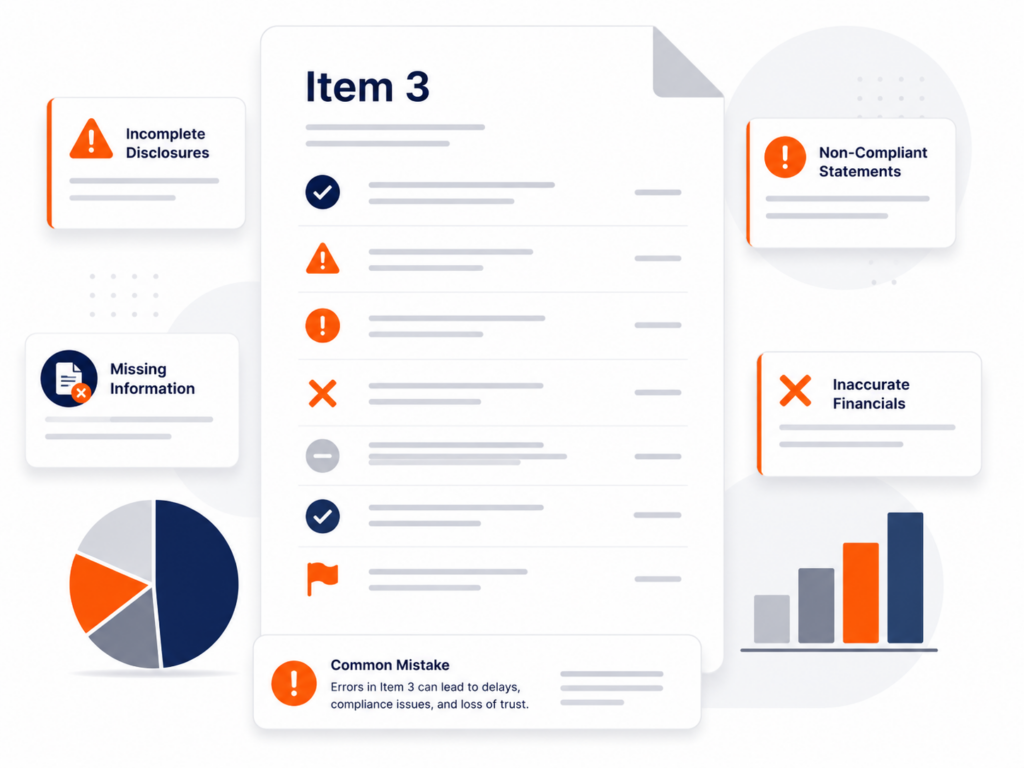
The most common Item 3 mistakes involve misjudging which matters to disclose and providing incomplete entries. Both create compliance gaps under the Franchise Rule and can mislead candidates about the system’s legal history.

Some franchisors disclose too little by treating a material action as routine, and others fail to track matters involving a parent, affiliate, or one of the individuals named in Item 2. Incomplete entries are another frequent issue, such as omitting the forum, the relationship of the opposing party, or the outcome of a concluded action. Item 3 must also stay current, since a new action or order may constitute a material change requiring an update to the FDD. The parties covered in Item 3 should line up with those disclosed in Item 2 and Item 4.

Franchise Genesis

How Franchise Genesis Helps Franchisors Prepare Item 3

Litigation disclosure carries real legal weight, since an inaccurate or incomplete Item 3 can expose a franchisor to liability and damage trust with candidates. Getting Item 3 right means disclosing the matters the rule requires, in the detail it requires, without misstating the record.

Franchise Genesis works with franchisors to prepare a franchise disclosure document that is accurate, compliant, and built to support franchise sales. Experienced franchise attorneys are included in the development program. They help franchisors identify covered parties, apply the appropriate materiality standard to each matter, and document each action with the details Item 3 requires.

Contact Franchise Genesis to learn how the development program supports FDD preparation from Item 1 through Item 23.

Get Started Today!
Main Image
Questions

Frequently Asked Questions

What is Item 3 of the FDD?

 Item 3 discloses certain pending and past litigation involving the franchisor, its predecessors, certain parents and affiliates, and the management individuals identified in Item 2. It is governed by 16 CFR 436.5(c).

Does Item 3 require disclosing every lawsuit?

 No. Item 3 targets defined categories, including actions alleging fraud or violations of franchise law, material actions involving the franchise relationship, certain felony convictions and civil liability over the past 10 years, and currently effective injunctive or restrictive orders.

What does "held liable" mean in Item 3?

A party is held liable when, as a result of claims or counterclaims, it must pay money or other consideration, reduce a debt by the amount of an award, lose the ability to enforce its rights, or take action against its own interests.

What if a franchisor has no litigation to disclose?

When none of the categories apply, the franchisor states in Item 3 that no litigation is required to be disclosed.

What is the difference between Item 3 and Item 4?

Item 3 covers litigation, including lawsuits, criminal actions, and certain orders. Item 4 covers bankruptcy filings and discharges involving the franchisor and related parties.