

Franchise Genesis

FDD Item 4: Bankruptcy Explained

Item 4 of the franchise disclosure document requires franchisors to disclose certain bankruptcy filings and discharges involving the franchise and the people and companies connected to it. It is governed by 16 CFR 436.5(d).

What Is Item 4 of the FDD?

Item 4 is the bankruptcy section of the franchise disclosure document. It tells prospective franchisees whether the franchisor or the parties connected to it have a recent bankruptcy history, which helps candidates judge the financial stability behind the system. The disclosure requirements are codified under 16 CFR 436.5(d) and enforced by the Federal Trade Commission.

Item 4 focuses on a defined 10-year window and a defined set of parties. When no covered party has a bankruptcy event to report, the franchisor states that no bankruptcy is required to be disclosed in this item.

Because Item 1 sets the context for every section that follows, the information here must be accurate and consistent with the rest of the FDD. A prospective franchisee uses Item 1 to understand the company’s background and history before reviewing its fees, obligations, and financial condition.

Who Item 4 Covers

Item 4 applies to the franchisor, any parent, any predecessor, any affiliate, and the franchisor’s officers and general partners, as well as any individual with management responsibility relating to the sale or operation of the franchises offered in the document. It also covers the franchisor’s officers and general partners, along with any other individual who will have management responsibility relating to the sale or operation of the franchises offered in the document. This is a broad set of parties, and a bankruptcy involving any of them may need to be disclosed.

What Must Be Disclosed in Item 4?

Item 4 covers specific bankruptcy events during the 10-year period before the disclosure document’s date and also requires disclosure of certain related proceedings under foreign bankruptcy laws.

Bankruptcy Petitions in the Past 10 Years

Item 4 must disclose whether a covered party filed a petition under the United States Bankruptcy Code, or had a petition filed against it, during the 10 years before the date of the disclosure document, along with the required identifying details of the proceeding.

Discharges of Debt

Item 4 must disclose whether a covered party obtained a discharge of its debts under the Bankruptcy Code during the same 10-year period, including the applicable chapter where relevant.

Bankruptcies Tied to a Person’s Prior Company

Item 4 includes certain bankruptcies connected to an individual’s past role. It must disclose whether a covered person was a principal officer of a company, or a general partner in a partnership, that filed or had filed against it a bankruptcy petition, or that obtained a discharge of its debts, while that person held the position or within one year after leaving it.

Foreign Bankruptcy Proceedings

Item 4 must also disclose bankruptcy cases and related proceedings involving covered parties under the laws of foreign countries.

What Each Bankruptcy Disclosure Must Include

For each bankruptcy reported in Item 4, the franchisor must state the current name, address, and principal place of business of the debtor.

 
The Debtor's Relationship

The Debtor's Relationship

It must state whether the debtor is the franchisor, and if not, the debtor's relationship to the franchisor, such as an affiliate or officer, or another covered relationship.

 
The Filing Details

The Filing Details

The disclosure must include the date of the original filing and the material facts, including the bankruptcy court and the case name and number.

 
Discharge and Confirmation

Discharge and Confirmation

When it applies, the entry must also state the discharge date, including a discharge under Chapter 7 and the confirmation of any reorganization plan under Chapter 11 or Chapter 13 of the Bankruptcy Code.

How Item 4 Connects to Other FDD Items

Item 4 works with the items around it to present the franchisor’s legal background. Item 1 names the parents, predecessors, and affiliates whose bankruptcies may fall within Item 4’s scope, and Item 2 names the officers and management individuals it covers. Item 4 sits next to Item 3, which covers litigation involving many of the same parties, so the two are often reviewed together. Item 4 also complements Item 21, where the franchisor presents its audited financial statements. Where Item 21 shows the current financial condition, Item 4 shows whether a recent bankruptcy is part of the history behind it.

item 19

Common Mistakes Franchisors Make With Item 4

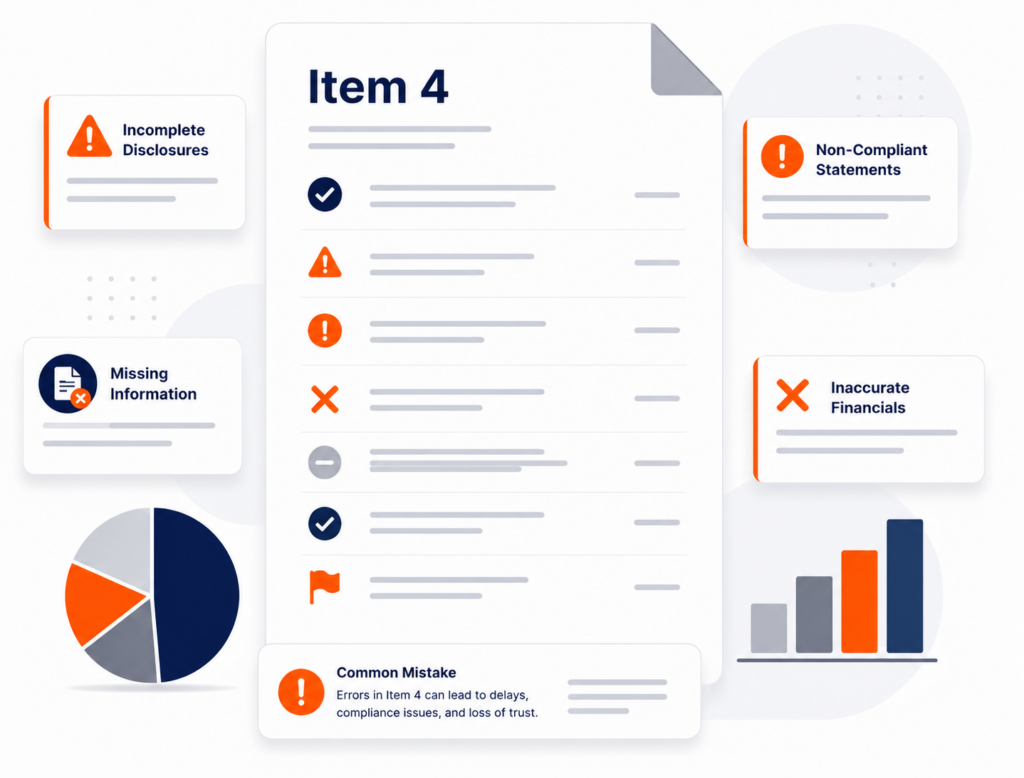
The most common Item 4 mistakes involve missing a covered party and leaving out the prior-company bankruptcies the rule reaches. Both create compliance gaps under the Franchise Rule.

A management individual’s bankruptcy tied to a previous company is easy to overlook, yet Item 4 requires it when the person held a principal officer or general partner role at the relevant time. Affiliate bankruptcies are another frequent miss, since Item 4 covers any affiliate. Foreign proceedings and incomplete entries, such as a missing court, case number, or discharge date, also create problems. Item 4 must stay current because a new filing may constitute a material change requiring an update to the FDD.

Franchise Genesis

How Franchise Genesis Helps Franchisors Prepare Item 4

Bankruptcy disclosure shapes how candidates view the financial footing of a franchise, and the rule sets clear boundaries for what belongs in this item. Getting Item 4 right means reviewing every covered party against the right 10-year window and reporting each event with the detail the rule requires.

Franchise Genesis works with franchisors to prepare a franchise disclosure document that is accurate, compliant, and built to support franchise sales. Experienced franchise attorneys are included in the development program. They help franchisors identify every covered party, surface the prior-company and foreign proceedings that are easy to miss, and document each filing with the facts Item 4 requires.

Contact Franchise Genesis to learn how the development program supports FDD preparation from Item 1 through Item 23.

Get Started Today!
Main Image
Questions

Frequently Asked Questions

What is Item 4 of the FDD?

 Item 4 discloses certain bankruptcy filings and discharges involving the franchisor, its parents, predecessors, affiliates, officers, general partners, and management individuals, during the 10 years before the document’s date. It is governed by 16 CFR 436.5(d).

Who does Item 4 cover?

The franchisor, any parent, predecessor, or affiliate, the franchisor’s officers and general partners, and any other individual with management responsibility over the sale or operation of the franchise.

How far back does Item 4 go?

The main bankruptcy events are disclosed for the 10-year period immediately before the date of the disclosure document. Item 4 also requires disclosure of related proceedings under foreign laws.

Does an executive's personal bankruptcy have to be disclosed?

It can. When a covered individual filed for bankruptcy, obtained a discharge, or held a principal officer or general partner role at a company that did so within the 10-year window, Item 4 requires disclosure.

What is the difference between Item 3 and Item 4?

Item 3 covers litigation, including lawsuits, criminal actions, and certain orders. Item 4 covers bankruptcy filings, discharges, and related foreign proceedings.