

Franchise Genesis

FDD Item 21: Financial Statements Explained

Item 21 of the franchise disclosure document requires franchisors to include audited financial statements that show the financial condition of the business behind the franchise. It is governed by 16 CFR 436.5(u).

What Is Item 21 of the FDD?

Item 21 is the financial statements section of the franchise disclosure document. It provides prospective franchisees with audited financial statements of the franchisor, allowing candidates to review the financial condition of the business behind the franchise. The disclosure requirements are codified under 16 CFR 436.5(u) and enforced by the Federal Trade Commission.

Item 21 is where a candidate, or their accountant, can assess the financial footing of the franchisor. Because Item 21 financial statements are prepared according to required accounting standards and may include audited statements as the franchisor matures, they offer one of the most objective measures in the entire disclosure document.

What Must Be Disclosed in Item 21?

Item 21 requires a defined set of financial statements, prepared and audited to recognized standards.

The Required Financial Statements

Item 21 must include the franchisor’s balance sheet for the previous two fiscal year-ends before the issuance date, along with statements of operations, stockholders’ equity, and cash flows for each of the previous three fiscal years. The statements present financial information for multiple fiscal years to allow comparison across periods.

Audit and Accounting Standards

The statements must be prepared according to United States generally accepted accounting principles (GAAP), or as permitted by the Securities and Exchange Commission. Except as permitted under the phase-in provisions for new franchisors, the financial statements must be audited by an independent certified public accountant in accordance with generally accepted United States auditing standards. The audit requirement is what gives Item 21 its weight, since an independent accountant has reviewed the figures.

When Affiliate or Parent Statements Apply

In place of its own statements, a franchisor may use an affiliate’s financial statements if those statements meet the same requirements and the affiliate provides an absolute and unconditional guarantee of the franchisor’s obligations. That guarantee must cover all of the franchisor’s obligations to the franchisee, and a copy is attached to the disclosure document. When a franchisor holds a controlling interest in a subsidiary, its statements should reflect the financial condition of both. Separate statements are also required for any subfranchisor and for any parent that guarantees the franchisor’s obligations, with any required guarantee attached to the disclosure document.

The Phase-In Option for New Franchisors

A start-up franchisor that does not yet have a full audited financial history may phase in required financial statements during its initial years of franchising, as permitted under the Franchise Rule.

 
First Year Selling Franchises

First Year Selling Franchises

In the franchisor's first partial or full fiscal year selling franchises, it may provide an unaudited opening balance sheet. (Unless you are offering franchises in certain registration states that require this).

 
Second Year Selling Franchises

Second Year Selling Franchises

In the second fiscal year, the franchisor must include an audited balance sheet as of the end of that first partial or full fiscal year.

 
Third Year and Beyond

Third Year and Beyond

In the third and later fiscal years, the franchisor must include all required financial statements for the most recent fiscal year in accordance with the phase-in requirements.

How Item 21 Connects to Other FDD Items

Item 21 anchors the financial picture that other items build on. Item 1 identifies the parent, subsidiary, and affiliate relationships that determine whose statements appear here. Item 4 reports any recent bankruptcy, which a candidate reads against the current condition shown in Item 21. The franchisor’s financial strength also bears on Item 11, since a company needs the resources to deliver the training, support, and advertising it commits to there. Any guarantee that lets an affiliate or parent stand in for the franchisor is attached among the agreements in Item 22.

item 19

Common Mistakes Franchisors Make With Item 21

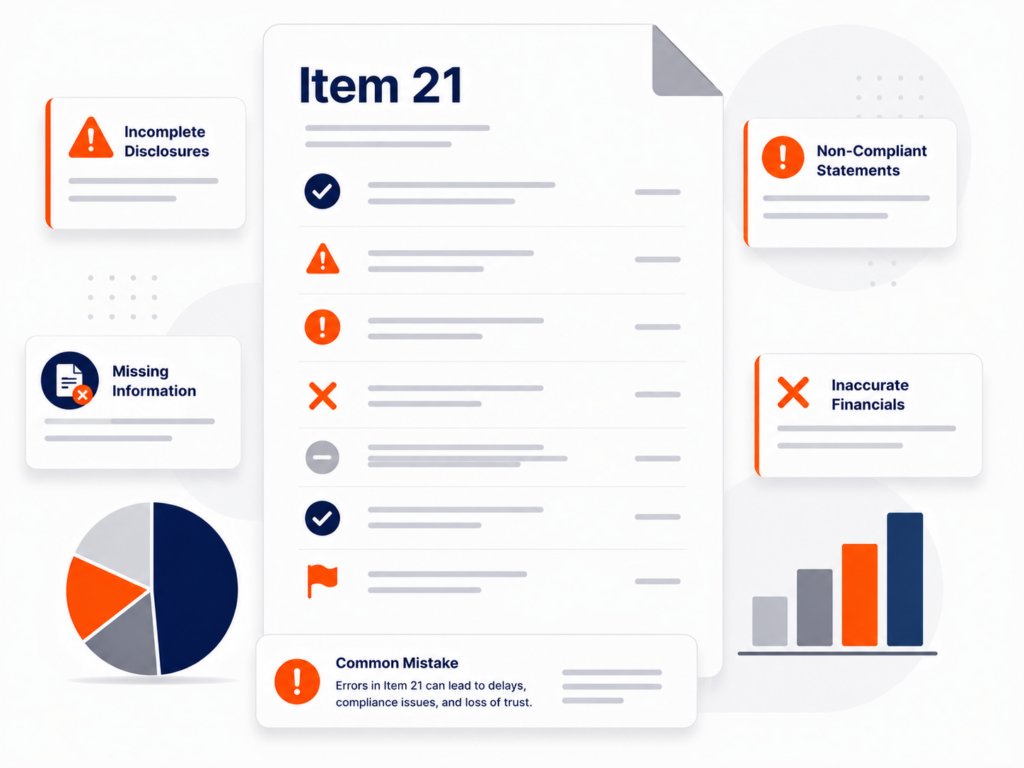
The most common Item 21 mistakes involve providing the wrong statements and missing the audit requirement. Both create compliance gaps under the Franchise Rule and can delay approval in states that require FDD review.

Submitting unaudited statements after the phase-in window has closed is a frequent issue, as is omitting one of the required years for the balance sheet or the operations, equity, and cash flow statements. Using an affiliate’s statements without attaching the unconditional guarantee the rule requires is another error. Item 21 also has to be refreshed each year, since financial statements that fall out of date no longer reflect the franchisor’s condition at the time of disclosure.

Franchise Genesis

How Franchise Genesis Helps Franchisors Prepare Item 21

Item 21 is one of the few items where an outside auditor and recognized accounting standards set the bar, which leaves little room for approximation. Getting Item 21 right means the correct statements, audited to the right standards, covering the right years.

Franchise Genesis works with franchisors to prepare a franchise disclosure document that is accurate, compliant, and built to support franchise sales. Experienced franchise attorneys are included in the development program. They help franchisors coordinate the required audited statements, apply the phase-in option correctly for new systems, and handle the affiliate and parent guarantees that Item 21 allows.

Contact Franchise Genesis to learn how the development program supports FDD preparation from Item 1 through Item 23.

Get Started Today!
Main Image
Questions

Frequently Asked Questions

What is Item 21 of the FDD?

Item 21 requires the franchisor to include audited financial statements showing the financial condition of the business behind the franchise. It is governed by 16 CFR 436.5(u).

Do the financial statements have to be audited?

Yes. The statements must be audited by an independent certified public accountant using United States auditing standards, except under the phase-in option available to new franchisors.

How many years of statements are required?

Item 21 requires balance sheets for the previous two fiscal year-ends and statements of operations, stockholders’ equity, and cash flows for the previous three fiscal years.

Can a new franchisor offer franchises without a full audited history?

Yes. A start-up franchisor may phase in audited statements over its first few years of selling franchises, beginning with an unaudited opening balance sheet and adding audited statements over time.

Can a parent's or affiliate's financial statements be used instead?

In defined circumstances. An affiliate’s statements may be used when they meet the same requirements and the affiliate provides an unconditional guarantee of the franchisor’s obligations, with a copy of the guarantee attached to the disclosure document.