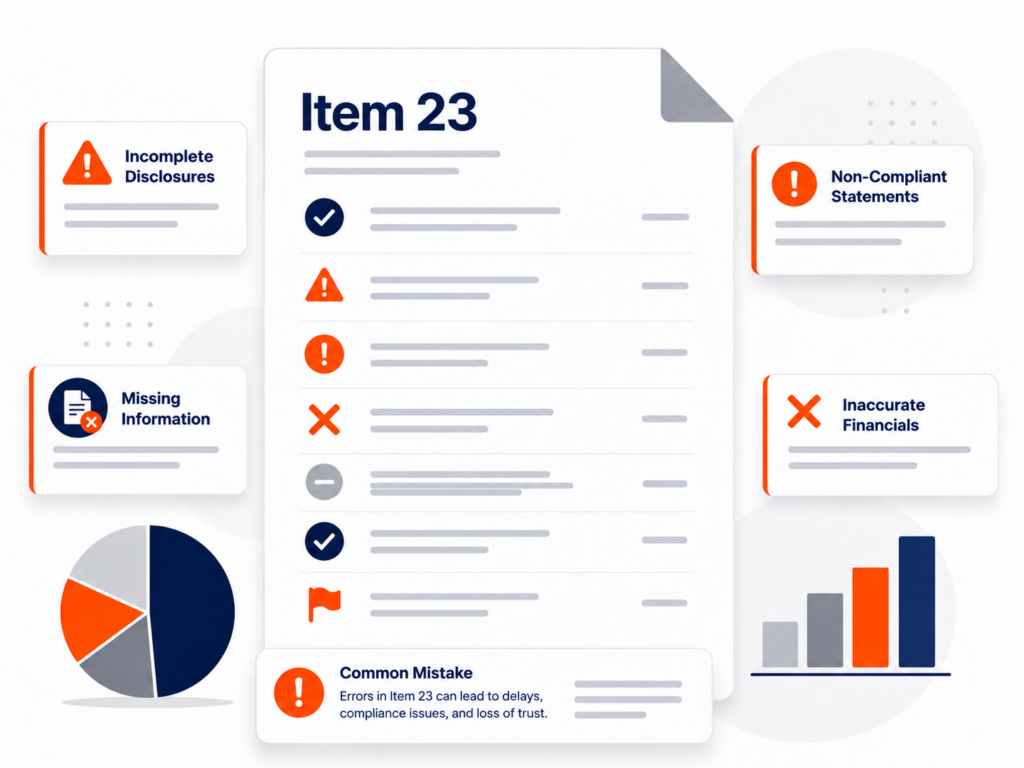

Item 23 of the franchise disclosure document is the detachable receipt at the end of the document that a prospective franchisee signs and dates to confirm they received it. That signed, dated receipt is how a franchisor proves it met the disclosure timing the law requires. Item 23 is governed by 16 CFR 436.5(w).
Item 23 is the receipts section of the franchise disclosure document. It is the last item, and it consists of two copies of a detachable acknowledgment of receipt that records the date a candidate received the FDD.
Item 23 is short, but it carries real weight. The signed receipt is the franchisor’s evidence that the candidate received the disclosure document on a specific date, which is what starts the required waiting period before any agreement is signed or money changes hands.
Item 23 includes a receipt that must contain specific required information, including the prescribed title and statement, the names of the franchise sellers, the effective date, and a signature line for the prospective franchisee.
Item 23 provides two copies of a detachable acknowledgment of receipt at the very end of the document. The candidate keeps one copy and signs the other, which goes back to the franchisor. The title “RECEIPT” appears in bold at the top.
Two copies exist so both sides keep a record, one for the franchisee and a signed one for the franchisor.
The receipt opens with a prescribed statement that identifies the disclosure document, names the franchisor, states the requirement to deliver the FDD at least 14 calendar days before signing or payment, and tells the candidate to report any violation to the Federal Trade Commission and the appropriate state agency.
The receipt also lists each franchise seller involved in the offer, including salespersons, brokers, and subfranchisors, along with their names, business addresses, and telephone numbers.
The receipt records the issuance or effective date of the disclosure document and lists the exhibits included with it. The candidate signs and dates the receipt to acknowledge what they received.
The date the candidate writes is the date that starts the waiting period, which is why it has to be accurate.
Item 23 sits at the end of the document and ties back to the pieces in front of it.

The Franchise Rule requires a franchisor to give a prospective franchisee the completed FDD at least 14 calendar days before the candidate signs any binding agreement or pays any money in connection with the franchise. Item 23 is how the franchisor documents that this happened.

If a dispute or a regulatory review ever asks when the candidate received the document, the signed and dated receipt is the answer. A franchisor that cannot produce it has no way to show it met the timing the law requires, which is why the receipt is collected and kept rather than treated as a formality.

Item 23 sits at the end of the document and ties back to the pieces in front of it.
The exhibit list on the receipt includes the agreements attached under Item 22, so the two items have to agree on what was delivered. The franchisor identified on the receipt is the same franchisor disclosed in Item 1. The franchise sellers named on the receipt connect to the people disclosed in Item 2.
The receipt also depends on the document being complete. Because the candidate acknowledges receiving the full FDD with its exhibits, every other item and every attachment has to be in place before the receipt is signed.
The date on the receipt drives the waiting period, so an incorrect or missing effective date is a serious error. When the receipt is signed with a date that does not match the actual delivery, the franchisor cannot rely on it to prove compliance.
The date has to reflect when the candidate actually received the document.
The receipt has to name every franchise seller involved in the offer and list every exhibit included. Leaving out a salesperson or broker, or an exhibit list that does not match what was delivered, is a frequent problem.
The exhibit list on the receipt should match the agreements attached in Item 22.
The most costly mistake is not retaining the signed receipt. A franchisor that hands over the document but never collects and files the signed copy has no proof of when disclosure occurred.
Without that record, the franchisor cannot show it met the 14-day rule if the question ever comes up.
Item 23 looks like a formality, but it is the piece that proves every other item reached the candidate on time. A receipt with the wrong date, a missing franchise seller or a signed copy that never makes it back to the file can undo the compliance the rest of the FDD was built for.
That is why the receipt earns the same attention as the disclosures ahead of it. Franchise Genesis prepares it so the effective date is correct, the franchise sellers and exhibits are complete and there is a clear process for collecting and storing each signed copy.
The development program includes experienced franchise attorneys who draft the receipt to the language the Franchise Rule requires and match its exhibit list to the agreements in Item 22. The result is a franchise disclosure document that holds up if a candidate, a state examiner or a court later asks when disclosure happened.
Ready to build an FDD that stands up to review? Contact Franchise Genesis to see how the development program handles Item 23 and every item before it.

Item 23 is the detachable receipt at the end of the disclosure document that a prospective franchisee signs and dates to confirm they received it. It is governed by 16 CFR 436.5(w).
Item 23 provides two copies so both sides keep a record. The candidate keeps one copy, and the other is signed and returned to the franchisor for its files.
The Franchise Rule requires the franchisor to deliver the completed FDD at least 14 calendar days before the candidate signs any binding agreement or makes any payment. The signed, dated receipt is how the franchisor proves the timing was met.
The receipt includes a prescribed statement, the franchisor’s name, each franchise seller with contact information, the document’s effective date, the list of exhibits, and a place for the candidate to sign and date.
It is the franchisor’s proof of when disclosure occurred. Without a signed and dated receipt on file, the franchisor cannot show it met the 14-day disclosure rule if a dispute or regulatory review ever raises the question.