
Item 1 of the franchise disclosure document requires franchisors to identify the company behind the franchise offering and describe its legal structure, business background, and any parents, predecessors, and affiliates tied to the system. It is governed by 16 CFR 436.5(a).
Item 1 is the opening disclosure section of the franchise disclosure document. It tells prospective franchisees exactly who they would be entering a relationship with by disclosing the franchisor’s legal identity, the names it operates under, its business form, and its connections to parent companies, predecessors, and affiliates. The disclosure requirements are codified under 16 CFR 436.5(a) and enforced by the Federal Trade Commission.
Because Item 1 sets the context for every section that follows, the information here must be accurate and consistent with the rest of the FDD. A prospective franchisee uses Item 1 to understand the company’s background and history before reviewing its fees, obligations, and financial condition.
Item 1 covers the franchisor’s identity, corporate structure, and the related companies connected to the franchise. The following disclosures are required.
Item 1 must state the name and principal business address of the franchisor, any affiliates that offer franchises or that are otherwise involved in offering or operating the franchise system, or that supply products or services to franchisees as required under the Franchise Rule. Identifying these related entities gives prospective franchisees a clear view of the broader organization standing behind the offering.
Franchisors must disclose the name and principal business address of any predecessor from the 10 years immediately before the close of the most recent fiscal year. A predecessor is a company that the franchisor acquired or succeeded, and disclosing it lets candidates trace the history of the franchise system.
Item 1 must disclose the name the franchisor currently uses to conduct business and any names it intends to use. This includes trade names or fictitious names that differ from the franchisor’s legal name, so candidates can recognize the brand in the marketplace.
Franchisors must state their type of business organization, such as a corporation or partnership, and the state where the entity was organized. Item 1 must also identify the franchisor’s agent for service of process and that agent’s principal business address.
Beyond identity and structure, Item 1 describes what the business does, the market the franchisee will enter, and how long the franchisor and its related companies have operated.

Item 1 must explain whether the franchisor operates businesses of the type being franchised, describe the franchisor's other business activities, and describe the business the franchisee will conduct. This gives candidates a direct picture of the operation they are buying into and the company's experience running it.

Franchisors must describe the general market for the product or service the franchisee will offer, including whether the market is developed or developing, which may include whether sales are seasonal, and whether the goods or services are sold primarily to a particular group. Item 1 includes, in general terms, any applicable laws or regulations specific to the industry, along with a general description of the competition the franchisee will face.

Item 1 must disclose the prior business experience of the franchisor and any predecessors, and, where applicable, affiliates involved in the franchise system. This includes how long each has conducted the type of business the franchisee will operate and how long each has offered franchises in that line of business. If any of them has offered franchises in other lines of business, Item 1 must describe each line, state the number of franchises sold, and state how long franchises have been offered in each.

Item 1 identifies the franchisor and its related companies, which sets up several disclosures that follow. Item 2 covers the business experience of the individual directors, officers, and managers who run the franchise, while Item 1 covers the experience of the company itself. The parents, predecessors, and affiliates named in Item 1 carry through to Item 3, which discloses litigation involving those parties, and Item 4, which discloses bankruptcy. The affiliates that supply products or services to franchisees connect to Item 8, which covers restrictions on sources of products and services. The corporate structure disclosed in Item 1 also frames Item 21, where the franchisor presents its audited financial statements. Because so many later items build on the entities named here, accuracy in Item 1 supports consistency across the entire document.
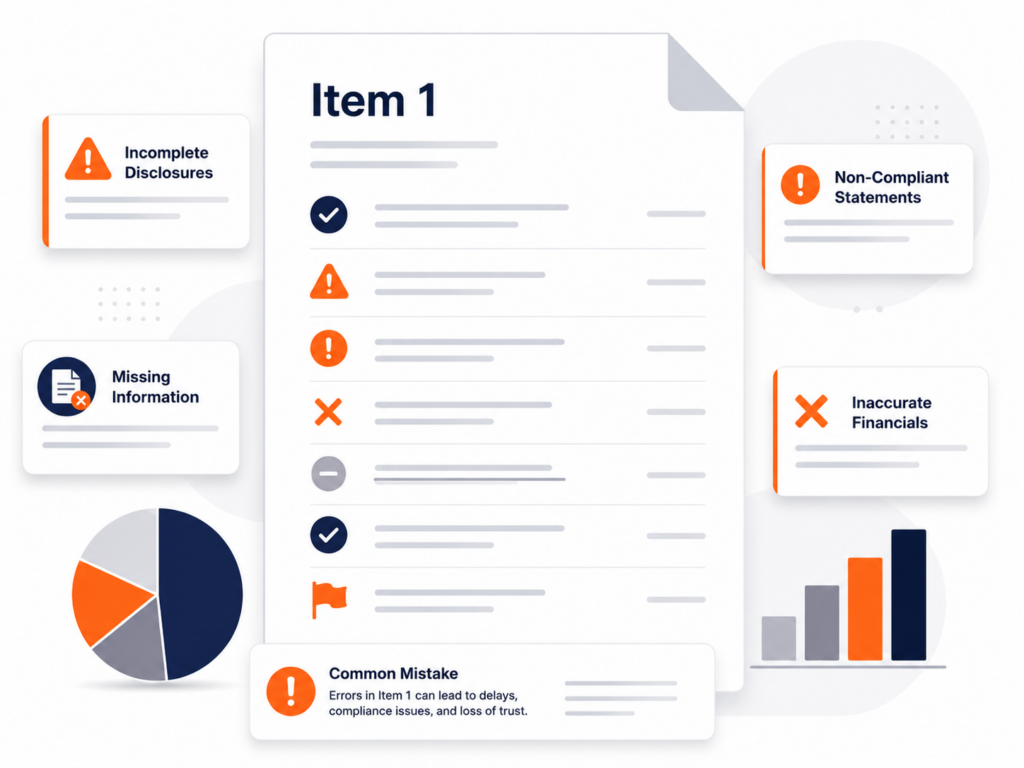
The most common Item 1 mistakes involve leaving out affiliates and creating inconsistencies between Item 1 and later items. Both errors create compliance gaps and give prospective franchisees an incomplete picture of the organization behind the franchise.
Affiliates that are required to be disclosed under the Franchise Rule and are involved in offering or supporting the franchise system must be named in Item 1, and omitting them can create compliance risk. Disclosures that conflict with Item 3, Item 4, Item 8, or Item 21 signal an error in FDD preparation and can undermine a candidate’s confidence before the relationship begins. Vague descriptions of the market and competition are another frequent issue, since Item 1 calls for a clear account of the conditions the franchisee will operate in.
Errors in the opening disclosure create legal exposure and shape how a candidate views the rest of the document. Getting Item 1 right from the start establishes an accurate foundation and builds credibility with franchise candidates.
Franchise Genesis works with franchisors to prepare a franchise disclosure document that is accurate, compliant, and built to support franchise sales. Experienced franchise attorneys are included in the development program. They guide franchisors through the disclosure requirements under 16 CFR 436.5(a), confirm that every parent, predecessor, and affiliate is properly identified, and keep Item 1 consistent with the disclosures that follow.
Franchise attorneys are included in the Franchise Genesis development program. They guide franchisors through the disclosure requirements, help structure financial performance data with a defensible reasonable basis, and make sure Item 19 reflects actual operating results accurately.
A well-prepared Item 19 is not just a legal requirement. It is a franchise sales tool. Contact Franchise Genesis to learn how the development program supports FDD preparation from Item 1 through Item 23.

Item 1 identifies the franchisor and describes its legal structure, business background, and any parents, predecessors, and affiliates connected to the franchise. It is the opening disclosure section of the FDD and is governed by 16 CFR 436.5(a).
Item 1 must disclose the franchisor’s name and principal business address, any parents and affiliates, predecessors from the past 10 years, the names used to conduct business, the business organization type and state, the agent for service of process, the business and market the franchisee will enter, and the prior business experience of the franchisor and its related companies.
A parent is a company that controls the franchisor. A predecessor is a company the franchisor acquired or succeeded within the past 10 years. An affiliate is a company under common control with the franchisor, and it must be disclosed when it offers franchises or supplies products or services to franchisees.
Item 1 discloses the franchisor as a company, including its structure, history, and related entities. Item 2 discloses the business experience of the individual people who manage the franchise, such as directors, officers, and other management.
Item 1 is the first information a candidate reviews, and it establishes with whom they would be doing business. An accurate Item 1 helps candidates understand the company’s background and sets an honest tone for the rest of the disclosure document.