Why Every Franchisor Needs a Bulletproof Operations Manual
A franchise operations manual is the documented foundation that governs how every franchise location operates—from opening procedures to customer service standards to closing checklists. It’s the single most important tool for ensuring brand consistency, quality control, and franchisee success across your entire system.
Quick answer for business owners looking to franchise:
- What it is: A comprehensive guide detailing every aspect of operating your franchise, including procedures, standards, policies, and brand guidelines.
- Why you need it: Ensures consistency across locations, reduces franchisee support burden, protects your brand, and serves as a legal quality control document.
- Key benefit: Franchises with well-designed operations manuals have a failure rate of only 10%, compared to 60% for independent businesses.
- Legal role: Acts as an enforceable extension of your Franchise Agreement and must have its table of contents disclosed in your Franchise Disclosure Document (FDD).
- What’s inside: Brand standards, pre-opening procedures, daily operations, marketing guidelines, training protocols, financial reporting, and legal compliance requirements.
Your operations manual is more than instructions—it’s a practical guide and a critical legal document. It standardizes processes, trains franchisees, protects your brand, and helps establish franchisees as independent contractors, reducing your liability. It’s the blueprint for turning your successful business into a scalable franchise system.
Without a comprehensive operations manual, you risk inconsistent customer experiences, frustrated franchisees, brand dilution, and legal vulnerabilities. With one, you create a foundation for sustainable growth and franchisee success.
I’m Monique Pelle Kunkle, Vice President of Operations at Franchise Genesis, and I’ve guided dozens of business owners through creating franchise operations manuals that serve as the backbone of their systems—including helping scale concepts from single locations to 100+ franchises. In this guide, I’ll walk you through everything you need to know to build a manual that protects your brand and empowers your franchisees to thrive.
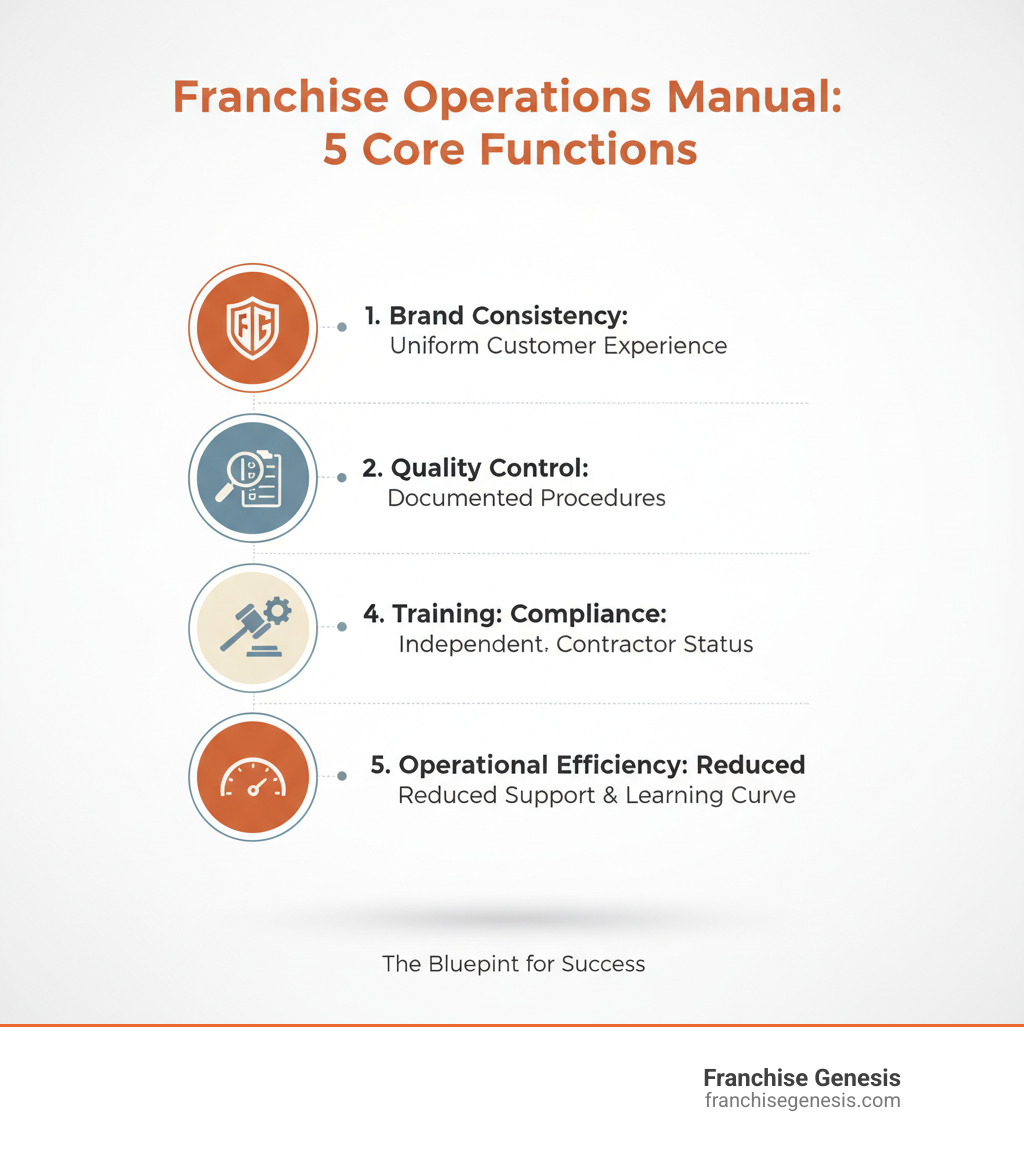
Basic franchise operations manual glossary:
The Core Functions and Legal Significance of Your Operations Manual
Your franchise operations manual isn’t just another business document—it’s the beating heart of your franchise system. It’s the bridge between your successful business model and every franchisee who joins your network. This is why franchises with comprehensive manuals see a failure rate of only 10%, compared to the staggering 60% failure rate for independent businesses.

The manual serves a dual purpose that makes it irreplaceable: it’s both your practical operations guide and a legally binding document. Without it, you’d be constantly fielding calls from franchisees asking “How do I…?” for every aspect of the business. With it, you create a self-sufficient network that operates with precision and consistency.
The Manual’s Role for the Franchisor
When building a franchise system, the franchise operations manual is your most powerful tool for protecting and scaling your brand. It’s how you package everything that makes your business successful for others to replicate.
- System standardization: Your manual documents every procedure, ensuring customers receive the same experience at every location. This consistency builds brand loyalty.
- Quality control mechanism: It sets clear benchmarks, allowing you to monitor performance and providing objective criteria for addressing any issues with franchisees.
- Training foundation: It serves as the core curriculum for new franchisees, reducing training time and costs while ensuring comprehensive instruction.
- Legal enforcement tool: Referenced in the Franchise Agreement, the manual’s contents are contractually binding, giving you the legal leverage to enforce operational standards.
- Brand protection: It protects against brand dilution by detailing everything from logo usage to service expectations, preventing locations from deviating from the model.
- Operational efficiency: A thorough manual answers most franchisee questions, freeing your corporate team to focus on strategic growth instead of daily support.
The Manual’s Role for the Franchisee
For your franchisees, the franchise operations manual is their constant companion and guide. It’s the difference between feeling lost and feeling confident in their new business.
- Clear roadmap: It provides a clear roadmap, giving overwhelmed new franchisees the confidence of a proven system.
- Step-by-step guidance: It offers step-by-step guidance for everything from daily tasks to handling customer complaints, reducing guesswork and anxiety.
- Daily reference: It acts as a trusted daily reference, providing answers whenever questions arise.
- Reduced learning curve: It dramatically reduces the learning curve, accelerating a franchisee’s path to profitability by providing proven procedures.
- Budget adherence: By outlining efficient procedures and approved suppliers, it helps franchisees control costs and adhere to their budget.
- Increased probability of success: A comprehensive manual increases the franchisee’s probability of success, protecting their investment.
Legal Standing and Compliance
The franchise operations manual carries significant legal weight in your franchise system, and understanding this is crucial for both protection and enforcement.
The manual is legally binding because the Franchise Agreement requires franchisees to comply with it. This makes the manual a dynamic extension of the agreement, allowing you to update operational policies without amending the core contract.
As required by the FTC’s franchise rules, your Franchise Disclosure Document (FDD) must include the manual’s table of contents in Item 11. This signals the importance of your standards to prospects, while the full, confidential document is provided only after signing to protect your proprietary methods.
By clearly outlining expectations, the manual helps avert legal disputes. If disagreements occur, it provides an objective framework for resolution, reducing the risk of litigation.
Crucially, the manual helps establish franchisees as independent contractors, which reduces your vicarious liability. It documents that they follow a system while operating their business independently.
Understanding how the operations manual fits into the broader legal framework is essential. For a comprehensive look at the entire franchising process and legal requirements, explore our complete guide to franchising your business.
Building a Comprehensive Franchise Operations Manual: Key Sections and Content
Creating a comprehensive franchise operations manual is a critical investment in your franchise system. It’s where your unique business processes are translated into standardized, repeatable procedures that any franchisee can follow to deliver the high-quality experience that made your business a success.
The content of your manual will be custom to your business. A restaurant manual will look very different from a fitness center or automotive service manual. However, every effective manual should include these core components.
Introduction and Brand Story
This section introduces franchisees to the heart of your brand—the “why” behind what you do. Start with your company overview—your mission, vision, and core values. These are the guiding principles for every decision. Share your brand history and the founder’s story to build a connection. Include a management team directory with key contacts and their roles. Finally, detail your brand standards, including your unique selling proposition and customer experience philosophy. This foundation helps franchisees uphold the brand’s integrity. If you’re just starting, learning how to franchise your small business provides the bigger picture.
Pre-Opening and Development Roadmap
This section guides your franchisee through the critical steps of establishing their business, from site selection to grand opening.
- Site selection criteria: Be specific about demographics, traffic, accessibility, and other factors. Without this guidance, franchisees can choose poor locations, leading to higher start-up costs and unsustainable rent.
- Lease negotiation guidelines: Provide advice on favorable terms, duration, and key clauses. This guidance helps them avoid costly real estate mistakes.
- Design and construction specifications: Detail your brand’s requirements for layout, design, signage, and equipment. Without this guidance, franchisees risk significant budget overruns and opening delays that deplete their working capital.
- Initial inventory and supplier lists: Provide approved vendors and a comprehensive list of everything needed to open.
- Grand opening plan: Outline a step-by-step approach for a successful launch event to generate buzz and build a customer base.
- Pre-opening checklist: Provide a detailed timeline of tasks to be completed before opening. This checklist prevents costly overruns and sets franchisees up for a stronger start.
Daily Operational Procedures
This is the core of your franchise operations manual—the detailed day-to-day procedures that make your business model replicable.
- Opening and closing procedures: Use detailed checklists so a new employee could follow them.
- Customer service standards: Document protocols for every customer interaction to ensure an exceptional and consistent experience.
- Product or service delivery protocols: Provide step-by-step instructions. This includes proprietary recipes and food safety for restaurants, service protocols for service businesses, or merchandising standards for retail.
- POS system usage: Detail how to operate the system, handle transactions, and run reports. Make this section user-friendly.
- Inventory management: Cover ordering, receiving, stocking, and optimizing stock levels. Proper inventory management is critical for profitability.
- Health and safety compliance: Detail all guidelines for cleanliness, food safety, equipment maintenance, and adherence to local regulations. For more, see our page on franchise operational procedures.
Marketing, Branding, and Sales
This section ensures all marketing efforts are cohesive and aligned with your brand identity.
- Brand identity guidelines: Be specific about logo usage, color palettes, typography, and imagery. Provide clear examples of correct and incorrect usage.
- Approved marketing materials: Offer templates for local advertising, promotions, and signage. This enables franchisees to execute local marketing easily and on-brand.
- Local marketing requirements: Outline investment expectations, community strategies, and promotional duties.
- Social media policies: Provide guidelines for content, posting frequency, customer engagement, and crisis management.
- Public relations: Cover how to handle media inquiries, manage brand reputation, and escalate issues to corporate. Learn more in our guide to franchise sales marketing.
Administration, Finance, and Reporting
This section covers essential back-office functions for smooth and compliant operations.
- Financial reporting procedures: Detail required reports, formats, and deadlines for royalty calculations and performance tracking.
- HR and personnel policies: Provide guidelines for hiring, training, and performance management. Include an employee handbook template that franchisees can adapt to local labor laws.
- Insurance requirements: Specify mandatory coverage types, minimum amounts, and proof of insurance.
- Data protection: Outline procedures for protecting customer and business data in compliance with privacy laws.
- Legal notices: Include disclaimers, compliance requirements, and other legal language to protect both parties.
Creation, Maintenance, and Modernization
Your franchise operations manual is a living document that evolves with your franchise system. Getting it right from the start—and keeping it current—is a critical investment.

Who Prepares the Manual
As the franchisor, preparing and updating the manual is your responsibility. However, a DIY approach can take over 2,000 hours—nearly a full year of work.
This is why we strongly recommend involving franchise lawyers and consultants. Their expertise ensures your manual is legally compliant, comprehensive, and built on best practices, helping you avoid costly mistakes.
At Franchise Genesis, we guide franchisors through this intricate process. Our team helps you translate your operational excellence into a document that protects your brand and empowers your franchisees, so you can focus on growing your business.
Common Mistakes to Avoid When Creating a Franchise Operations Manual
- Vagueness: Ambiguous procedures lead to inconsistency. Your manual must be specific and leave no room for interpretation.
- Poor organization: If franchisees can’t find information quickly, they won’t use the manual. Ensure a logical structure, detailed table of contents, and intuitive navigation.
- Using generic templates: Templates fail to capture your unique business processes and may not be legally current, creating liability.
- Forgetting visual aids: Dense text is hard to follow. Use diagrams, flowcharts, and images to make complex procedures clear and actionable.
- Ignoring legal review: Your manual is a legal document. An experienced franchise attorney must review it to ensure compliance and protect you from liability.
- Failing to involve stakeholders: Involve frontline staff in documenting procedures. Their insights ensure accuracy and create buy-in.
How Often to Update Your Franchise Operations Manual
Your manual is never truly “finished.” Successful franchise systems evolve, and your manual must keep pace.
We recommend a formal review at least annually, but updates should be made whenever significant changes occur.
- New technology: When you implement a new POS system or software, your manual needs to reflect those changes immediately.
- Regulatory changes: Updated health codes, new labor laws, or industry compliance requirements demand quick action.
- Market shifts: Evolving customer preferences, new competitors, or supply chain changes should drive process improvements.
A clear distribution process with digital notifications and version control is key to keeping everyone on the same page.
The Shift to Digital Manuals
Massive three-ring binders are a thing of the past. Modern franchise operations manuals live online, and the benefits are transformative.
- Searchability: Franchisees can instantly find what they need with a simple search.
- Video integration: Complex procedures can be demonstrated clearly through embedded videos.
- Accessibility: Information is available anytime, anywhere, from any device.
- Tracking acknowledgment: Digital platforms can show you which franchisees have viewed and acknowledged updates, creating a compliance trail.
- Instant updates: Changes roll out across your entire network simultaneously, ensuring everyone has the current version.
At Franchise Genesis, we help you explore modern solutions to manage your franchise operations manual effectively. A well-structured manual works hand-in-hand with comprehensive franchise training success, creating a foundation that supports all franchisees.
Frequently Asked Questions about Franchise Operations Manuals
As you build your franchise system, questions about the franchise operations manual will come up. Here are the most common ones we hear from business owners.
How does the manual differ by industry?
While every franchise operations manual aims to standardize operations, the content varies dramatically by industry.
- Food service: Manuals focus on proprietary recipes, food safety, sanitation, plating standards, and inventory for perishable goods. Consistency is critical, as one bad experience can damage the entire brand.
- Retail: The focus is on merchandising, visual display guidelines (planograms), customer flow, sales techniques, and inventory management to maximize sales and control capital.
- Service-based: These manuals detail service delivery standards, scheduling protocols, client communication guidelines, and any required professional certifications or licenses.
The key is that your manual must reflect the reality of running your specific business, not a generic template.
What is the legal relationship between the Franchise Agreement and the Operations Manual?
Understanding this legal relationship is crucial for protecting your franchise system.
The Franchise Agreement is the foundational contract that legally binds the franchisee to comply with the operations manual, making its rules a contractual obligation. The manual provides the detailed “how-to” instructions for fulfilling those obligations.
Crucially, the Franchise Agreement allows you, the franchisor, to update the manual. This lets you evolve your system—by adding new technology or procedures—without amending every franchise contract, keeping your brand competitive. This power is generally limited to operational procedures; material changes to the business terms still require a formal amendment to the agreement.
This legal structure protects both parties: franchisees get clear guidance on how to operate, and you maintain the ability to keep your system current.
How can I use the manual to effectively train new franchisees?
Your franchise operations manual is your most powerful training tool. Put it at the center of your training program to ensure consistency and success.
- Use it as the core curriculum: Structure your initial training program around the manual’s sections, so franchisees learn where to find information as they learn the procedures.
- Develop assessments: Create checklists and quizzes from the manual’s content to verify franchisee competency before they open.
- Create hands-on scenarios: Use the manual’s step-by-step guides for role-playing and on-the-job training exercises to bridge the gap between theory and practice.
- Build an e-learning library: Convert key sections into interactive e-learning modules and video tutorials for ongoing education and refresher training.
This approach ensures everyone in your system is learning from the same comprehensive guide, which translates directly to operational consistency.
Conclusion: Your Manual as the Cornerstone of Franchise Success
Your franchise operations manual is the beating heart of your franchise system. It’s what transforms your successful business into a repeatable, scalable model that can thrive in hundreds of locations.
As we’ve covered, a comprehensive manual ensures brand consistency, protects your reputation, and reduces your support burden. It empowers franchisees with a roadmap for success and gives you the legal framework to maintain quality, contributing to the much lower failure rate of franchises compared to independent businesses.
This document is your operational blueprint and legal safeguard. It standardizes the customer experience, helps protect you from liability, and serves as the foundation for training, support, and growth.
Creating a world-class operations manual requires expertise, time, and a deep understanding of franchising. That’s where we come in. At Franchise Genesis, we’ve guided countless business owners through building comprehensive, legally compliant manuals that become powerful tools for franchisee success and system-wide growth.
We know how to document your unique processes in a way that’s clear, actionable, and scalable. We’re committed to helping you create a manual that evolves with your business, incorporating new technologies and market demands.
Your franchise system is only as strong as its foundation. Ready to build the foundation for your franchise empire? Explore our services for franchisors to learn how we can help you create a world-class operations manual that protects your brand and propels your growth. Let’s turn your successful business into a thriving franchise system together.