
Why Understanding Franchising is Critical for Business Growth
What is a franchise? It’s a business expansion model where you, the franchisor, grant an independent operator, the franchisee, the right to run a business using your brand, systems, and operational blueprint in exchange for fees. Franchisees get a proven business model, and you get rapid growth without massive capital investment.
This model is a massive economic force, with franchises contributing almost $900 billion to the U.S. economy annually.
Franchising isn’t about giving away your business; it’s about strategically replicating your success. You maintain control over brand standards while collecting revenue from locations you don’t have to personally fund or manage. The model works by aligning incentives: your franchisees are motivated owner-operators with their own capital invested, not just hired managers. Their success is your success.
The real question isn’t if franchising works—the data proves it does. It’s whether your business is ready for the strategic shift franchising requires.
I’m Monique Pelle Kunkle, Vice President of Operations at Franchise Genesis. I’ve spent my career guiding business owners through this exact question, helping them scale their concepts into successful multi-unit franchises.
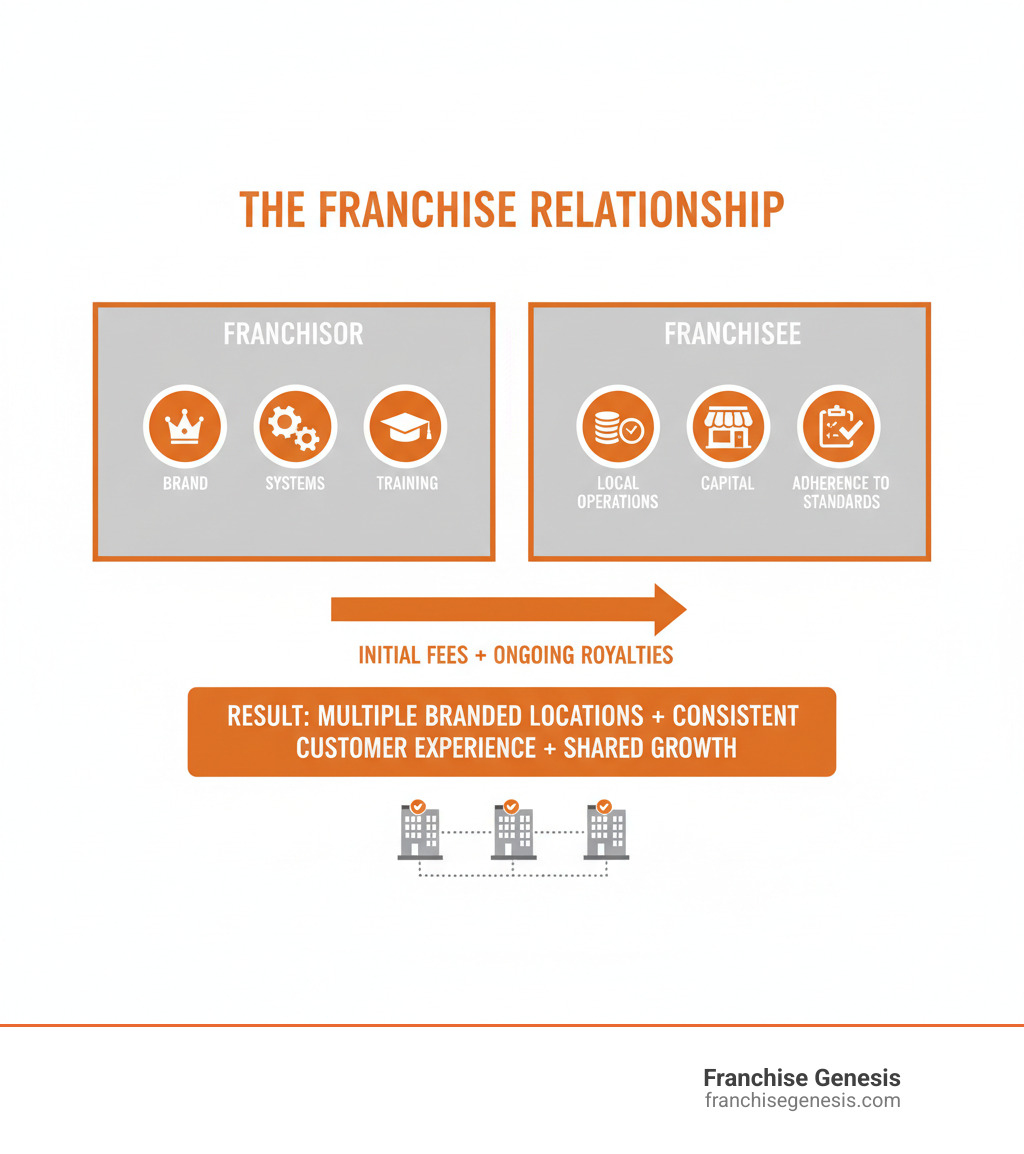
Simple guide to what is a franchise terms:
What is a Franchise? A Blueprint for Business Expansion
You’ve built a successful business with dialed-in systems and loyal customers. Now you’re asking: How do I grow without draining my bank account or working 80-hour weeks? Franchising is a powerful answer.
What is a franchise? It’s a licensing model that lets you clone your success. Instead of opening every new location yourself, you grant entrepreneurs the right to operate your business concept using your brand, intellectual property, and proven systems. In return, they pay you fees and adhere to your standards.
The result is a network of independently owned businesses that look, feel, and operate like yours. Franchisees get a head start with a recognized brand, and you get rapid expansion without the massive capital investment of traditional growth. Every franchisee has skin in the game, creating a level of motivation that’s impossible to get from hired managers.

The Core Components: What is a franchise from a legal standpoint?
Whether you call it a “franchise” doesn’t matter; what matters is if it legally is one. According to The FTC’s Franchise Rule, a business relationship is a franchise if it meets three criteria:
- Trademark Association: The franchisee operates under your brand identity (trademark, logo, etc.). This is why brand consistency is non-negotiable.
- Significant Control or Assistance: You must provide significant control or assistance over the franchisee’s method of operation, such as site selection, training, and marketing. This protects your brand and ensures a consistent customer experience.
- Required Payment: The franchisee must pay you at least $500 within the first six months. This includes the initial franchise fee, royalties, and other contributions.
If your business arrangement meets these three criteria, it’s legally a franchise, and you must comply with federal and state franchise laws. Ignoring these franchise legal requirements can lead to serious penalties.
Business Format vs. Product Distribution Franchising
When people ask what is a franchise, they usually mean business format franchising. This is the most common model, where you license your entire business concept: trade name, products, operating procedures, marketing, and support. It’s a comprehensive, turnkey model for replicating a customer experience.
The other type is product distribution franchising, which focuses on distributing products (e.g., car dealerships, beverage bottlers). The franchisor has less control over the overall business operation. For most service, retail, or restaurant concepts, business format franchising is the appropriate model to replicate a unique operational system.
The Franchisor’s Playbook: How the Model Works
Strategically, franchising is a powerful growth engine. It allows you to expand your brand using other people’s capital, penetrating new markets faster than you could alone. While a competitor saves up to open a second location, you could have multiple franchisees building out units simultaneously.
The model’s brilliance lies in the motivation factor. Franchisees aren’t salaried managers; they are owner-operators who have invested their own savings. Their dedication and entrepreneurial drive are nearly impossible to replicate in a corporate-owned structure.

How Franchisors Generate Revenue
As a franchisor, you build multiple revenue streams that fund your ability to support the network and grow the brand.
- Initial Franchise Fee: An upfront payment (typically $25,000-$50,000+) for the right to join your system. This fee helps cover your costs for recruiting, training, and launching a new franchisee.
- Royalty Fees: Your primary ongoing revenue, usually 4-8% of a franchisee’s gross sales. In exchange, you provide continuous support, system improvements, and brand development.
- Advertising Fund Contributions: Typically 1-2% of gross sales, pooled for national or regional marketing campaigns that benefit the entire system.
- Other Fees: Many systems include technology fees for proprietary software or generate revenue through required product sales or supplier rebates, which helps maintain quality control.
This revenue structure ensures that as your franchisees succeed, you succeed. For more on costs from the franchisee’s view, see our guide on franchise startup costs.
The Two Sides of the Coin: Franchisor and Franchisee Roles
A franchise is a partnership with distinct responsibilities.
The Franchisor’s Role (The Architect):
- Develop and refine the business system.
- Provide comprehensive initial and ongoing training.
- Offer continuous operational support.
- Execute system-wide marketing and brand-building initiatives.
- Drive innovation and protect the brand’s intellectual property. A detailed franchise operations manual is the key tool for communicating standards.
The Franchisee’s Role (The Operator):
- Provide the capital investment for their location.
- Manage all day-to-day operations, including staffing and customer service.
- Strictly adhere to all brand standards and operational procedures.
- Pay all fees (royalties, advertising, etc.) on time.
- Execute local marketing and build a customer base in their community.
This division of labor is powerful: you focus on big-picture strategy, while your franchisees focus on excellent local execution.
Building Your Franchise Empire: Advantages and Considerations
Before dreaming of seeing your logo coast-to-coast, you must honestly assess your business’s readiness. What is a franchise, if not a proven, scalable model? Your concept must be profitable, have strong brand equity, and feature well-documented systems that another person can follow.
You’re at a crossroads: continue corporate growth, shouldering all the cost and operational burden yourself, or choose franchising to leverage others’ capital and energy for faster growth.

The Benefits of Franchising Your Business
The advantages of franchising can be transformative for the right business.
- Rapid Expansion with Less Capital: Franchisees fund their own locations, allowing your brand to grow at a pace that would be impossible with corporate funding alone.
- Motivated Management: A franchisee with their life savings invested will almost always outperform a salaried manager. This owner-operator motivation is a core strength of the model.
- Increased Market Penetration: More locations mean greater brand recognition, creating a growth momentum that makes each new unit easier to launch.
- Reduced Operational Burden: You are freed from the day-to-day management of individual locations. You focus on strategy while franchisees handle local operations.
- New Revenue Streams: Initial fees, ongoing royalties, and marketing contributions create a predictable and scalable revenue model.
- Economies of Scale: As the network grows, your collective buying power increases, lowering costs for supplies, marketing, and technology for everyone.
Explore these advantages further in our guide on the benefits of franchising.
The Challenges and Disadvantages to Weigh
Franchising is not without its challenges. A realistic understanding is crucial.
- Loss of Direct Control: You cannot manage a franchised location directly. You lead through influence, training, and contractual obligations, which is a major mindset shift.
- Permanent Support Obligation: You have an ongoing duty to train, support, and guide your franchisees. This requires a dedicated support infrastructure that grows with your system.
- Legal and Regulatory Complexity: Navigating FTC and state franchise laws is complex and requires specialized legal counsel to avoid costly mistakes.
- Potential for Disputes: Disagreements over territories, performance, or support can arise and may lead to legal conflicts that drain time and resources.
- Initial Investment: Before earning any franchise fees, you must invest significantly (often six figures) in legal documents, operations manuals, and marketing systems.
These challenges are manageable with proper planning and expert guidance. They are steps in the journey, not roadblocks.
The Legal Gauntlet: Navigating Franchise Law and Documentation
When you explore what is a franchise, you quickly learn you’re entering a highly regulated field. Federal (FTC) and state laws (like those in North Carolina) create a transparent framework to protect both you and your franchisees. This is not a DIY project; expert legal counsel is the foundation of a sustainable franchise system.
These regulations aren’t obstacles but a blueprint for building a fair and legally sound system. A great resource for understanding the franchisee’s perspective is the FTC’s A Consumer’s Guide to Buying a Franchise.

The Cornerstone Document: What is a franchise FDD?
The Franchise Disclosure Document (FDD) is the most important legal document in your system. Mandated by The FTC’s Franchise Rule, this comprehensive document must be given to a prospective franchisee at least 14 calendar days before they sign any agreement or pay any money (the “14-day rule”).
The FDD contains 23 required disclosure items, covering everything from your company’s background, litigation history, and all fees and costs to training programs and territory policies. It also includes your audited financial statements and a list of current and former franchisees for due diligence.
The purpose of the FDD is to ensure legal transparency. A well-crafted FDD is a powerful sales tool because it demonstrates that you have a legitimate, well-documented system. Creating one requires specialized legal expertise. Learn more in our guide on the FDD document.
Crafting the Franchise Agreement
While the FDD is for disclosure, the franchise agreement is the binding legal contract governing your long-term relationship with each franchisee.
Key clauses in the agreement include:
- Term Length and Renewal: Defines the contract duration (e.g., 10 years) and the specific conditions a franchisee must meet to earn renewal rights.
- Territory Rights: Precisely defines whether a territory is exclusive or non-exclusive.
- Fees and Payments: Spells out every financial obligation, including royalties and advertising contributions.
- Operational Standards: Legally obligates the franchisee to follow your brand standards, operations manual, and quality control measures.
- Termination and Post-Termination: Outlines conditions for default and termination, as well as obligations like non-compete clauses and de-identification of the business after the contract ends.
This agreement must be drafted by a specialized franchise attorney to protect your brand and create a fair framework for partnership.
Frequently Asked Questions about Franchising a Business
Business owners considering franchising often have the same questions. Here are answers to the most common ones about what is a franchise and if it’s the right move for you.
How much does it cost to franchise my business?
There’s no single price tag, as the cost depends on your business’s complexity. The investment, often recouped from your first few franchise fees, covers several key areas:
- Legal Fees: Your largest upfront cost, for drafting your Franchise Disclosure Document (FDD) and franchise agreement with an experienced franchise attorney.
- Operations Manual Development: Documenting your entire business system into a comprehensive, teachable guide.
- Marketing Materials: Creating a professional franchise sales website, brochures, and other collateral to attract qualified candidates.
- Consultant Fees: Strategic guidance from franchise development experts like Franchise Genesis to help you avoid costly mistakes and accelerate your launch.
For a deeper look, see our guide on how to franchise your small business.
Is my business “franchise-able”?
Not every successful business is ready for franchising. Yours might be if it has these key characteristics:
- A Proven and Profitable Concept: You need at least one corporate-owned location with a strong, consistent track record of profitability.
- Documented Systems and Processes: Your business must be systems-based, not people-dependent. Its operations must be teachable.
- Strong Brand Identity: Your brand should be recognizable and appealing, with a clear value proposition that can resonate in new markets.
- Scalability and Teachability: The concept must be replicable in different markets and simple enough for a new owner to learn and execute successfully.
- Market Demand: There must be evidence of demand for your product or service beyond your current location.
How long does the process to become a franchisor take?
Becoming a franchisor is a strategic process that typically takes several months to a year. The key stages include:
- Strategic Planning (1-3 months): Assessing feasibility, defining the franchise model, and outlining a growth strategy.
- Legal Documentation (3-6 months): Drafting the FDD and franchise agreement with your attorney.
- Operations Manual Development (2-4 months): Capturing your business methodology in a comprehensive guide.
- Marketing and Sales Strategy (1-2 months): Creating the messaging and process to attract and vet quality franchisees.
- Launch and Sales: The ongoing phase where you officially begin selling franchises.
This thorough process is what ensures the long-term stability and success of your franchise system. Explore each stage in our franchise development complete guide.
Conclusion: Is Franchising the Genesis of Your Business’s Future?
So, what is a franchise? It’s a sophisticated growth model that can transform your successful business into a thriving network. It’s about strategically multiplying your perfected concept through partnerships with motivated owner-operators.
The path requires a proven, profitable concept with documented, teachable systems. You must steer the complex legal landscape, from FTC rules to North Carolina state requirements, with an FDD and franchise agreement that protect all parties. You must also commit to providing ongoing training and support to ensure your network’s success.
While there is an initial investment and a shift from direct control to strategic leadership, the rewards can be transformative: rapid, capital-light expansion, motivated partners, increased brand recognition, and new, stable revenue streams.
The question isn’t whether franchising works—the nearly $900 billion it adds to the U.S. economy proves it does. The real question is whether your business is ready and if you have the right partner to guide you.
At Franchise Genesis, we’ve walked this path with countless business owners. We help you evaluate readiness, develop your system, and launch a successful franchise. We are your partners in building something bigger.
Is franchising the genesis of your business’s future?
Ready to expand your brand? Learn how to franchise your business with our expert guidance.