
Why Franchise Legal Requirements Are the Foundation of Your Expansion
Franchise legal requirements are the mandatory disclosure obligations, contractual frameworks, and regulatory compliance steps that franchisors must follow when expanding their business through franchising. In the United States, this involves a dual system of federal and state laws.
Key Legal Requirements for U.S. Franchisors:
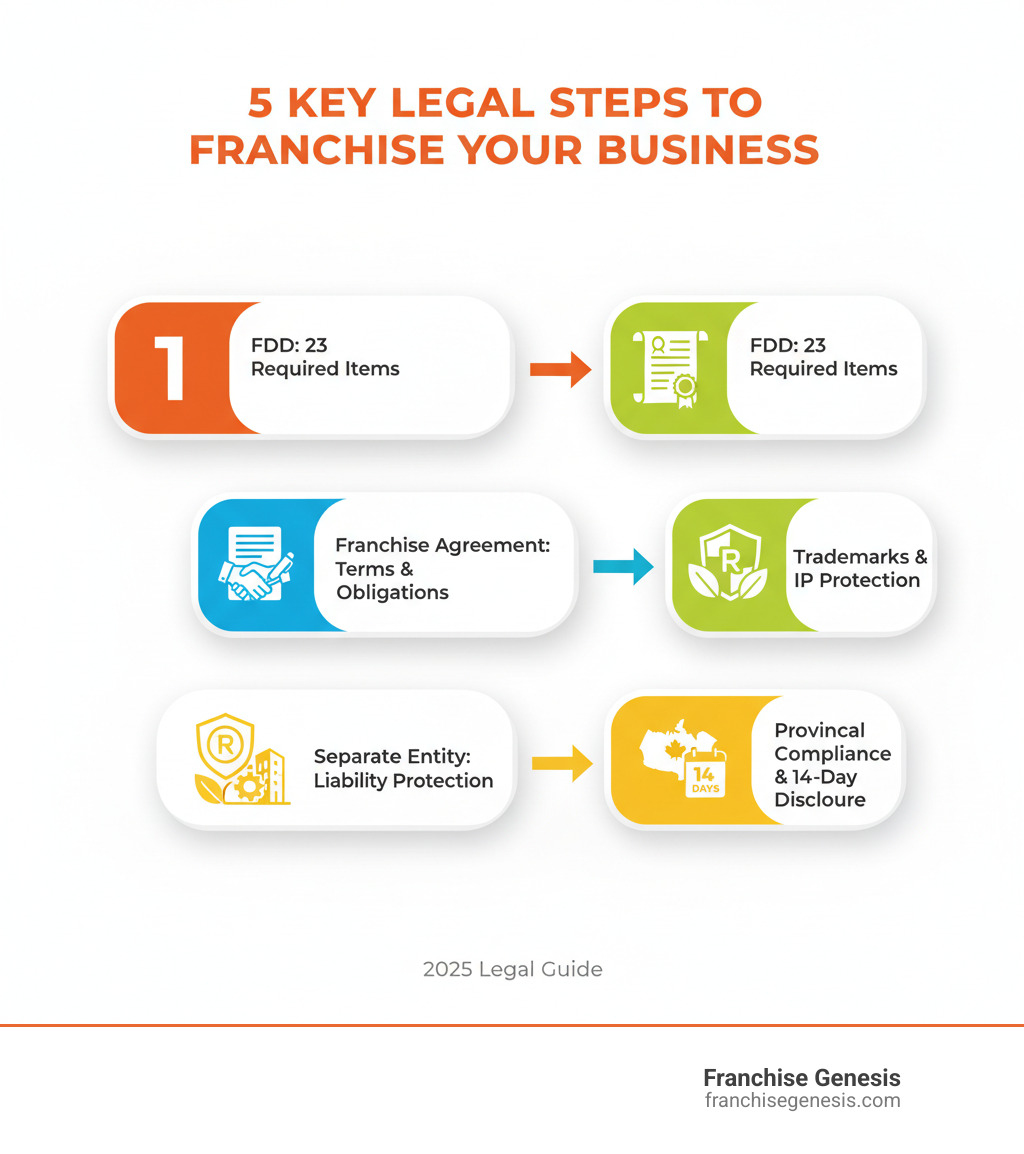
- Franchise Disclosure Document (FDD) – Must be provided at least 14 days before any agreement is signed or money is paid, as required by the federal FTC Franchise Rule.
- Franchise Agreement – The binding contract that governs the franchisor-franchisee relationship.
- State Compliance – Many states have their own franchise laws, with about 14 requiring you to register your FDD with them before you can offer or sell a franchise there.
- Trademark Protection – Federal registration of your brand name, logo, and other intellectual property with the U.S. Patent and Trademark Office (USPTO).
- Corporate Structure – Establishing the right legal entities to protect your existing business from franchising-related liabilities.
- Duty of Good Faith – An obligation, implied in most states, to act honestly and in a commercially reasonable manner in all franchise dealings.
The consequences of non-compliance are severe. Failing to provide a proper FDD or violating state registration laws can give your franchisee the right to sue for damages or rescind the entire agreement, potentially forcing you to refund their entire investment and compensate them for losses.
When you franchise your business, you’re not just teaching someone to replicate your operations. You’re entering a complex legal framework designed to protect prospective franchisees through mandatory disclosure. The federal Franchise Rule sets the national baseline, but a patchwork of state laws adds another layer of complexity, with some states requiring a formal review and registration of your franchise offering.
Many business owners accidentally start franchising without understanding these requirements, exposing themselves to significant financial and legal penalties. One misstep in your disclosure document—whether it’s missing information, incorrect financial statements, or failing to update material changes—can void your franchise agreements and cost you hundreds of thousands of dollars.
As Monique Pelle Kunkle, Vice President of Operations at Franchise Genesis, I’ve guided dozens of business owners through the complex process of understanding and implementing franchise legal requirements, from structuring their first FDD to scaling operations across multiple states. My experience has shown that getting the legal foundation right from the start is the single most important factor in building a successful, sustainable franchise system.
The Foundational Legal Documents: FDD vs. Franchise Agreement

When you decide to franchise your business, you’ll quickly find that two documents form the legal backbone of your entire franchise system: the Franchise Disclosure Document (FDD) and the Franchise Agreement. These aren’t interchangeable—they serve completely different purposes, though both are absolutely essential to meeting your franchise legal requirements.
Many business owners we work with initially think these documents are variations of the same thing. They’re not. Understanding the distinction between them is crucial to building a compliant, sustainable franchise system that protects both you and your future franchisees.
The Franchise Disclosure Document (FDD): Your Pre-Sale Obligation
The FDD is essentially your franchise system’s complete biography—a comprehensive disclosure document that tells prospective franchisees everything they need to know before they invest a single dollar. This isn’t optional reading material or a marketing brochure. It’s a mandatory legal requirement under the Federal Trade Commission’s (FTC) Franchise Rule, designed specifically to enable informed investment decisions.
Think of the FDD as transparency in action. Its sole purpose is pre-contractual disclosure, ensuring that potential franchisees understand exactly what they’re buying into before any money changes hands or contracts are signed. The FTC’s Franchise Rule Compliance Guide outlines precisely what must be included in your FDD.
A compliant FDD contains 23 distinct items covering every aspect of your franchise opportunity. You’ll need to include detailed information about your franchisor background—who you are, your business history, and the experience of your management team. You’ll disclose your financial statements, which may need to be audited. Every fee and cost associated with the franchise must be clearly outlined, from the initial franchise fee to ongoing royalties, marketing contributions, and any other payments franchisees will owe.
Your FDD will also detail territorial rights (if any), explain the training and support you provide, disclose any litigation history, and even list current and former franchisees so prospects can contact them directly. Nothing is hidden. This level of disclosure might feel uncomfortable, but it’s what protects both parties and builds trust from the start.
The FDD isn’t just about compliance—it’s about creating a foundation of honesty that sets the tone for your entire franchisor-franchisee relationship.
The Franchise Agreement: The Rulebook for Your Relationship
While the FDD tells the story, the Franchise Agreement writes the rules. This is the legally binding contract that actually governs your day-to-day relationship with each franchisee. Once someone decides to join your system, the Franchise Agreement becomes the operating manual for how that partnership works.
Here’s where the distinction becomes critical: the FDD is purely informational, while the Franchise Agreement creates legal obligations. The FDD describes what you offer; the Franchise Agreement defines what both parties must do. You must include a copy of your proposed Franchise Agreement as an exhibit in your FDD, so prospects can review the actual contract terms before committing.
Your Franchise Agreement spells out everything in precise legal language. It defines exactly how franchisees can use your brand, trademarks, and proprietary systems. It establishes the standards they must maintain to protect your brand’s reputation. The agreement specifies all royalties and fees, including when and how they’re calculated and paid.
The agreement also covers the term of the franchise relationship—typically five to ten years—and the conditions for renewal. What happens if either party wants out? Your termination clauses address that. What if a franchisee decides to open a competing business after leaving your system? That’s where non-compete clauses come in. These protective provisions are essential for maintaining the integrity and value of your franchise system.
Every right and obligation of both parties lives in this document. It’s the reference point when questions arise, the rulebook when disputes occur, and the foundation that keeps your franchise system running smoothly.
| Feature | Franchise Disclosure Document (FDD) | Franchise Agreement |
|---|---|---|
| Purpose | Disclosure to inform investment decisions | Contract defining the ongoing relationship |
| Timing | Pre-sale (at least 14 days before signing or payment) | At signing (after disclosure period) |
| Content | Standardized information about franchisor, costs, risks, system | Specific terms, rights, obligations, and operational requirements |
Understanding these two foundational documents—and getting them right—is where your franchise journey truly begins. They’re not just paperwork; they’re the legal architecture that makes franchising possible and protects everyone involved.
Navigating U.S. Franchise Legal Requirements
When you’re ready to expand your business through franchising in the United States, you’re stepping into a complex, two-tiered legal landscape. Unlike some countries with a single national law, the U.S. uses a dual system: a federal rule that applies everywhere, supplemented by a patchwork of state-specific laws. Navigating these franchise legal requirements is critical to a successful launch.
The FTC Franchise Rule: The National Standard
The foundation of U.S. franchise law is the Federal Trade Commission’s (FTC) Franchise Rule. This rule applies in all 50 states and has one primary purpose: to ensure you provide prospective franchisees with the information they need to make an informed decision. It mandates the use of the Franchise Disclosure Document (FDD), a comprehensive document outlining 23 specific areas of your franchise system. The FTC doesn’t approve or register your FDD; it simply requires you to prepare it accurately and provide it to a candidate at the right time.
State-Level Compliance: Registration, Filing, and Disclosure
On top of the federal rule, many states have their own franchise laws. These states generally fall into three categories:
- Franchise Registration States: About 14 states, including California, New York, Illinois, Maryland, and Virginia, require you to file your FDD with a state agency for review and approval before you can offer or sell a franchise in that state. This process can take several weeks or months, and state examiners may require changes to your FDD. You must also renew your registration annually.
- Franchise Filing States: A smaller number of states are considered “filing states.” They don’t require a full review and approval process like registration states, but they do require you to file a notice and/or a copy of your FDD with the state, along with a fee.
- Non-Registration States: The remaining states do not have specific franchise registration or filing laws. In these states, you only need to comply with the federal FTC Franchise Rule. However, other state business laws and regulations will still apply.
Understanding Your Disclosure Obligations and Timelines
The heart of U.S. franchise law is disclosure, and timing is everything. The FTC Rule requires you to provide a prospective franchisee with a compliant FDD at least 14 calendar days before they sign any binding agreement or pay you any money. Furthermore, if you make any unilateral, material changes to the final Franchise Agreement, you must provide the final agreement at least 7 days before signing.
What happens if you don’t comply? The consequences can be devastating. The FTC can impose significant financial penalties for violations. More importantly, under state laws, a failure to properly disclose can give your franchisee the right to sue you for damages or even rescind the franchise agreement. A successful rescission claim could force you to refund all fees, buy back inventory, and cover the franchisee’s operational losses, potentially costing you hundreds of thousands of dollars per location.
Building Your Legal & Corporate Framework
Once your foundational documents are in place, it’s time to build the scaffolding that will support your franchise system. This legal and corporate framework isn’t just paperwork—it’s what keeps your brand safe, shields you from unnecessary risk, and gives your franchise system the strength to grow.
Protecting Your Brand: Intellectual Property Essentials
Your brand is the crown jewel of your franchise system. Without proper protection, you’re handing over the keys to your hard-earned reputation.
Trademarks are your first line of defense. While you gain some common law rights just by using your business name, you need to register your trademarks with the U.S. Patent and Trademark Office if you’re serious about franchising. Federal registration gives you exclusive rights to your brand name and logo across the entire country, which is essential for national expansion. Before you file, a thorough trademark search is critical to ensure your chosen name is available and legally protectable.
Your operations manuals and training materials contain the secret sauce that makes your business successful. This confidential information is protected as trade secrets, but only if you treat it that way. You must clearly label these materials as confidential, limit access, and use non-disclosure agreements. Your Franchise Agreement should explicitly define what information is confidential and the consequences of its misuse.
Don’t forget about copyright protection for your creative content—training videos, marketing materials, and website copy. Copyright protection is automatic upon creation, but to fully protect your rights, especially against contractors you hire, you need written agreements that clearly assign all copyright ownership to your company. Overlooking this is a common but costly mistake.
Choosing the Right Corporate Structure
Here’s where you get strategic about protecting your existing business. The corporate structure you choose will determine your risk exposure as you expand.
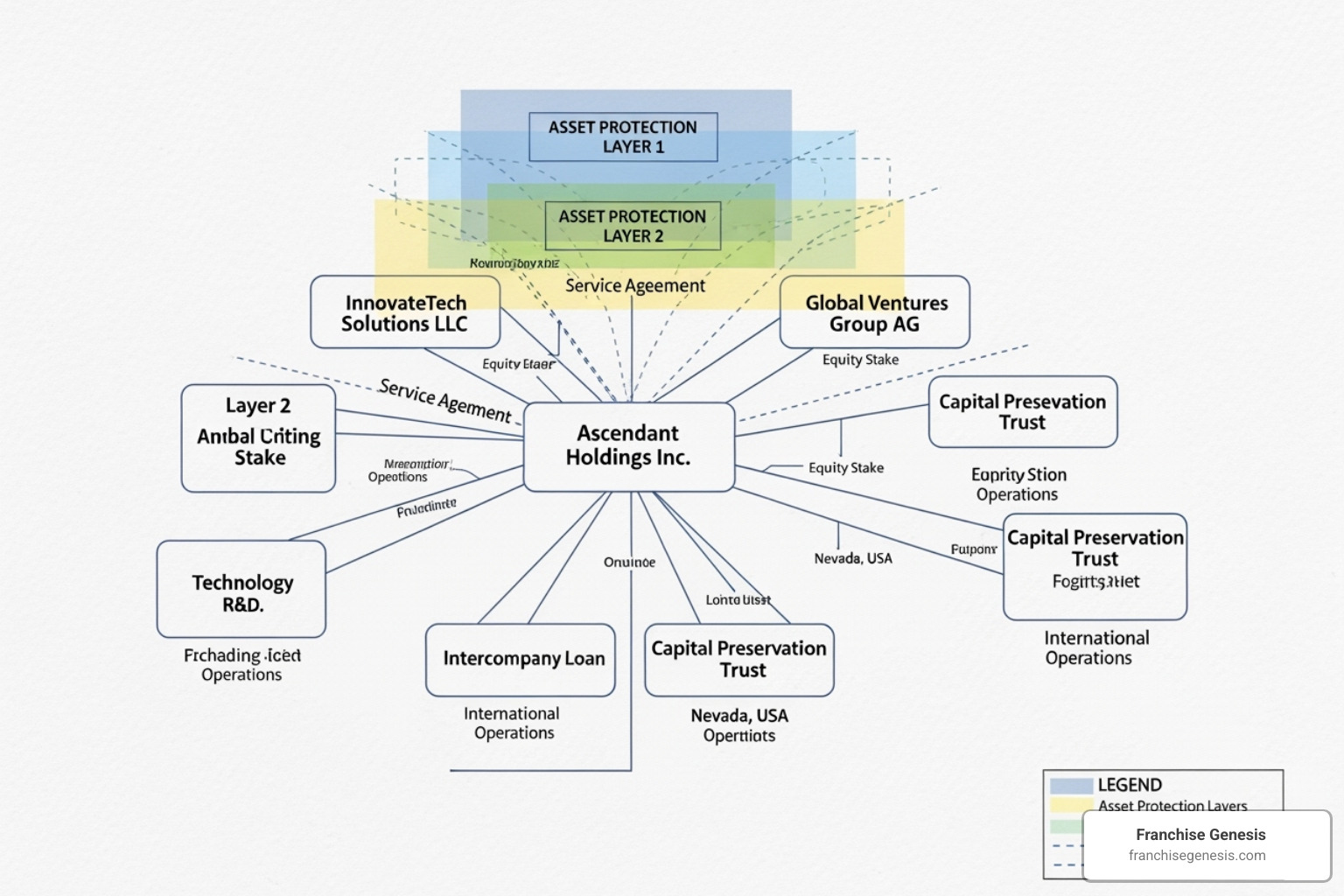
Most successful franchisors create a separate franchising entity—a new corporation or LLC whose sole purpose is to offer and sell franchises. This company becomes the franchisor that signs Franchise Agreements. This creates a legal firewall between your original operating business and your franchising activities. If a franchisee sues, the claim is directed at the franchising entity, not the core business you’ve spent years building.
Some franchisors add another layer of protection by establishing an IP holding company. This separate entity owns all the trademarks and copyrights, then licenses them to the franchising entity. This further insulates your most valuable assets from operational liabilities.
Proper corporate registration in every state where you do business is also a key compliance step.
Antitrust Law and Other Key Legal Requirements
U.S. antitrust laws, like the Sherman Act and Clayton Act, are designed to ensure fair competition, and as a franchisor, you need to understand the rules.
One area that surprises new franchisors is pricing. You can suggest retail prices to your franchisees, but you absolutely cannot force them to charge specific prices. This is called resale price maintenance, and it’s a violation of antitrust law. You can recommend and advise, but you cannot mandate pricing.
Requiring franchisees to buy supplies from you or approved suppliers (exclusive dealing) is generally allowed, but only if the requirement is for maintaining brand standards and doesn’t substantially lessen competition in the marketplace.
Your non-compete clauses are enforceable in most states, but they must be reasonable in their geographic scope, duration, and the activities they restrict. Courts will not enforce clauses that are overly broad. Recently, federal and state regulators have also cracked down on no-poach agreements (preventing franchisees from hiring each other’s employees), so these should be avoided.
Finally, the duty of good faith and fair dealing is a principle implied in contracts in most states. It means you can’t exercise your contractual rights in a way that is malicious or undermines the fundamental benefits your franchisee expected from the agreement. As the party with more power, franchisors must be especially mindful of acting fairly and reasonably.
Frequently Asked Questions about Franchising Your Business
As we guide business owners through the franchising process, we hear the same questions come up time and again. These are smart questions—the kind that show you’re thinking seriously about protecting your business and doing things right. Let me address the most common concerns we encounter.
What are the consequences for failing to provide a compliant Franchise Disclosure Document (FDD)?
This is perhaps the most important question, because the consequences of getting your FDD wrong are severe. Under the FTC Franchise Rule and various state laws, failing to provide a compliant FDD on time can have devastating results.
The FTC can levy significant fines for violations. More directly, a franchisee who was not properly disclosed to may have the right to sue you for damages. In many states, they may also have the right of rescission, which treats the agreement as if it never existed.
If a franchisee successfully rescinds the agreement, you are typically required to refund all the money they paid you—the initial franchise fee, royalties, and other fees. You may also have to buy back their inventory and equipment and compensate them for any losses they incurred while operating the business.
This is why getting your franchise legal requirements right from the very beginning isn’t just a best practice—it’s absolutely essential to protecting your business from catastrophic financial risk.
Do I need to register my franchise in the U.S.?
This is a common point of confusion. The answer is: it depends on the state. The U.S. has a two-tiered system of franchise regulation.
At the federal level, the FTC Franchise Rule requires you to prepare and disclose a compliant FDD to prospective franchisees. However, the FTC does not require you to register or file your FDD with them. This is a disclosure-only requirement.
At the state level, it’s a different story. About 14 states are “franchise registration states.” In these states (which include major markets like California, New York, and Illinois), you must submit your FDD to a state regulatory agency for review and approval before you can legally offer or sell a franchise there. A handful of other states are “filing states,” which require a simpler notice filing.
So, while there is no single national registration, you absolutely must comply with registration requirements in specific states to expand legally. The primary legal obligation is federal disclosure plus state-by-state registration where required.
What is the ‘duty of good faith and fair dealing’ in franchising?
This concept trips up some franchisors because it’s not something you can simply check off a list—it’s an ongoing obligation that shapes how you conduct yourself throughout the entire franchise relationship.
In the U.S., the duty of good faith and fair dealing is a common law doctrine implied in most commercial contracts, including franchise agreements. Some states have also written this duty directly into their franchise relationship laws. It requires both you (the franchisor) and your franchisees to act honestly and with commercial reasonableness in performing and enforcing the agreement.
In practice, it means you can’t use the letter of your contract to behave in ways that are fundamentally unfair or that undermine the spirit of your partnership. For example, if you have the contractual right to approve a franchisee’s proposed location, the duty of good faith means you can’t unreasonably withhold that approval for a malicious or arbitrary reason.
This duty prevents either party from being technically “right” according to the contract while being fundamentally unfair in how they exercise their rights. It’s about maintaining the integrity of the franchise relationship and ensuring both parties honor the partnership their agreement represents.
Conclusion: Partnering for a Legally Sound Franchise Launch
So, here we are at the end of our journey through franchise legal requirements. If your head is spinning a little, you’re not alone! The path to franchising your business is genuinely exciting—it’s about multiplying your success and watching your brand grow beyond what you could achieve alone. But it’s also, as we’ve seen, a path that demands real attention to legal detail.
Think about what we’ve covered together. A compliant Franchise Disclosure Document isn’t just paperwork—it’s your promise of transparency to future franchisees. Your Franchise Agreement becomes the foundation of every relationship you’ll build in your franchise system. Protecting your intellectual property means safeguarding the brand you’ve worked so hard to create. And structuring your corporate framework correctly? That’s about protecting what you’ve already built while creating room to grow.
The complexity is real. Between the federal FTC Rule and the patchwork of state registration and relationship laws, there’s a lot to get right. And the consequences of getting it wrong—FTC penalties, rescission rights, liability exposure, loss of your investment—are serious enough that they should give any business owner pause.
This is exactly why we do what we do at Franchise Genesis. We’ve walked this path with dozens of business owners just like you, changing successful single-location businesses into thriving franchise systems. We know where the pitfalls are, what state regulators look for, and how to build a franchise structure that’s not just legally compliant, but strategically positioned for sustainable growth.
You’ve built something special with your business. Now let us help you expand it the right way—with confidence, legal soundness, and a clear roadmap for success.
Learn more about our services for new franchisors and let’s start this journey together.