Why Franchise Digital Marketing is Critical to Your Growth
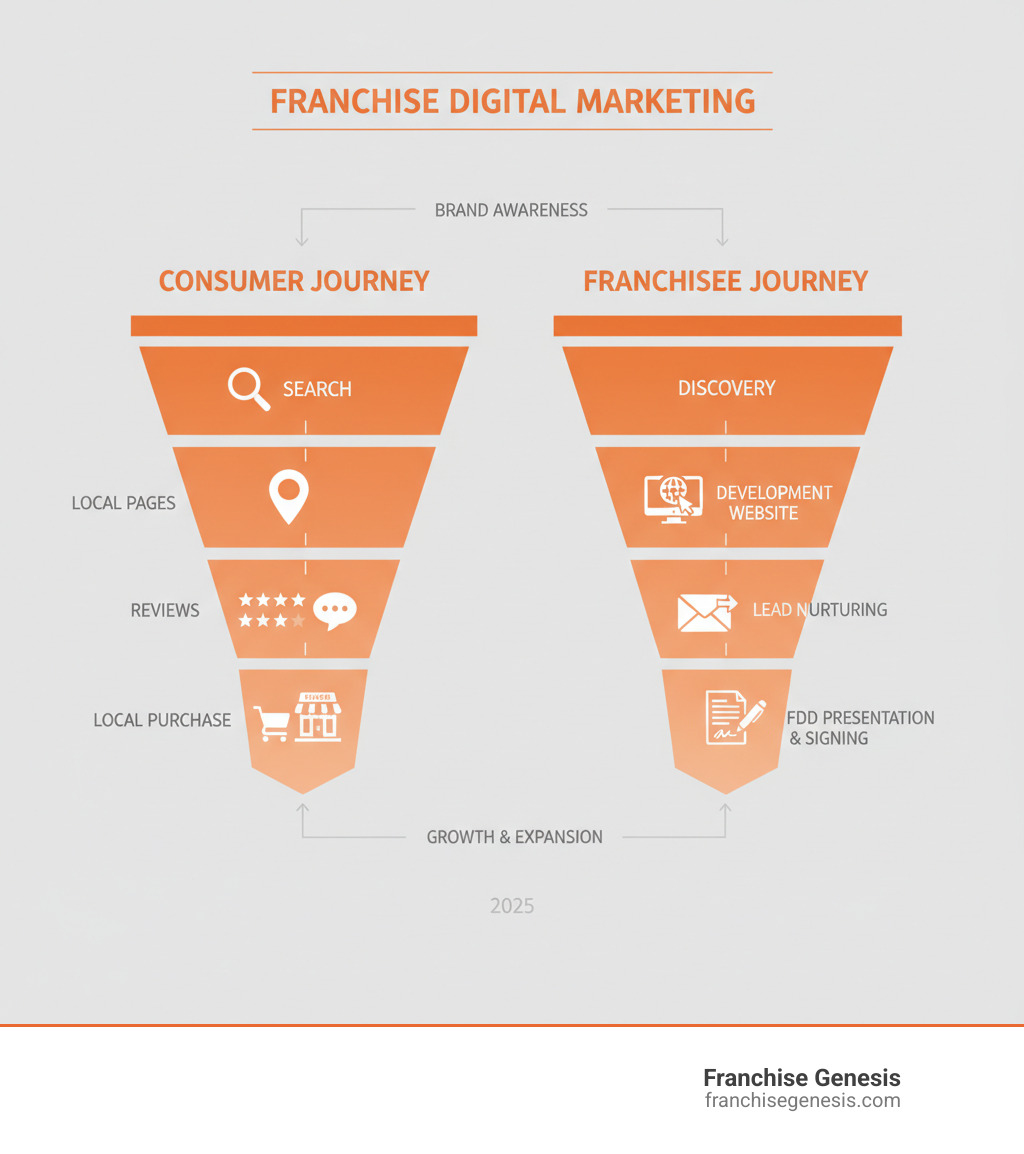
Franchise digital marketing is the strategic promotion of a franchise system to two distinct audiences: customers who buy from your franchisees, and potential franchisees who want to buy into your brand. It involves:
- Operational/Consumer Marketing: Driving customers to franchise locations through local SEO, paid ads, and social media.
- Franchise Development Marketing: Attracting qualified franchisee candidates through targeted lead generation.
- Brand Consistency: Maintaining a unified brand message and identity across all locations.
- Multi-Location Management: Coordinating digital campaigns and analytics across dozens or hundreds of locations.
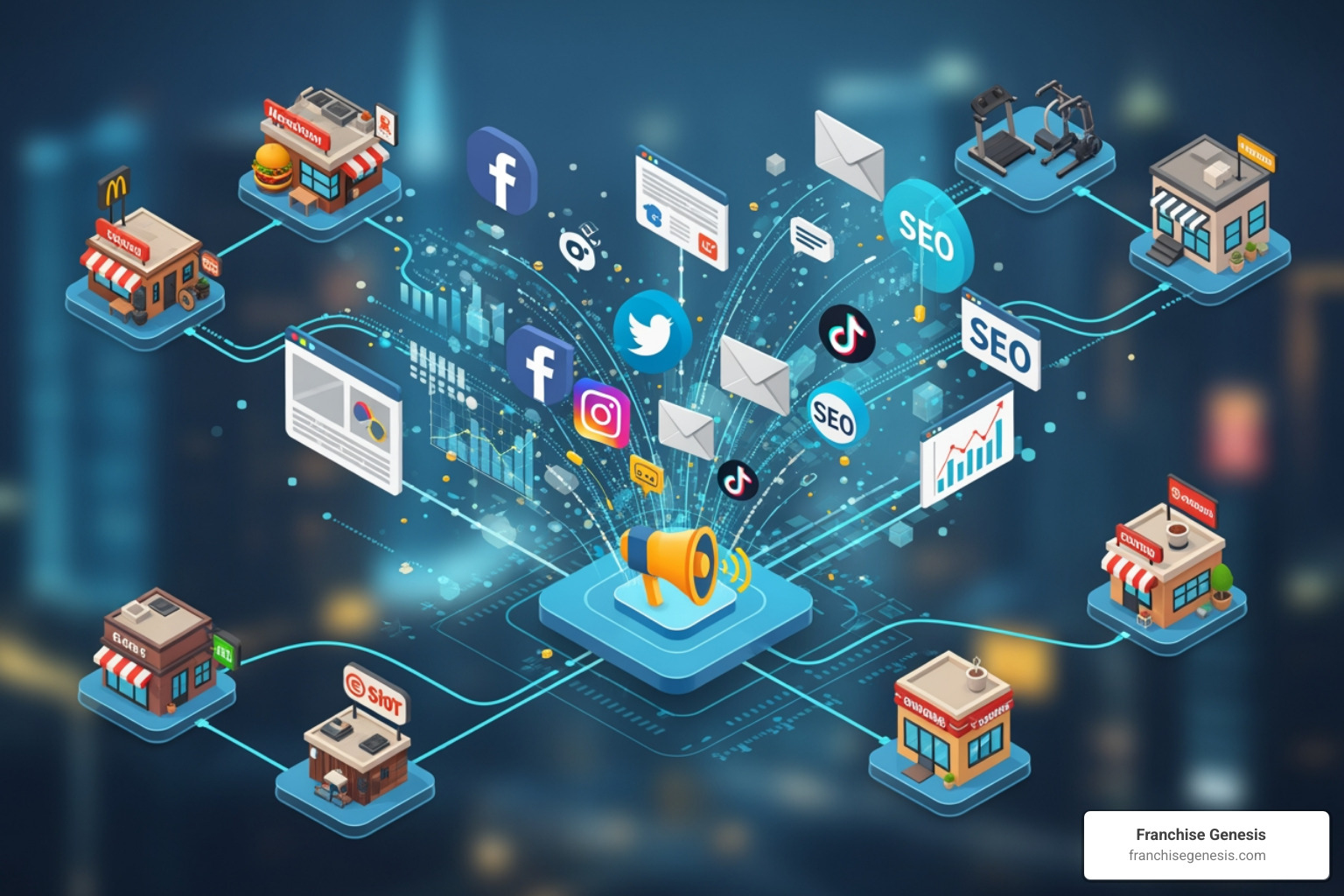
- Integrated Strategy: Combining SEO, PPC, social media, and content marketing for maximum impact.
If you’re franchising your business, you’re entering a $860 billion industry. The challenge is marketing two things at once: you need customers for your franchisees and qualified entrepreneurs to invest in your system.
This dual focus makes franchise marketing different from single-location marketing. You’re building a brand ecosystem that works at both the national and hyper-local level. The key is balancing brand consistency—so a customer in Miami gets the same experience as one in Seattle—with the flexibility for franchisees to adapt to their unique local markets.
Most business owners struggle with this transition. Scaling marketing across multiple owners in different markets requires a new playbook. As Monique Pelle Kunkle, Vice President of Operations at Franchise Genesis, I’ve guided dozens of brands through this challenge. Franchise digital marketing success comes down to building the right foundation, implementing proven strategies for both audiences, and empowering your franchisees with tools they can use.
Franchise digital marketing terms to learn:
The Unique Challenges of Marketing a Franchise System
The marketing approach that built your successful single-location business won’t work when you scale. When you franchise, you must balance national brand consistency with local market relevance. A promotion that works in a college town might flop in a retirement community.
The real challenge is empowering franchisees to win locally without losing control of your brand. Too much freedom creates a disjointed brand identity; too little stifles their ability to respond to local opportunities. This balance is what makes franchise digital marketing unique. Without a centralized strategy, inconsistency can erode customer trust and your bottom line. The solution starts with understanding you’re running two different marketing operations at once.
Operational vs. Franchise Development Marketing
When you franchise, you market to two entirely different audiences with different goals.
-
Operational Marketing (or Consumer Marketing) attracts local customers to your franchisees’ doors. This is the marketing you’re likely familiar with—local ads, search results for “pizza near me,” and promotional emails. The goal is to drive immediate sales for each franchisee.
-
Franchise Development Marketing attracts qualified entrepreneurs to invest in your system. Here, you’re not selling a product; you’re selling a business opportunity. The messaging, channels, and sales cycle are completely different and much longer. Our Franchise Development Complete Guide details how to build this marketing engine.
Confusing these two wastes money and confuses your audience. Each needs its own strategy and budget. Understanding Why You Should Franchise helps clarify these distinct objectives.
Maintaining Brand Consistency Across All Locations
Your brand is a promise of a specific experience. Inconsistency damages trust across the entire system. A rogue franchisee with an “improved” logo can confuse customers and dilute your brand’s value. Brand consistency is the foundation of your franchise’s worth.
-
Centralized Brand Assets: Provide franchisees a digital toolkit with approved logos, imagery, fonts, and messaging. Make it simple for them to access and use.
-
Marketing Templates: Create pre-designed, on-brand templates for social media, ads, and emails that franchisees can customize with local details. This approach is detailed in our Franchise Brand Guidelines.
-
Approval Workflows: Establish a fast, clear process for reviewing localized marketing materials. An efficient system encourages compliance.
-
Brand Voice Training: Your Franchise Operations Manual should teach franchisees how to communicate in your brand’s personality, not just what visuals to use. This training is essential for authentic representation across all digital touchpoints.
One off-brand campaign reflects on your entire franchise system. Building this foundation early is critical to your success.
Building Your Digital Foundation: The Franchise Website Ecosystem
Your single-location website must evolve into a franchise ecosystem that serves your national brand and every individual franchisee. Centralized website management is key. A unified platform saves money, provides better analytics, strengthens SEO by building authority on a single domain, and ensures a consistent customer experience. This consistency drives Accelerated Brand Growth.
Key Components of a Franchise Website
Your franchise digital marketing website ecosystem has several interconnected parts:
- Corporate Site: The main brand hub that tells your story and values.
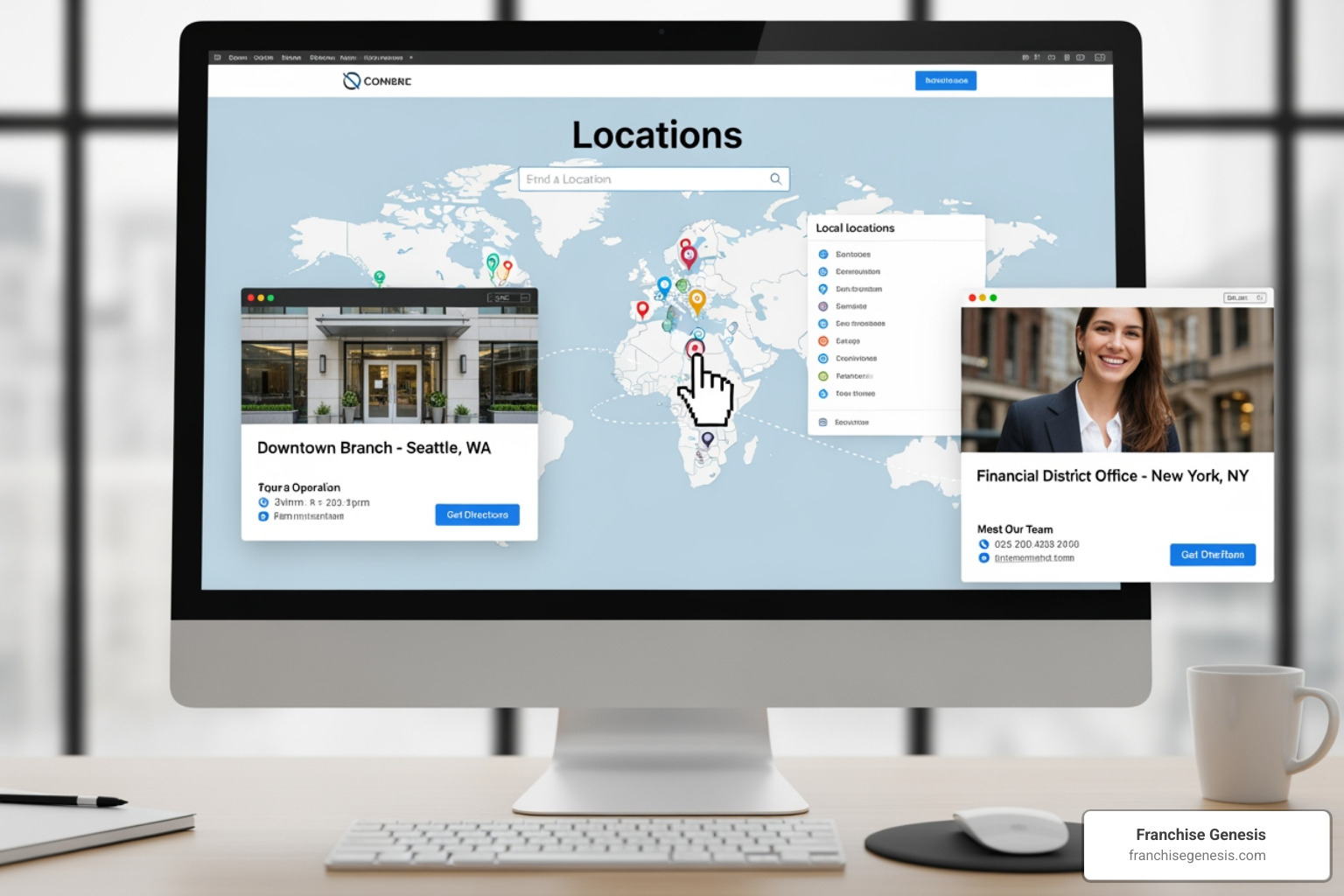
- Local Pages/Microsites: Critical for local SEO, providing location-specific info like address, hours, and services.
- Store Locator: An essential tool for customers to quickly find their nearest location.
- Landing Pages: For targeted promotional campaigns with clear calls-to-action.
- Franchise Development Site: A dedicated section or separate site to attract and educate potential franchisees. Our Franchise Development Services can help build this out correctly.
Local Pages vs. Multi-Page Franchisee Sites
Should each franchisee get a simple local page or a full multi-page site? It depends on your business model.
| Feature | Local Pages (e.g., Quick-Service Restaurants, Retail) | Multi-Page Franchisee Sites (e.g., Home Services, B2B) |
|---|---|---|
| Purpose | Provide essential location-specific info, drive foot traffic, online orders. | Showcase wide range of services, build local expertise, capture leads for complex services. |
| Content Depth | Concise: hours, address, phone, menu/product highlights, simple promotions. | Extensive: team bios, detailed service descriptions, case studies, local testimonials, lead forms, blog. |
| SEO Focus | Google Business Profile, local keywords, NAP consistency, local reviews. | Local SEO + service-specific keywords, long-tail queries, authority building, local content marketing. |
| User Journey | Quick lookup, click-to-call, get directions, order online. | Researching services, comparing options, filling out detailed quote requests, scheduling consultations. |
| Management | Centralized templates, easy updates, minimal franchisee input. | More franchisee involvement for unique content, but still guided by franchisor. |
| Example | A pizza place with pages for “Pizza Huntersville NC,” “Pizza Charlotte NC.” | A landscaping franchise with pages for “Lawn Care Huntersville NC,” “Landscaping Design Charlotte NC.” |
For businesses with a straightforward customer journey like QSR or retail, local pages are perfect. For complex services like home services or B2B, customers need more information to make a decision, making multi-page sites necessary. Even with multi-page sites, you maintain control through templates and brand guidelines.
Technical SEO and Website Optimization
If your site’s technical foundation is weak, you won’t appear in search results. Focus on these key areas:
- URL Structure: Use a logical structure like
www.yourfranchise.com/city/to help users and search engines. - Mobile-Friendliness: With over 60% of searches on mobile and Google’s mobile-first indexing, a mobile-friendly site is non-negotiable.
- HTTPS Security: The padlock icon is a ranking factor and a crucial trust signal for customers.
- Page Speed and Core Web Vitals: Google measures user experience through these metrics. A slow site frustrates visitors and hurts your search rankings.
- Google Search Console: This free tool is your best friend for monitoring site health, finding errors, and identifying performance issues before they impact your rankings.
Getting your digital foundation right allows your franchise digital marketing efforts to compound and succeed.
Core Strategies for Franchise Digital Marketing
With a solid website foundation, you can layer on the franchise digital marketing strategies that drive results. The key is an integrated, data-driven approach where SEO, paid ads, social media, and content marketing work together. This holistic method is central to our Franchise Sales & Marketing philosophy.
The Role of SEO in Franchise Digital Marketing
For franchises, SEO works on two complementary levels:
- National SEO builds brand authority by ranking your corporate site for broad industry terms (e.g., “best pizza franchise”). This builds trust that benefits every location.
- Local SEO drives foot traffic and sales for franchisees. This is about dominating local search results for terms like “pizza near me.” The cornerstone is a fully optimized Google Business Profile (GBP) for every location, which is critical for appearing in the Google Map Pack.
GBP optimization includes accurate information, photos, posts, and a steady stream of customer reviews. Beyond GBP, localized content on franchise web pages helps Google see your location as part of the local community. Our Franchise SEO Consulting Ultimate Guide details these strategies.
Paid Advertising for National and Local Reach
While SEO is a long-term play, paid advertising offers immediate, controlled visibility. We run ads on two simultaneous tracks:
- National Brand Awareness Campaigns: Franchisor-managed campaigns build general brand recognition.
- Geo-Targeted Local Campaigns: These drive direct ROI for franchisees. Using Google Ads, we target specific geographic areas so a local searcher sees the local franchisee’s ad. 63% of people say they click on paid ads.
Social media advertising on platforms like Facebook offers detailed demographic targeting for local customers. For franchise development, LinkedIn is ideal for reaching qualified professionals with the capital to invest.
Social Media and Reputation Management
Social media for franchises is about building community and managing your brand’s reputation. This involves:
- Establishing Brand Guidelines: Give franchisees clear rules on visuals and tone of voice so they can engage locally while staying on-brand.
- Encouraging User-Generated Content (UGC): Customer photos and reviews are authentic social proof. 76% of users have bought a product based on a brand’s social post.
- Review Management: Monitor reviews across all platforms and ensure franchisees respond professionally to all feedback. A professional response to a negative review can build trust. Implementing local review schema on local pages also boosts local SEO.
Content, Email, and SMS Marketing
These channels nurture relationships and drive repeat business.
- Content Marketing: Create valuable blogs, videos, and guides to build E-E-A-T (Experience, Expertise, Authoritativeness, and Trust). Video content is especially powerful and more likely to rank in search results.
- Email Marketing: This channel has one of the highest ROIs, with an average return of $40 for every $1 spent. Use segmented, personalized newsletters to drive customer loyalty.
- SMS Marketing: Use text messages for time-sensitive offers, appointment reminders, and flash sales. Its immediacy and high engagement rates make it incredibly effective.
Corporate can provide templates and campaigns, while franchisees customize them for their local customer base. This is efficient franchise digital marketing in action.
Attracting Your Future Partners: Franchise Development Marketing
While operational marketing brings in customers, franchise development marketing finds your next franchisee partners. This is where your franchise digital marketing strategy shifts from selling products to selling a business opportunity. You’re offering a support system, a proven model, and a path to entrepreneurship.

Investing in a franchise takes months of due diligence, and your marketing must support that journey. This requires different messaging, channels, and a much longer sales cycle than consumer marketing. Our Franchise Lead Generation strategies are built for this unique challenge.
Your Franchise Development Website
Your franchise development website is a prospect’s first serious look at your opportunity. It must inspire confidence and drive action. Key elements include:
- Investment Details: Be transparent about initial investment ranges, fees, and financial requirements. This builds trust.
- Franchisee Testimonials: Nothing sells your opportunity better than success stories from current franchisees. Video testimonials are especially powerful.
- The FDD (Franchise Disclosure Document): Explain what the FDD is and how prospects can access it, showing you operate with integrity.
- Clear Call-to-Action: Make the next step—requesting info, scheduling a call—obvious and easy on every page.
This site is a cornerstone of your strategy to Franchise Your Business Complete Guide.
Lead Generation and Nurturing for New Franchisees
Getting a lead is just the beginning; the real work is in the nurturing phase. This involves building a relationship and guiding candidates through their decision.
- LinkedIn: This is the go-to platform for targeting ideal franchisee candidates. Its professional audience and precise targeting options (by industry, job title, income) ensure you reach qualified prospects.
- Content Marketing: Create content that addresses the concerns of prospective franchisees, such as “What to Look for in a Franchisor.” This positions you as a helpful guide.
- Email Drip Campaigns: Use automated email sequences to keep prospects engaged over the long sales cycle, delivering success stories, financial insights, and training details.
- CRM System: A robust CRM tracks every interaction, allowing for a personalized approach and ensuring no lead falls through the cracks. This systematic process helps Transform Leads Into Loyal Franchisees With A Proven Sales Strategy.
Tools, Teams, and Planning for Success
Effective franchise digital marketing requires a solid plan, the right tools, and the right team. Start with a marketing plan that outlines your goals and key performance indicators (KPIs) for both operational and franchise development marketing. The key is to measure what matters and use analytics to optimize your strategy. A comprehensive Franchise Growth Strategies Guide can help you build this growth engine.
Essential Software and Tools
Managing marketing across multiple locations requires a specialized tech stack:
- CMS (Content Management System): A multi-location CMS lets you manage your corporate site and local pages from one hub, ensuring brand consistency.
- Listings Management Software: This automates updates to your business information (address, hours) across hundreds of online directories, which is crucial for local SEO.
- Social Media Management Tools: These provide franchisees with pre-approved content libraries and templates to stay active and on-brand.
- Paid Advertising Platforms: Centralize ad management to allocate budgets, track performance, and optimize campaigns across all locations.
- Local SEO Tools: Track local search rankings for each franchise location to identify which areas need attention.
In-House vs. Outsourcing to an Agency
Should you manage marketing in-house or outsource to an agency? It depends on your resources and growth stage.
- In-House Team: Offers deep brand knowledge and direct control but comes with high overhead and challenges in scaling specialized expertise.
- Outsourcing to an Agency: Provides specialized expertise, scalability, and access to cutting-edge tools without the overhead. The tradeoff is less direct control.
A hybrid approach often works best for franchises. An in-house team sets strategy and manages franchisee relationships, while an agency handles specialized execution like SEO and paid advertising. Consider an agency if you’re struggling with technical demands, if growth is outpacing your team, or if you need expertise you can’t hire full-time.
Strategic Franchise Consulting can help you make these decisions. And yes, Do Franchise Consultants Offer Marketing Advice? We help you build marketing operations that scale with your franchise system.
Conclusion
Successful franchise digital marketing is about creating a system where national brand consistency and local relevance thrive together. You must market two distinct journeys: one that brings customers to your franchisees, and another that attracts entrepreneurs to your brand.
The digital foundation you build today—a centralized website, solid SEO, and effective tools—determines your growth tomorrow. Empowering your franchisees with the right marketing support creates a virtuous cycle: their local success strengthens your brand, which in turn makes recruiting new franchisees easier.
Navigating the complexities of franchising and building a powerful marketing engine requires expertise. At Franchise Genesis, we’ve guided dozens of brands from single locations to thriving multi-unit systems. We understand that franchise digital marketing is about building a sustainable system that scales with your ambitions.
Whether you’re exploring franchising or ready to accelerate your growth, we provide the strategic guidance and proven frameworks to turn your business into a national brand.