Why Strategic Planning Makes or Breaks Your Franchise System
Franchise strategy development is the blueprint for changing a successful business into a replicable, scalable franchise system. It involves assessing your business for franchisability, defining the franchise structure, creating financial models, developing legal frameworks, building operational systems, and establishing marketing strategies.
Inadequate planning is the primary reason new franchisors fail. The stakes are high: a single percentage point error in your royalty structure can cost millions of dollars over a ten-year franchise term. Yet 85% of the 4,000+ active franchisors never achieve 100 open locations, often because they viewed creating franchise documents as the goal rather than the starting point.
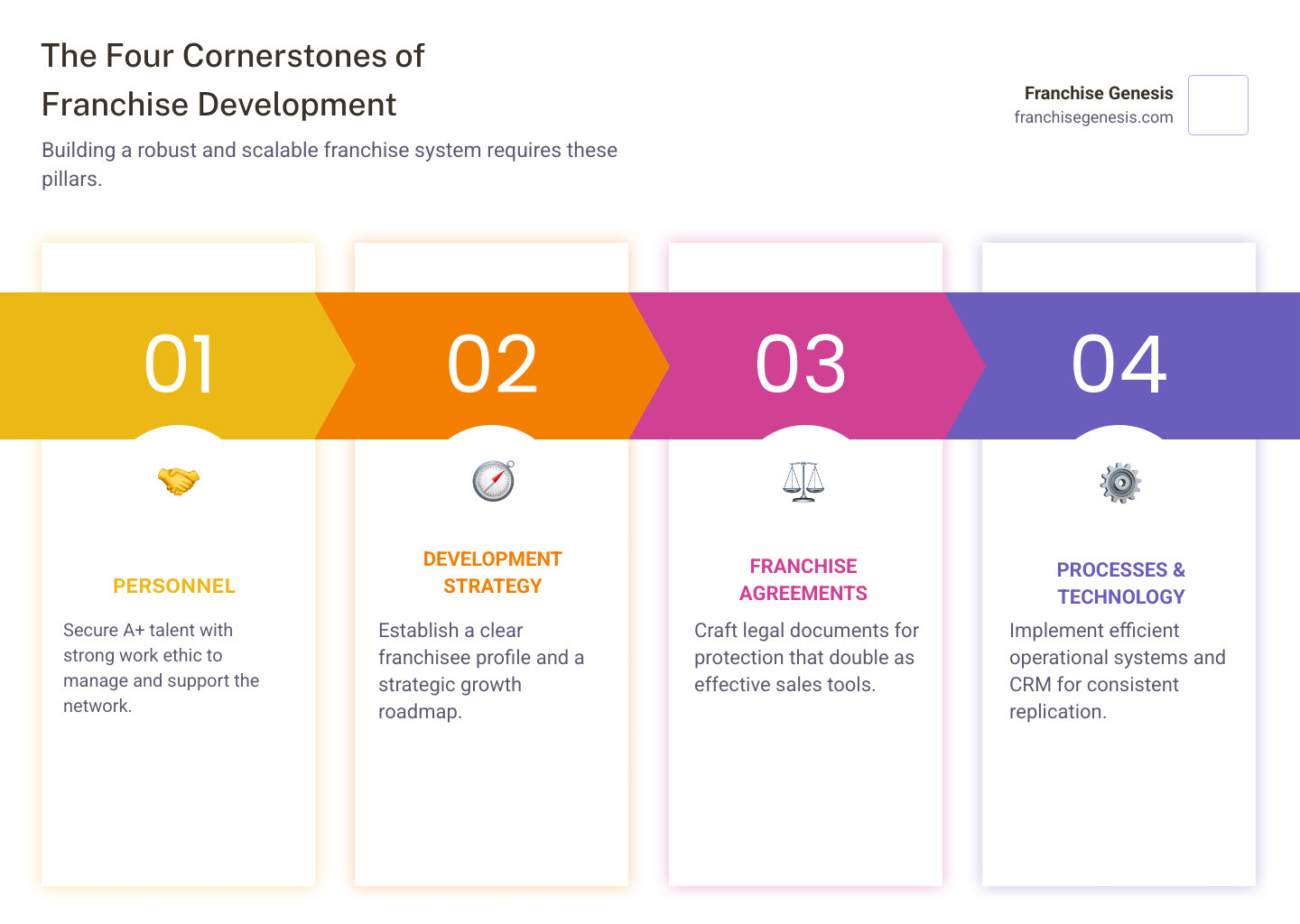
The franchise industry accounts for over $827 billion in economic value in the U.S. alone, but this opportunity demands a sophisticated plan that addresses four critical cornerstones: personnel, development strategy, franchise agreements, and processes/technology.
As Vice President of Operations at Franchise Genesis, I’ve guided dozens of businesses through franchise strategy development, including scaling an ABA therapy franchise to over 100 locations in its first year. My experience shows that successful franchisors are those who invest time upfront in building a solid strategic foundation.
Quick Franchise strategy development definitions:
Is Franchising Your Next Growth Chapter?
There’s a moment in every successful business owner’s journey when growth hits a ceiling. You’ve maxed out your personal capacity, and you’re wondering: What’s next? For many, franchising becomes that next chapter—a way to scale a proven concept without draining your bank account or cloning yourself.
Why Businesses Choose to Franchise
When you franchise, you invite motivated entrepreneurs to invest in your success story. They bring their own capital, local market knowledge, and an owner-operator mentality that’s hard to find in hired managers.
Accelerated brand growth is a compelling reason. Instead of opening one location per year, you could launch many more through franchisees, establishing a market presence faster than through corporate expansion alone. The financial model is also attractive, as franchisees fund their own locations, freeing up your capital to build robust support systems and strengthen the brand. You leverage “other people’s money” to grow while collecting fees and royalties.
Operationally, franchising reduces your direct management overhead. While you provide support and maintain brand standards, the day-to-day headaches fall to the franchisees, allowing you to focus on strategic growth.
Key Indicators of Readiness for a Franchise Growth Strategy
Not every successful business should franchise. Ask yourself these questions first:
- Is your business genuinely profitable? Potential franchisees will scrutinize your financial performance. Your concept needs proven profitability.
- Is your business model replicable? If success depends heavily on your personal skills or daily involvement, you’ll struggle to franchise. The magic must be in the system, not just in you.
- Do you have a strong brand identity? Your brand should resonate with customers and potential franchisees. A Franchise Feasibility Study can help assess your brand’s market appeal.
- Are your systems and processes documented? Everything from customer greetings to inventory management must be in a manual that allows franchisees to replicate your success.
- Is there market demand beyond your current location? You need evidence that customers in other territories want what you’re offering.
Choosing Your Franchise Model
Your franchise model shapes your entire franchise strategy development. The two main types are:
- Business format franchising: You license your entire business system—brand, operating methods, training, and support. This is the most common model, offering high control over brand standards.
- Product distribution franchising: You primarily focus on getting your products to market through franchisees who buy and resell them. Support is less comprehensive. Car dealerships are a classic example.
You’ll also decide on an expansion structure. A single-unit franchise is one location per franchisee. Multi-unit development involves one franchisee opening multiple locations, accelerating growth. For major expansion, a master franchise allows a master franchisee to develop an entire region, acting as a mini-franchisor.
For a deeper dive, check out our Franchise Business Model Complete Guide.
The Four Cornerstones of a Strong Franchise System
A great concept isn’t enough. Successful franchise strategy development requires a solid foundation across four critical areas:
- Personnel: You need A+ talent with a strong work ethic to build your support system. A great company culture and mission attract and retain them.
- Development Strategy: A clear roadmap for growth, including an ideal franchisee profile and a refined recruitment process.
- Franchise Agreements: Your FDD and franchise agreement are legal protections and powerful sales tools that communicate your value proposition.
- Processes and Technology: Robust CRM and operational systems keep your growing network running smoothly and efficiently.
Strengthening these cornerstones creates the foundation for Understanding the Key to Building a Thriving Franchise Network.
Building Your Blueprint: The Core Components of Franchise Strategy Development

Think of franchise strategy development as designing a home. You wouldn’t start building without a blueprint. The same principle applies when turning your business into a franchise system. You need a detailed plan covering everything from the foundation to the finishing touches.
Strategic and Business Plan Essentials
At Franchise Genesis, we help clients build a strategic plan and a business plan. These are living documents that guide growth and answer fundamental questions:
- Expansion: Will you focus on single-unit or multi-unit franchisees?
- Ideal Franchisee: Who are you looking for? Experienced operators or passionate career changers?
- Territory Rights: How will you define and protect franchisee territories?
- Support Structure: What training, operational guidance, and ongoing assistance will you provide?
- Marketing: How will you attract franchisees and help them attract customers?
Your business plan adds the operational detail, including financial forecasting for both franchisor and franchisee, market analysis, fee structure justification, documented operational procedures, and comprehensive training programs.
Competitive Differentiation and Avoiding the Copycat Trap
Many aspiring franchisors make the mistake of copying successful competitors. This is a flawed approach because you’re competing with established brands on their terms, and you might be adopting a strategy that isn’t as successful as it appears.
The real power comes from defining your unique value proposition—what makes franchisees choose you. This could be a superior consumer offer, a more robust support structure, an innovative marketing approach, or a more efficient operational model that delivers higher profit margins. These differentiators are the foundation of a compelling franchise opportunity that attracts the right partners and builds a thriving network.
A Profitable Franchise Strategy Development: Financial Modeling
Getting your numbers right is everything. Too many promising franchise concepts stumble because they rush their financial modeling or guess at fee structures based on competitors.
The Financial Decisions That Define Your Success
Your financial structure has several key components that must work in harmony. These include royalty fees (your primary ongoing revenue), the initial franchise fee (covering your upfront value), an advertising fund for system-wide marketing, and often technology fees for proprietary software. We also help define territorial rights, which directly impact a franchisee’s revenue potential and your royalty income.
Why a Single Percentage Point Can Cost You Millions
Let’s run the numbers on a seemingly small decision. Imagine choosing between a 5% and 6% royalty. For a system with 100 locations averaging $500,000 in annual revenue, that 1% difference is $500,000 in lost annual royalties. Over a ten-year franchise term, that’s $5 million.
It gets worse. When private equity firms value franchise companies, they use earnings multiples. At a 10X multiple, that 1% royalty error just cost you $10 million in enterprise value. This is why precision in financial modeling is non-negotiable.
Building Financial Models That Work for Everyone
Our franchise strategy development process includes sophisticated cash flow modeling to test critical business decisions. We model both franchisor profitability and franchisee ROI simultaneously because a system only thrives when it’s a win-win. If franchisees can’t make money, you won’t succeed. If you can’t fund support, the system collapses.
We use financial sensitivity analysis to stress-test the model against real-world scenarios, like lower-than-projected revenues or higher costs. The goal is a financial structure that’s sustainable, scalable, and profitable for everyone. Our Strategic Franchise Consulting services guide you through this complex process.
Legal and Regulatory Foundations
The legal framework is the non-negotiable foundation of your franchise system.
- The Franchise Disclosure Document (FDD): Mandated by the FTC, this document provides prospective franchisees with comprehensive information to make an informed decision. It’s designed to create transparency and trust.
- The Franchise Agreement: This is the binding contract that defines the rights and responsibilities of both you and the franchisee.
- Intellectual Property Protection: Your brand is your most valuable asset. We help secure trademarks and build IP protection into your agreements.
- FTC and State Regulations: The Federal Trade Commission (FTC) Franchise Rule governs franchise sales in the U.S. Additionally, many states have their own registration and disclosure requirements that add another layer of complexity.
Navigating this legal landscape requires experienced franchise attorneys. Getting it right upfront saves you from exponentially larger problems down the road, a process we cover when Starting a Franchise Company Legally.
The Six-Step Approach to Franchise Strategy Development
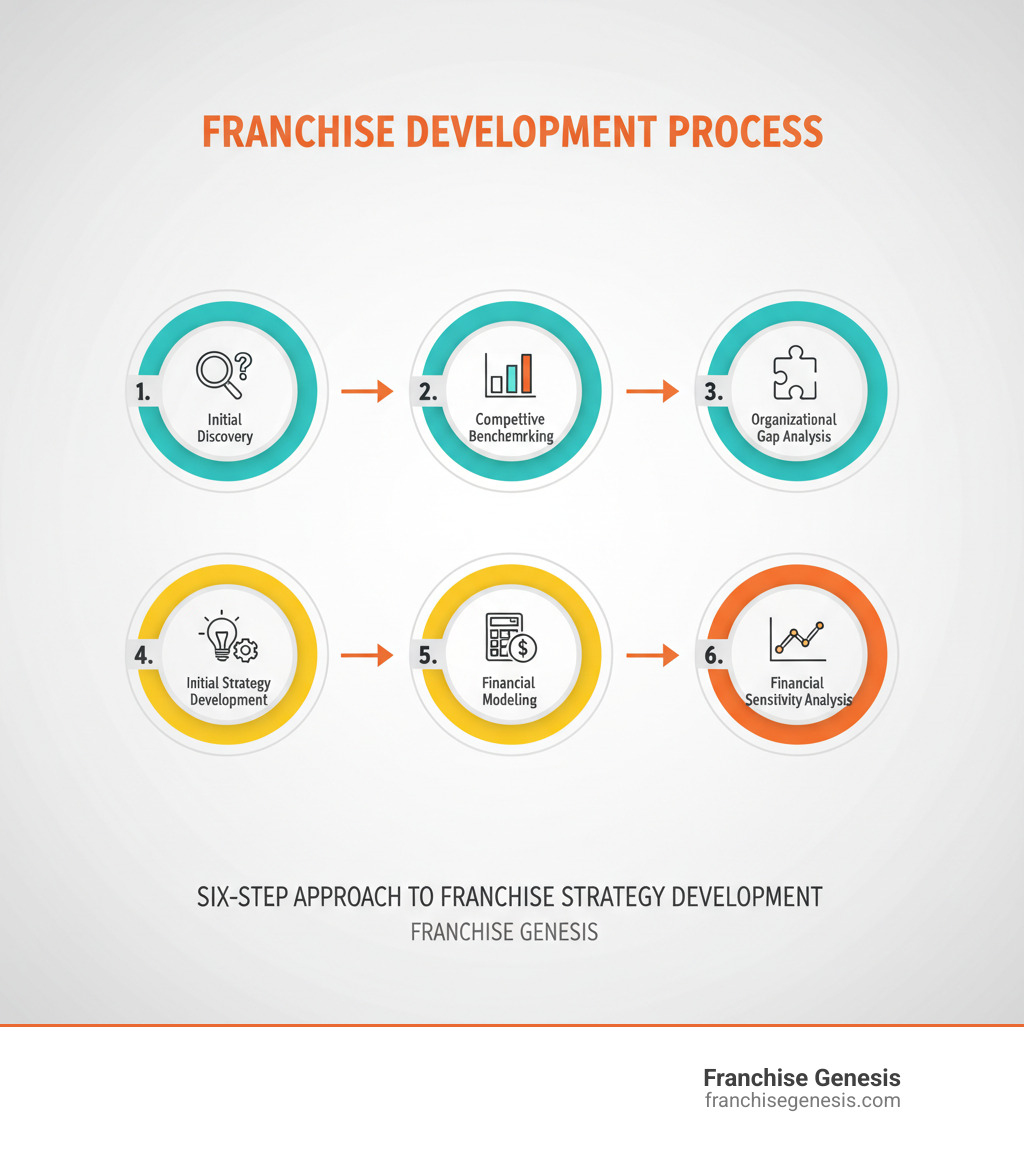
Turning a successful business into a thriving franchise system requires a methodical, strategic approach. At Franchise Genesis, we’ve refined our franchise strategy development process into six distinct steps that create a customized strategy for your unique business.
Franchise developers act as the architects of your franchise system, packaging your intellectual property and brand into a replicable offering. Emerging brands typically benefit from partnering with consulting firms that bring objectivity and specialized knowledge. Our Step-by-Step Franchise Consulting Guide provides additional detail on this journey.
Step 1 & 2: Findy and Competitive Benchmarking
The foundation begins with a deep understanding of your business and the competitive landscape. Initial Findy is where we dig into your operations, culture, and what truly differentiates you. We identify the replicable “secret sauce” of your success. Competitive Benchmarking follows, where we analyze other franchise systems to understand common strategies, fee structures, and support models. This isn’t to copy them, but to find gaps and opportunities where your unique strengths can shine.
Step 3 & 4: Gap Analysis and Initial Strategy
Next, we assess your readiness. Organizational Gap Analysis honestly evaluates what you have versus what you’ll need to support a franchise system—from personnel and documented systems to technology and financial resources. We identify these gaps before they become expensive problems. Initial Strategy Development then brings everything together. We craft your custom roadmap, outlining the franchise model, ideal franchisee profile, fee structures, and support framework, all aligned with your long-term goals.
Step 5 & 6: Financial Modeling and Sensitivity Analysis
The final steps ensure financial viability for everyone. Financial Modeling involves creating a sophisticated cash flow model that projects profitability for both you and your franchisees. This is where we prevent costly mistakes, like the 1% royalty error that can cost millions. Financial Sensitivity Analysis stress-tests these models against various scenarios (e.g., lower revenues, higher costs) to ensure your system is resilient and built for a win-win outcome.
These six steps form the backbone of our comprehensive Franchise Development Services, ensuring you launch with a solid strategic foundation.
Execution and Growth: Marketing, Milestones, and Mistake-Proofing

With your franchise strategy development blueprint complete, execution begins. This is a multi-year commitment requiring patience and persistence. The franchisors who succeed view this journey realistically, understanding that building a thriving network is measured in years, not months. Our Franchise Growth Strategies Guide walks you through this long-term vision.
Franchise Marketing and Sales Strategy
A brilliant concept won’t grow without qualified franchisees. Your marketing strategy must be both compelling and strategic. This starts with a brand identity that tells a story, answering “why you” and “why now.” Defining your ideal franchisee profile sharpens your marketing efforts, allowing you to target your message effectively.
Digital marketing is essential for modern Franchise Lead Generation. Franchise SEO helps prospects find you online, content marketing builds trust, social media showcases your culture, and franchise portals expand your reach to serious buyers.
A Realistic 5-Year Plan for a New Franchise System
Building a sustainable franchise system is a staged process. Avoid the trap of expecting to sell 50 franchises in year one.
- Year 1: Launch and Seasoning. Your goal is to sell 5-10 units to highly qualified pioneers. Their success will validate your model and become your most powerful marketing tool.
- Years 2 and 3: Support and Validation. With your first franchisees thriving, they become your best salespeople through validation calls. You’ll spend this time refining operations and strengthening support systems.
- Years 4 and 5: Acceleration. With a proven model, you can pursue aggressive growth. You’ll diversify marketing, build broker relationships, and work toward “royalty sufficiency”—the point where royalty income covers your operating costs, making you attractive to investors.
Growing from 0 to 50 units is often harder than growing from 50 to 100. This staged approach is strategic and builds a system that lasts. For more, explore our insights on Franchise Growth Strategies.
Advanced Growth: The Extended Ansoff Matrix
Once established, the Extended Ansoff Matrix is a valuable tool for planning your next growth phase.

- Market Penetration: Selling more of your current offerings to existing customers (e.g., loyalty programs).
- Market Development: Taking current offerings to new markets or customer segments. This is the core of franchise expansion.
- Product Development: Introducing new products or services to your existing customer base.
- Diversification: The boldest move—new products for new markets, such as launching a new brand concept.
Applying this matrix to your franchise strategy development helps you manage risk and plan for sustainable growth. Learn more about using the Extended Ansoff Matrix for market challenges.
Frequently Asked Questions about Franchise Strategy
What are the most common mistakes new franchisors make?
After guiding dozens of businesses through franchising, we’ve seen the same avoidable pitfalls. The most common mistakes include:
- Inadequate Planning: Viewing the FDD as the finish line instead of the starting point. The business structure must be fully developed.
- Under-capitalization: Underestimating the investment needed for support, marketing, and infrastructure.
- Poor Franchisee Selection: Awarding franchises to unqualified candidates out of a desire for rapid growth, which leads to long-term brand damage.
- Insufficient Support: Failing to provide the comprehensive training and ongoing guidance franchisees need to succeed.
- Unrealistic Growth Expectations: Expecting immediate, rapid expansion, which leads to “franchise fatigue.” Building a strong system takes time.
- Costly Early Decisions: Small miscalculations, like a 1% royalty error, can compound into multi-million dollar problems over time.
How do I distinguish my franchise from competitors?
Standing out is about amplifying what makes you unique, not copying others. Focus on:
- Your Unique Selling Proposition (USP): What makes your product, service, or model genuinely special?
- Superior Franchisee Support: Exceptional training and operational guidance create happy, successful franchisees who become your best advocates.
- Innovative Technology: Efficient operational platforms or customer engagement tools give your system a competitive edge.
- A Stronger Consumer Offer: The ultimate driver is a product or service that customers prefer over the competition.
- A More Profitable Model for the Franchisee: A financial model with a clear, realistic path to a strong ROI will always attract serious candidates.
What is the difference between a franchise consultant and a franchise broker?
Understanding this distinction is vital. They play completely different roles.
A franchise consultant, like Franchise Genesis, works with business owners to turn their business into a franchise. We are involved in the entire franchise strategy development process—from financial modeling and legal documents to operational manuals and support infrastructure. We help you build the franchise system from the ground up.
A franchise broker acts as a matchmaker, connecting individuals who want to buy a franchise with existing franchise opportunities. They help sell franchises that have already been built, typically earning a commission from the franchisor.
In short, a Franchise Growth Consultant helps you become a franchisor. A broker helps you find franchisees once your system is established.
Conclusion
The journey from a successful local business to a thriving franchise system is both exhilarating and demanding. Effective franchise strategy development isn’t just a helpful tool—it’s the foundation that determines whether your franchise will flourish or flounder.
The stakes are high. A small royalty rate error can cost millions in enterprise value, and a rushed franchisee selection can damage your brand. These are real consequences for those who skip the strategic planning phase.
With the right blueprint, you can avoid these pitfalls. A comprehensive plan addresses every critical element, from financial modeling to franchisee support, changing your business into a replicable system that empowers others to succeed while building long-term value for you.
At Franchise Genesis, we’ve seen how a well-structured strategy accelerates growth. Our experience includes scaling an ABA therapy franchise to over 100 locations in its first year—proof that ambitious goals are achievable with proper planning. We develop customized strategies that honor what makes your business special while positioning it for sustainable growth.
The franchise industry represents over $827 billion in economic value, with plenty of room for well-planned systems. The question isn’t whether franchising can work, but whether you’re ready to invest in building a solid foundation.
Are you ready to transform your successful business into a thriving franchise system? We’re here to guide you through every step.
Take the first step today. Learn more about how we can help you Franchise Your Business and start building your franchise legacy.