
Table of Contents
Short Answer: Franchising lets a proven business grow faster through franchisee investment, repeatable systems, and owner-operator drive. The tradeoff is less direct control and more responsibility for training, support, and brand standards. If you can build a scalable system, franchising is a strong growth path.
This guide breaks down the advantages and disadvantages of franchising so you can decide if the franchise model fits your growth plan.
What Is Franchising and How Does the Franchise Model Work?
Franchising is a business model built on a relationship between two parties: the franchisor and the franchisee. The franchisor owns the brand, the systems, and the rights to license the business. The franchisee pays an initial franchise fee and ongoing royalties for the right to operate a franchise location under that established brand name.
Franchisor vs. Franchisee: Who Does What?
The franchisee handles day-to-day operations at the local level, including hiring, customer service, and running the business on the ground. The franchisor sets brand standards, builds training programs, provides marketing strategies, and improves the franchise model over time.
The pros and cons of franchising both stem from one shift. You are no longer growing by opening locations yourself. You are building a franchise network through other people, and that creates both the biggest upsides and the most common challenges of franchise ownership.
Advantages of Franchising
The advantages of franchising show up most when your concept is proven, repeatable, and in demand across more than one market.
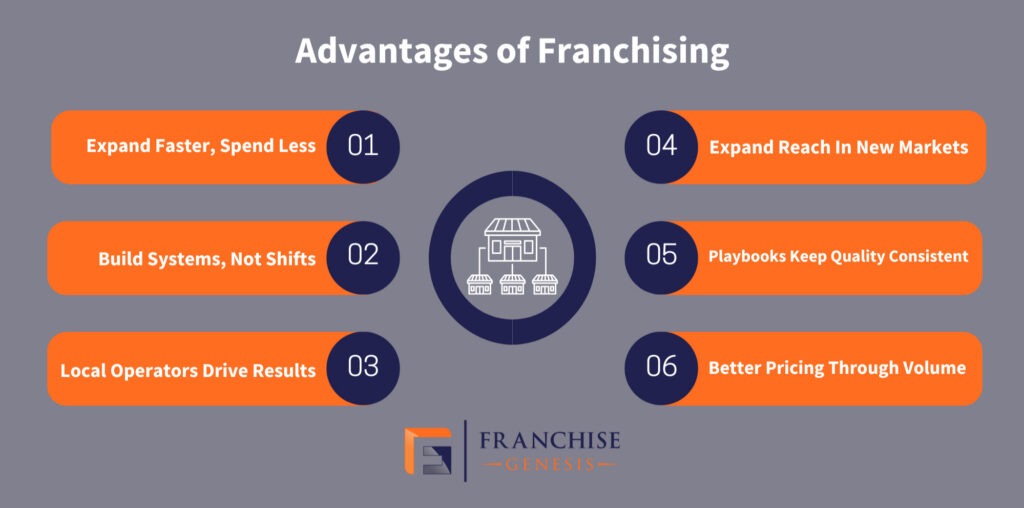
Faster Expansion Without Funding Every New Location Yourself
Instead of funding every new location with your own capital, each franchisee makes the initial investment to open and operate their unit. This creates multiple revenue streams while allowing growth to happen in parallel. Franchising can also reduce early trial and error because franchisees start with a proven playbook rather than building a new business from scratch.
You Shift from Operator to Brand Builder
Franchisees handle local execution and hiring. Your role shifts to building the franchise system, setting standards, creating training programs, and developing marketing strategies. When the franchise business model is built right, this shift frees you to focus on growing the brand instead of managing individual locations. It is also what many business owners underestimate.
Owner-Operators Bring Stronger Local Execution
A franchise owner has personal capital and reputation on the line. That investment often produces stronger performance than remote management by a corporate team. Franchisees build local relationships and stay closely connected to daily operations. This advantage of franchising works best when you have a strong selection process for choosing the right potential franchisee.
Brand Recognition Grows with Each New Unit
Every new franchise location is a new point of brand recognition and local marketing presence. Brand consistency plays a major role here. When customers get the same experience at every location, trust builds across the entire franchise network. A single-location business cannot match that pace.
Systems Create Consistency Across Markets
A franchise system runs on playbooks, training materials, and brand standards. These tools help new franchisees deliver the same customer experience from day one. Instead of each franchise location figuring things out on its own, the network benefits from a proven system that has already been refined.
Scale Benefits Like Vendor Leverage and Shared Tools
Larger networks can negotiate better supplier pricing, access shared technology, and pool marketing resources. When a strategy works in one market, it can be shared across all franchise locations. These scale benefits are a major advantage of franchising that standalone businesses rarely access.
Disadvantages of Franchising
These potential disadvantages are manageable, but they are real. The goal is to understand the franchising advantages and disadvantages clearly before you commit.
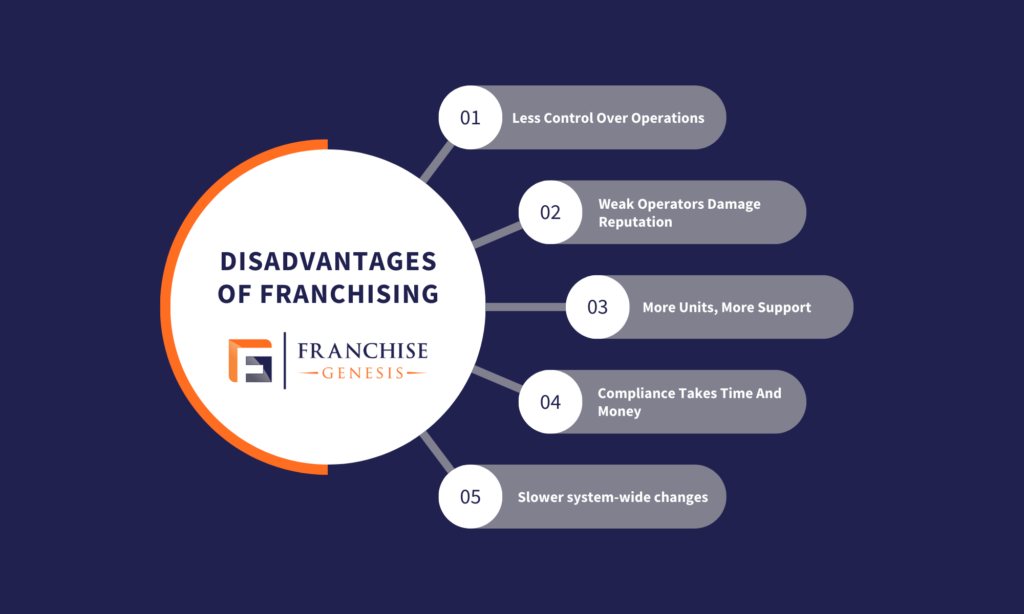
Less Day-to-Day Control at Each Location
You can set brand standards and operating requirements, but you are not running every shift at every franchise location. This is one of the most common disadvantages of franchising. Enforcement depends on training, accountability, and the support infrastructure you build.
Brand Risk When a Franchisee Underperforms
One weak franchise owner can affect how customers perceive the entire brand name. The more franchise locations you have, the faster reputation issues can spread. A clear franchise agreement, strong training, and accountability help manage this risk.
Ongoing Support Never Stops
After the initial fee is collected and the franchise agreement is signed, the real work begins. Training, field support, marketing guidance, and problem-solving are all part of the franchisor’s ongoing responsibility. Ongoing fees like the ongoing royalty and any marketing fee fund this infrastructure, but your bandwidth needs to grow alongside the network. This disadvantage of franchising catches some business owners off guard.
Legal and Compliance Work Adds Time and Cost
You will need a franchise disclosure document (FDD), a franchise agreement, and processes to stay compliant at both the federal and state levels in the U.S. Working with experienced franchise consultants can reduce the complexity. The legal side is not hard forever, but it adds cost during the early stages.
Quick Comparison: Advantages vs. Disadvantages of Franchising
Advantages | Disadvantages |
Faster growth through franchisee investment | Reduced direct control over daily operations |
Owner-operator drive and local execution | Brand risk from underperforming locations |
Increased brand recognition and market reach | Ongoing support load grows with the network |
Consistency through proven systems and standards | Legal and compliance overhead (FDD, state filings) |
Scale benefits like vendor leverage and shared tools | Slower decision-making when rolling out system changes |
Is Franchising the Right Growth Path for Your Business?
Franchising works best when the business model is already producing consistent results and the operations can be taught to someone who did not build them. Before making an informed decision, use these checkpoints.
A Simple Readiness Checklist
- Consistent unit economics and proven demand across more than one market
- Repeatable operations that are not dependent on the founder running every detail
- The ability to train and support new franchisees through onboarding and beyond
- A business opportunity that others would want to invest in as their own business
Signs You Should Pause Before Franchising
- Results vary too much depending on the location or the manager in charge
- Processes live in someone’s head rather than in documented playbooks
- Margins are thin or unpredictable, making the initial investment hard to justify for a potential franchisee
- No plan in place for training, ongoing support, site selection, or accountability
How to Keep the Downsides Small
Build the Franchise System Before You Sell
A proven business model needs to be written down, not just understood by the founder. The more detailed your franchise system is before you start selling, the lower risk your business expansion carries. Working with a franchise consultant during this stage can save significant time and money.
Choose Franchisees Like Long-Term Partners
Selection matters just as much as marketing when building a strong franchise network. Look for candidates with operational discipline, values that match your brand, and coachability. A great potential franchisee wants to be their own boss while following a proven system. The franchise fee and royalty payments should attract serious operators, not just anyone looking for a new business. Due diligence goes both ways.
Next Steps to Franchise Your Business
If you are considering franchising, your next steps usually include documenting operations, validating unit economics, and working through the FDD and franchise agreement process. Most business owners benefit from working with a franchise consultant who can help identify gaps before they become problems.
Want to learn how to franchise my business? Franchise Genesis can help you map the path from proven operator to franchise-ready brand. Our team of experienced franchise consultants works with you to turn a strong existing business into a scalable franchise brand.
FAQs About Franchising Your Business
What is the main advantage of franchising?
The biggest advantage of franchising is the ability to grow faster without funding every new location yourself. Franchisees invest their own capital to open and operate units, which allows the franchise network to expand in parallel while the franchisor focuses on brand building and system improvement.
What is the biggest disadvantage of franchising?
The most common disadvantage of franchising is reduced day-to-day control. You set the brand standards, but franchisees run their own locations. If training and accountability systems are not strong, inconsistency across the franchise network can hurt the brand.
How do royalties work in a franchise?
Franchisees typically pay an initial franchise fee to join the system and ongoing royalties as a percentage of revenue. These royalty payments fund the franchisor’s ongoing support, training, and marketing. Some franchise systems also charge a separate marketing fee that goes toward national or regional advertising
What is a Franchise Disclosure Document (FDD)?
A franchise disclosure document is a legal document that franchisors in the U.S. are required to provide to potential franchisees before any agreement is signed. It includes details about fees, obligations, financial performance, litigation history, and other information that helps buyers complete their due diligence before committing to franchise ownership.