
Understanding the Financial Reality of Franchising Your Business
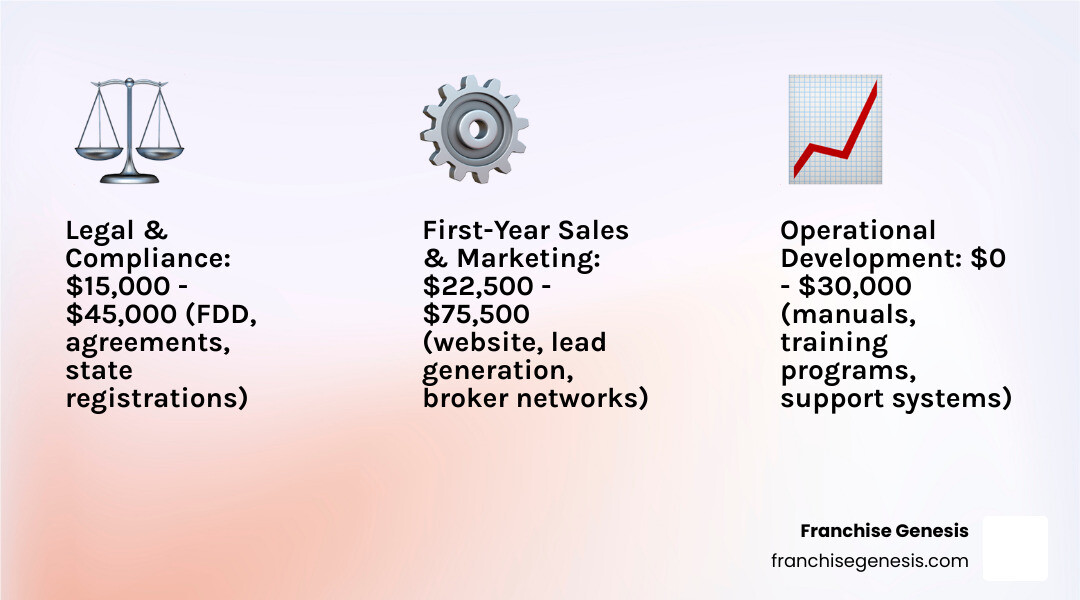
The cost to franchise your business typically ranges from $48,500 to $160,000 in the first year. This covers legal requirements, operational development, and initial sales efforts. Here’s a breakdown of the core investment categories:
- Legal & Compliance: $15,000 – $45,000 (FDD development, franchise agreements, state registrations)
- Operational Development: $0 – $30,000 (operations manual, training programs, support systems)
- Financial Setup: $2,500 – $5,000 (audited financials, new corporate entity)
- First-Year Sales & Marketing: $22,500 – $75,500 (website, lead generation, broker networks)
Many business owners believe franchising requires millions, but that’s often not true. While some online estimates include multi-year budgets, the actual cost to franchise begins with a more manageable legal and foundational framework—typically between $26,000 and $84,500.
The real question is whether you understand what you’re paying for and how to phase your investment. Some costs, like your Franchise Disclosure Document, are mandatory upfront, while others can be scaled over time.
At Franchise Genesis, we’ve guided dozens of business owners through this process. We’ve seen how strategic planning around the initial investment can make the difference between a franchise system that thrives and one that struggles from day one.
Basic Cost to franchise terms:
The Upfront Investment: Core Costs to Franchise Your Business

Before you can sell a franchise, you must build the legal and operational foundation. These upfront costs are not optional; they are the bedrock that transforms your business into a legitimate franchise system, creating a framework that protects you and your future franchisees.
Legal and Compliance Costs
Your legal foundation is critical for avoiding regulatory trouble. The centerpiece is the Franchise Disclosure Document, or FDD. This document discloses 23 specific items about your opportunity, including company history, fees, and franchisee obligations. Creating a compliant FDD requires an experienced franchise attorney and costs between $15,000 to $45,000. This investment is crucial for legal protection and franchisee transparency.
Your Franchise Agreement is the binding contract between you and the franchisee, developed alongside the FDD. You’ll also have State Filing Fees of $1,000 to $4,500 to register your offering in certain states, as detailed in our Franchise Registration States Guide. Finally, Trademark Registration with the USPTO is essential to protect your brand identity.
Operational Development Costs
Next, you must create a replication system. Your Franchise Operations Manual is the comprehensive guide to running the business, covering everything from daily procedures to marketing guidelines. Development can cost $0 to $30,000. While you can write it yourself, professional help is a worthwhile investment to ensure completeness and quality. Learn more on our Franchise Operations Manual page.
Your Franchisee Training Program must be structured to turn a novice into a competent operator, using training materials and hands-on exercises. You’ll also establish Support Systems like field support and helpdesks to ensure ongoing franchisee success.
Financial and Administrative Setup
Becoming a franchisor requires a proper financial framework. You’ll need Audited Financial Statements from a CPA for your franchisor entity, which typically cost $2,500 to $5,000. Most franchisors also establish a New Corporate Entity to separate franchising operations from the original business, providing legal protection. You will also need specialized Accounting Systems to track franchise-specific revenue like fees and royalties.
Our guide on How to Franchise My Small Business walks through these steps in greater detail. Cutting corners on these upfront costs builds your franchise on shaky ground.
Building Your Financial Model: Setting Fees and Estimating Investments

After building your legal foundation, you must structure the financial relationship with your franchisees. This involves creating an offer that is attractive to operators and generates sustainable revenue. Setting fees correctly is critical: too high, and you’ll deter candidates; too low, and you can’t support your network.
Determining Your Franchise Fees
Your fee structure is your economic engine. The Initial Franchise Fee is a one-time payment for the right to use your brand and system, typically covering initial training and opening support. Fees generally range from $20,000 to $50,000. Our Franchise Fee Complete Guide details how to set this fee.
Royalty Fees are your ongoing revenue, usually 5% to 9% of gross sales. They fund your continued support, training updates, and system-wide innovations. Advertising Fund Contributions, also a percentage of sales, are pooled for system-wide marketing campaigns that benefit all franchisees. When setting these fees, Competitor Benchmarking is essential to understand market expectations and position your offer’s value correctly.
Estimating the Franchisee’s Initial Investment (Item 7)
Your FDD’s Item 7 must provide a complete financial roadmap for a franchisee to open their location. This transparency builds trust and attracts prepared candidates.
This estimate includes:
- Real Estate Costs: Leasehold improvements, security deposits, or construction costs.
- Equipment & Supplies: All physical assets needed to operate, from kitchen equipment to POS systems.
- Initial Inventory: Products and materials needed to open for business.
- Working Capital: A critical cash cushion to cover bills for the first few months before profitability. We recommend funds for at least three months of operating and living expenses. Underestimating this is a common and costly mistake.
- Grand Opening Marketing: The initial budget to announce the new location and drive first customers.
- Other Costs: Utility deposits, business licenses, insurance, and professional fees.
Accuracy in these estimates is vital. A thorough Franchise Feasibility Study helps you project these figures with confidence, ensuring your franchisees are financially prepared for success.
Budgeting for Growth: First-Year Sales and Marketing Costs

Once legally structured, you must budget to attract your first franchisees. If nobody knows your opportunity exists, you won’t sell any franchises. First-year franchise sales costs can range from $22,500 to $75,500. This is the investment required to generate qualified leads and convert them into partners.
Building Your Sales Infrastructure
Before advertising, you need a sales machine. Your Franchise Sales Website is the first impression, a dedicated portal showcasing your concept and capturing leads. A professional site costs between $2,500 and $15,000. Brand Positioning defines your unique selling proposition, informing all marketing materials. You’ll also need professional Sales Presentations and a CRM Setup to manage your sales pipeline and track inquiries, which is crucial when working with franchise brokers.
Our Franchise Sales Marketing guide provides more strategies for building this infrastructure.
Marketing and Lead Generation
With your infrastructure ready, it’s time to generate leads. This is an ongoing investment.
- Paid Advertising (PPC): Platforms like Google Ads and social media can generate leads quickly but can be costly.
- Public Relations (PR): Getting featured in business or franchise media builds credibility and third-party validation.
- Franchise Portals: Online directories like Franchise.org are standard for listing your opportunity, usually for a fee.
- Franchise Broker Networks: Brokers match pre-qualified candidates with your brand. While you pay a commission on success, it’s an effective channel for serious investors.
The right mix of channels depends on your concept and budget. Our Franchise Lead Generation page explores these strategies in greater depth. This investment turns your legal structure into a growing network.
Frequently Asked Questions about the Cost to Franchise
This section provides quick answers to common questions business owners have about the cost to franchise.
What are the total initial costs to franchise a business?
The total estimated first-year cost to franchise ranges from $48,500 to $160,000. This covers:
- Legal & Compliance: $15,000 – $45,000
- Operational Development: $0 – $30,000
- Financial & Admin Setup: $2,500 – $5,000
- First-Year Sales & Marketing: $22,500 – $75,500
You don’t need to spend this all on day one. While legal costs are mandatory upfront, sales and marketing can be scaled. This phased approach helps manage cash flow. Our Franchise Startup Costs guide offers more detail on managing these expenses.
What legal and administrative costs are involved in the cost to franchise?
These costs are the foundation that protects you and your franchisees. Key expenses include:
- Franchise Disclosure Document (FDD): A federally required document, costing $15,000 to $45,000 to develop with an attorney.
- Franchise Agreement: The binding contract with each franchisee.
- State Registration: Filing your FDD in certain states, with fees from $1,000 to $4,500.
- Trademark Protection: Registering your brand with the USPTO.
- Audited Financials: Required for your FDD, costing $2,500 to $5,000.
These costs ensure you comply with regulations. Learn more in our Franchise Legal Requirements guide and from the International Franchise Association.
How can I finance the cost to franchise my business?
You have several options for financing the cost to franchise your business:
- Business Revenue Reinvestment: Use profits from your existing, successful business to fund your expansion.
- Conventional Business Loans: Secure loans from banks with a solid business plan and financial history.
- SBA Loans: These government-guaranteed loans often have favorable terms and are an excellent option for franchise development.
- Investor Capital: Attract private investors or venture capital, which typically involves giving up equity in your company.
Our Franchise Financing Options Complete Guide digs deeper into these options.
Conclusion: Your Next Step in Business Expansion
Now you understand what it truly takes to franchise your business. We’ve covered the complete financial picture, from legal foundations to operational systems and marketing. The cost to franchise in the first year, typically $48,500 to $160,000, is an investment in a scalable system for brand growth.
Every dollar you invest in a solid FDD, a comprehensive operations manual, or effective lead generation works toward creating multiple revenue streams through franchisee fees and royalties. You’re not just buying services—you’re building an asset.
You’ve already proven your business model works. Franchising provides the legal framework and support structure to share that success while maintaining brand control. However, navigating this process alone is overwhelming. A misstep in legal documentation or an unclear operations manual can cost you far more than getting it right the first time.
This is where expert guidance is crucial. At Franchise Genesis, we’ve helped dozens of business owners transform their operations into thriving franchise systems. We partner with you through every phase—from feasibility and legal development to operations and your first franchise sales. Our goal is to make your franchising journey as smooth and successful as possible.
The question isn’t whether you can afford to franchise. It’s whether you can afford not to explore this powerful growth strategy for your proven business.
Ready to franchise your business? Let’s discuss your brand and map out your path to expansion.