
Why Understanding Franchise Fees Matters for Your Business
Franchise fee structures are the financial foundation of your future franchise system. Structuring these fees is one of the most critical decisions you’ll make when franchising. Get it right, and you create a sustainable revenue model that supports both your growth and your franchisees’ success. Get it wrong, and you risk scaring away qualified candidates with high fees or starving your system of the resources it needs to thrive.
Here’s what you need to know about franchise fees:
- Initial Franchise Fee: A one-time payment (typically $20,000-$50,000) that grants franchisees the right to use your brand and system
- Ongoing Royalty Fees: Recurring payments (usually 4-8% of gross sales) that fund continuing support and system operations
- Advertising/Marketing Fees: Contributions (typically 1-4% of revenue) that build brand awareness and drive customer traffic
- Other Fees: May include technology fees, training fees, renewal fees, and audit costs
The franchise fee isn’t just about revenue—it’s about creating value. Think of it as the cost of entry: a license for franchisees to own and operate your proprietary business system. Your fee structure communicates the value of what you’re offering while ensuring you have the resources to deliver on your promises.
As Vice President of Operations at Franchise Genesis, I’ve helped dozens of business owners structure their franchise fees strategically, including scaling an ABA therapy franchise to over 100 locations within its first year. Throughout my career, I’ve seen how a well-designed franchise fee structure creates the foundation for sustainable growth for both franchisors and franchisees.
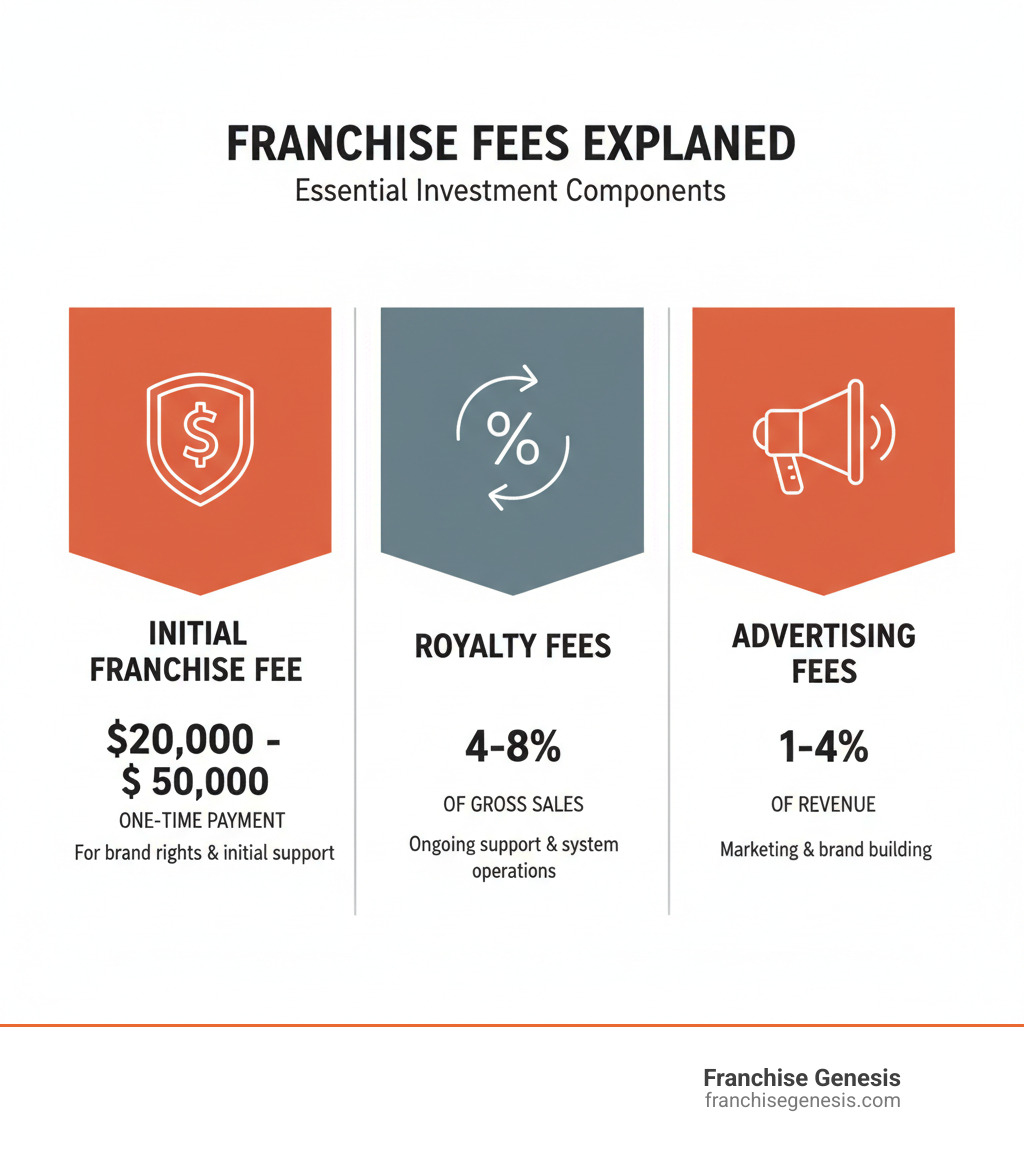
Essential franchise fee terms:
Deconstructing the Franchise Fee: What Are You Charging For?
Before setting a price, it’s crucial to understand what a franchise fee represents. It’s the financial exchange that makes your franchise system possible, allowing you to deliver real value. Franchisees pay for access to your established brand, proven systems, and hard-won expertise. They are paying to skip the painful learning curve of starting from scratch and adopt a successful business model. Understanding What is Franchising? clarifies that these fees are the fuel for everything from initial training to ongoing innovation. The revenue allows you to provide comprehensive support, including training, operations manuals, marketing, and field support. Without properly structured fees, you can’t deliver the value that attracts franchisees.
The Initial Franchise Fee
Your initial franchise fee is the one-time payment that kicks off the franchisor-franchisee relationship. It grants the right to operate under your brand, use your trademarks, and follow your proven systems. Most franchisors charge between $20,000 and $50,000, though this varies by brand strength and industry.
This initial fee is typically not a major profit center; many franchisors barely break even on it. Its real purpose is cost recovery. The fee covers the comprehensive support you provide in the first few months: training, site selection, lease negotiation, and pre-opening support. Franchisees also gain access to your Franchise Operations Manual, proprietary technology, supplier relationships, and marketing materials. Think of it as an investment in a long-term partnership, with real profitability coming from ongoing fees.
Ongoing Fees for a Sustainable System
If the initial fee gets franchisees started, ongoing fees keep the system thriving. These recurring payments fund continuous support, innovation, and brand-building.
Royalty fees are the backbone of ongoing revenue, typically a monthly payment of 4% to 8% of a franchisee’s gross sales. These fees fund field support, R&D, ongoing training, and quality control reviews. As franchisee sales grow, so does your ability to reinvest in the system, creating a win-win.
Advertising and marketing fees (usually 1% to 4% of gross sales) pool resources for marketing power that individual franchisees couldn’t afford alone. These funds support regional and national campaigns that drive customers to every location. This collective buying power is one of the key Benefits of Franchising.
Some franchisors also charge technology fees to maintain and improve shared digital infrastructure like POS systems or proprietary software, ensuring franchisees have cutting-edge tools without bearing the full development cost.
Disclosing Your Fees: The FDD
The Franchise Disclosure Document (FDD) is a legally required document under the FTC Franchise Rule. It ensures complete transparency, and you must provide it to prospective franchisees well before they sign or pay anything.
Your fees are detailed in three key sections:
- Item 5 breaks down the initial franchise fee: the amount, due date, refundability (usually non-refundable), and what it covers.
- Item 6 lists all other fees, including royalties, advertising, technology, transfer, renewal, and audit costs.
- Item 7 provides a comprehensive estimate of the total initial investment, including your fee plus real estate, equipment, inventory, and working capital.
The FDD is your opportunity to build trust. Being clear about all financial obligations demonstrates integrity and prevents future conflicts. Our detailed FDD Document guide walks you through this critical document. Transparency from day one sets the stage for a successful franchisor-franchisee relationship.
How to Strategically Calculate Your Franchise Fees
Setting your franchise fees is a strategic decision, not a guessing game. The goal is to find a financial balance where franchisees can build profitable businesses while you generate enough revenue to invest in the brand, support systems, and innovation. This requires careful financial modeling, competitive analysis, and a solid grasp of industry benchmarks.
A Franchise Feasibility Study helps dig into your business economics to determine what the market will support, what competitors charge, and what it costs to deliver an exceptional franchise experience. The goal is to build a sustainable system where both franchisor and franchisee win.

Calculating the Initial Franchise Fee
Your initial franchise fee should primarily be a cost-recovery model. It’s designed to cover the substantial costs of recruiting, training, and launching a new franchisee.
To determine this number, tally up the real expenses:
- Cost of sales and recruitment: Marketing, lead qualification, and closing efforts.
- Training program development and delivery: Creating materials and conducting initial training.
- Legal and administrative expenses: Preparing your FDD and franchise agreements.
- Site selection and build-out assistance: Helping franchisees find locations and maintain brand standards.
- Initial marketing support: Helping them launch strong in their local market.
Beyond these internal costs, market research helps you understand what similar franchises charge. However, it’s more important to demonstrate the value you deliver. A well-justified initial franchise fee is an investment franchisees are eager to make, and it’s an essential foundation when Becoming a Franchisor.
Structuring Your Royalty Fees
Royalty fees fuel your ongoing operations and growth, generating the majority of your profit. These recurring payments fund the continuous support and innovation that keep your system competitive.
- Percentage of gross sales: This is the most common structure, creating a natural alignment of interests. The average is around 6% of monthly revenues, but it can range from 4% to 12% depending on the industry.
- Fixed fee: A flat dollar amount offers predictability but doesn’t scale with performance, which can feel unfair to smaller operators or limit your upside.
- Tiered or variable structure: This can be powerful, such as offering lower rates for higher sales volumes to reward top performers. However, it adds complexity to accounting and legal documents.
The right choice depends on your business model, industry norms, and the level of support you provide. Understanding How Does a Franchise Work? helps design a royalty structure that fits your brand.
Setting Advertising and Marketing Fund Contributions
An advertising and marketing fund pools resources to create campaigns that no single franchisee could afford alone. These contributions, typically 1% to 4% of gross sales, support both national brand-building campaigns and local marketing initiatives.
When setting these contributions, think strategically about your marketing plan. What campaigns will the funds support? How will you allocate them between digital and traditional media? The goal is a cohesive brand presence that benefits every location. A properly funded marketing campaign builds brand recognition and drives customer traffic to all your franchisees. For more insights, explore our guide on Franchise Sales Marketing.

The Legal and Operational Side of Managing Fees
Once you’ve set your franchise fee structure, you must manage it legally and operationally. This requires proper documentation and systems.
Your franchise agreement is the legal rulebook for all financial obligations. This binding contract spells out when payments are due, how they are made, and the consequences of non-payment. It is critical to have a qualified Franchise Law attorney review this document to protect both you and your franchisees.
Successful franchisors use standardized payment schedules and collection methods, like Electronic Funds Transfer (EFT), for efficiency and accuracy. All financial details must also be exhaustively detailed in your FDD. This transparency, as outlined in FTC resources like its guide for prospective franchisees, builds trust and reduces future conflicts.
The Question of Negotiating Your Franchise Fee
It’s tempting to negotiate your franchise fee to land a great candidate, but for most franchisors, the answer should be a firm “no.” This isn’t about inflexibility; it’s about protecting your system and complying with the law.
FTC regulations require consistency. If you offer a discount to one franchisee, you are legally required to offer that same fee to everyone else. This can create ill will with franchisees who paid full price and lead to compliance issues, requiring you to amend your FDD and offer refunds.
Legitimate fee variations are typically built into the system from the start, not negotiated case-by-case. Examples include volume discounts for multi-unit agreements or introductory pricing for emerging franchise brands. Consistency is essential for your legal protection and reputation. Our Franchise Registration States Guide provides more context on how regulations can vary by location.
What to Do When a Franchisee Fails to Pay
Occasionally, a franchisee may fail to pay their fees. You need a professional and legal plan to handle this.
Non-payment is a breach of contract that affects your ability to support the entire system. Your franchise agreement should outline clear default procedures:
- Communication First: Reach out immediately. The issue could be a simple oversight or bank error that a conversation can resolve.
- Formal Notice of Default: If communication fails, issue a legal notice that the franchisee has violated the agreement, providing a specific timeframe (e.g., 30 days) to cure the breach.
- Legal Action: If the default isn’t cured, you have the right to take legal action. This could mean pursuing unpaid fees, seeking damages, or terminating the franchise agreement.
Termination is the last resort, but it’s a necessary tool to protect the system’s integrity. Franchisees are almost never advised to withhold payments as a form of protest, as the consequences of non-payment are severe and give the franchisor significant legal leverage. Clear documentation and a fair fee structure are your best protection against these situations.
Frequently Asked Questions about Setting Franchise Fees
Here are answers to the most common questions we hear from business owners who are franchising for the first time.
How much profit should a franchisor make from the initial franchise fee?
Very little, if any. The initial franchise fee is not a profit center. Most established franchisors use this upfront payment to break even or simply recover the costs of recruiting, vetting, training, and supporting a new franchisee’s launch. Your sustainable profitability comes from ongoing royalty fees, which are tied directly to your franchisees’ success.
Should I use a fixed percentage or a variable royalty fee structure?
This depends on your business model. A fixed percentage of gross sales is the most common approach because it’s simple, transparent, and scales with the franchisee’s business. A variable or tiered royalty structure can be a strategic tool to reward high performers or ease the burden on new franchisees, but it adds complexity to your accounting and legal documents. Before choosing a variable structure, work with your financial and legal advisors to ensure the benefits outweigh the complexity.
How do I justify my franchise fees to a potential franchisee?
Justification comes from demonstrating undeniable value. Be transparent in your FDD and marketing materials about what the franchise fee covers. Paint a clear picture of what they are buying: access to an established brand, a comprehensive training program, ongoing support, collective marketing power, and a proven business system.
Contrast this with the cost and risk of starting an independent business from scratch. The franchise fee is an investment that dramatically accelerates their path to profitability. The most powerful justification comes from your existing franchisees. During the validation process, encourage prospects to speak with current owners. Hearing about the value and ROI directly from their peers is more powerful than any sales pitch.
Build a Profitable and Sustainable Franchise System
Setting your franchise fees is a foundational step in franchising your business. The right structure requires a strategic balance, ensuring your franchisees can be profitable while generating the revenue you need to support and grow the brand.
A well-structured fee system is the financial backbone of a healthy franchisor-franchisee relationship, aligning everyone’s interests. Your initial franchise fee covers upfront costs, ongoing royalties fund continuous support and innovation, and marketing contributions drive customer traffic to every location.
At Franchise Genesis, we’ve helped dozens of business owners steer this critical decision, seeing how the right structure accelerates growth. The experienced team at Franchise Genesis can help you develop a successful and sustainable fee structure custom to your unique business. We conduct the financial modeling, competitive analysis, and feasibility studies needed to find that strategic sweet spot, ensuring your fees are justified and properly documented.
Ready to take the next step? Franchise your business with confidence, knowing you’ve built a fee structure that supports long-term, sustainable growth for everyone in your system.