
Why Franchise Growth Strategies Matter More Than Ever
Franchise growth strategies are the proven methods businesses use to expand their operations by turning one successful location into a network of many. Instead of facing the massive capital outlay and risk of company-owned outlets, franchising allows you to create royalty streams and partner with motivated entrepreneurs who have skin in the game.
Key franchise growth models include:
- Vertical Integration: Adding multiple locations of the same brand.
- Horizontal Integration: Diversifying with complementary franchise brands.
- Area Development: Securing rights to open multiple units in a defined region.
- Master Franchising: Becoming a regional developer who recruits sub-franchisees.
- Organic Growth: Enabling existing franchisees to open additional locations.
The numbers tell the story: franchise expansion in the USA accounts for over $827 billion in economic value. In 2024 alone, the U.S. added 15,000 new franchise units, bringing the total to 821,000 nationwide. Yet only 16% of franchisors successfully reach 100 locations—the difference comes down to strategy.
Franchising is about systemization, brand consistency, and building a network of aligned entrepreneurs. The challenge is that most business owners don’t know where to start, worrying about losing control, maintaining quality, or choosing the wrong partners.
I’m Monique Pelle Kunkle, Vice President of Operations at Franchise Genesis. I’ve guided businesses through successful franchise launches, including scaling one brand to over 100 locations in its first year. This guide shares the franchise growth strategies that separate thriving networks from stagnant systems.
Handy Franchise growth strategies terms:
Laying the Foundation: Is Your Business Ready to Franchise?
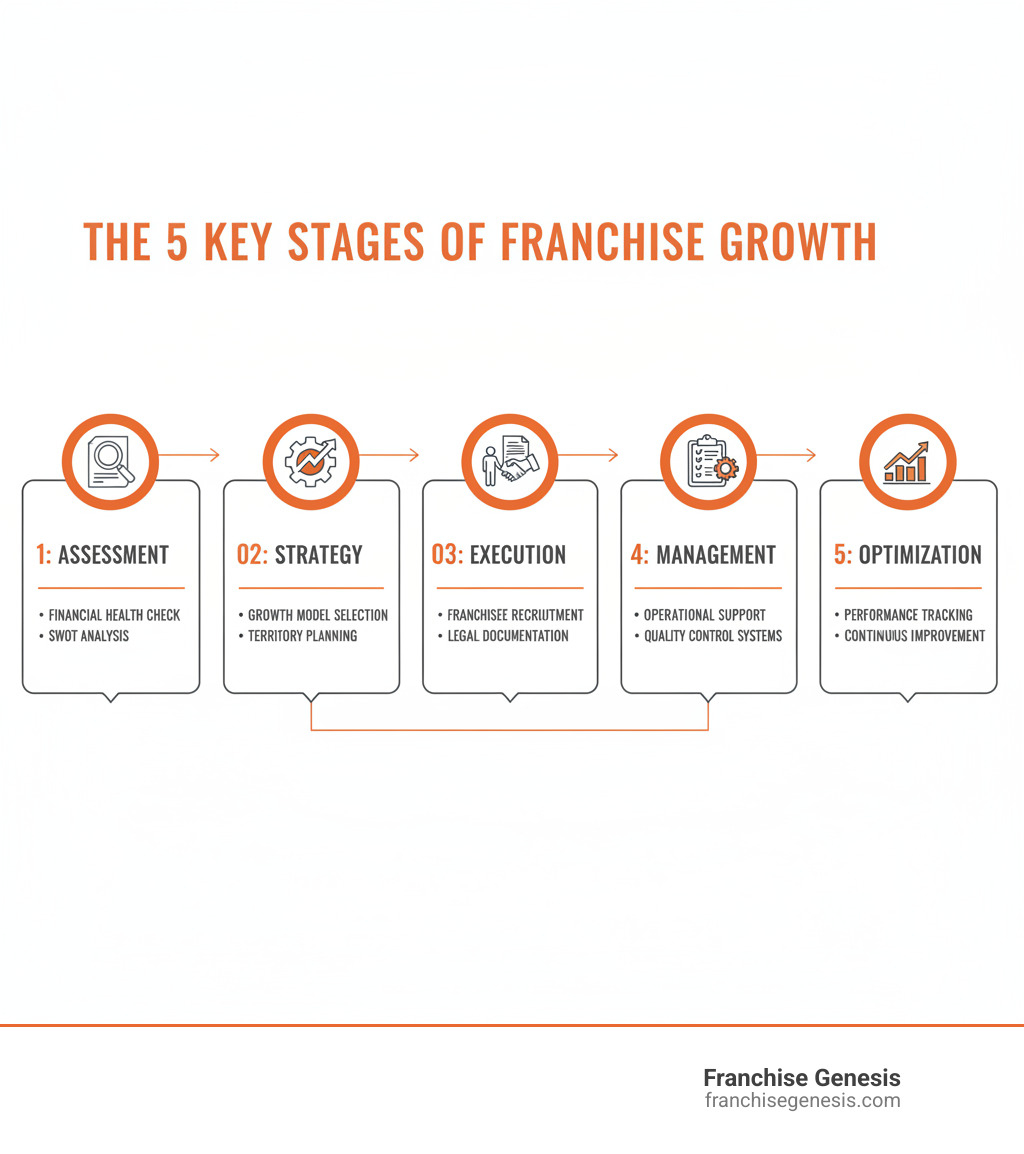
Before diving into franchise growth strategies, you must determine if your business is truly ready. Growth is exciting, but it’s not without risk. Investing in franchising without a solid foundation can lead to failure.

To assess your readiness, consider these key factors:
- Financial Health: Are your profits consistent and healthy? Research shows 82% of business failures stem from cash flow problems. Your profit margins must be strong enough to support both you and a franchisee.
- Market Position: What makes your business truly unique? Your value proposition must be compelling enough for an entrepreneur to invest their life savings in it.
- Operational Efficiency: Are your processes documented and replicable? If you are the only one who knows how to perform critical tasks, you are not ready to franchise.
- Proven Track Record: Can you demonstrate consistent profitability and market demand over several years? This is essential proof for potential franchisees.
- Support Capacity: Do you have the financial and human resources to provide comprehensive training, coaching, and marketing support? Franchisees are buying into a support system, not just a brand name.
For a deeper dive into these readiness factors, our Franchise Consulting Complete Guide walks through each element in detail.
What Defines a Scalable Business Model?
Successful franchise growth strategies begin with a scalable business model. A business is scalable when profits grow faster than operating costs. This means adding more units increases revenue disproportionately to your expenses.
Key elements of a scalable model include:
- Replicable Systems: Your core operations must be simple enough for anyone to learn and execute consistently. McDonald’s built its empire on standardized systems that ensure a consistent experience globally.
- Strong Unit Economics: Each franchise location must be profitable on its own. You need to prove a single unit can thrive before investors will commit to opening more.
- Technology Integration: Modern scalability relies on technology. Cloud-based systems for data syncing, customer management, and performance tracking are essential for managing multiple units efficiently. This technology integration allows you to manage a network without being overwhelmed by manual oversight.
A scalable model gets better as it grows, with each new location reinforcing the brand. For more on building this foundation, check out Understanding the Key to Building a Thriving Franchise Network.
Core Franchise Growth Strategies for Rapid Expansion
Once your business is ready, the focus shifts to actionable franchise growth strategies. Growth is typically driven by market demand, the potential for increased revenue, and the opportunity to leverage a proven concept. However, effective growth requires a clear plan.

Start by defining your North Star Metric, the single measure that best reflects the value you deliver, such as active franchise locations or average unit volume. Break this vision into SMART goals (Specific, Measurable, Achievable, Relevant, Time-bound) to create accountability. Track both leading indicators (e.g., lead conversion rates) to predict future performance and lagging indicators (e.g., revenue) to confirm past results.
With goals in place, pursue these tactical strategies:
- Deepen Market Penetration: Increase the value of existing customers through loyalty programs and personalized experiences. More profitable locations attract better franchisees.
- Product/Service Development: Innovate thoughtfully to stay relevant. This could mean a new service tier or a complementary offering that meets emerging customer needs.
- Strategic Partnerships: Form strategic alliances with complementary businesses to enter new markets or reach new customer bases.
- Data-Driven Marketing: Use market research and data to personalize campaigns and allocate resources effectively. Companies that do this grow 2-3 times faster.
Developing Your Franchise Marketing & Sales Engine
A strong marketing and sales engine must attract both customers and qualified franchisees. It starts with a clear brand identity that communicates your values and promise. For franchisee recruitment, craft compelling messaging that targets entrepreneurs where they look for opportunities. Our Franchise Sales & Marketing services are designed to do just this.
Digital marketing is non-negotiable. Use SEO-optimized content, social media, email marketing, and video to build awareness and convert leads. As you grow your customer base, you create the demand that makes new franchise locations viable. For effective lead generation, visit our Franchise Lead Generation page and learn how to Transform Leads into Loyal Franchisees with a Proven Sales Strategy.
Financial and Capital Strategies for Franchise Expansion
Smart financial planning is crucial for growth. First, define your capital requirements for expansion, including the ongoing support infrastructure (training, technology, field consultants). Underestimating these costs is a common and critical mistake.
To fund expansion, you can use reinvested profits, SBA loans for franchising, or private equity. Royalty structures, typically a percentage of gross sales, create a recurring revenue stream to fund ongoing support and align your success with your franchisees’. Proper cash flow management is essential to steer the gap between signing franchisees and their locations generating revenue.
For more, see our Franchise Financing Options Complete Guide and The Cost to Start a Franchise and Financing Options.
Choosing Your Expansion Model: Multi-Unit vs. Diversification
Your growth structure is a critical decision. Do you focus on one brand (multi-unit) or diversify across several (portfolio)?
| Feature | Multi-Unit Franchising (Vertical Integration) | Portfolio Diversification (Horizontal Integration) |
|---|---|---|
| Definition | Owning and operating multiple units of the same brand. | Owning and operating units of different, complementary brands. |
| Primary Goal | Leverage operational efficiencies, build market dominance. | Cross-marketing, seasonal balance, shared resources, risk mitigation. |
| Benefits | Simplified operations, economies of scale, deeper brand penetration. | Resilience during economic downturns, broader customer base. |
| Challenges | Market saturation risk, over-reliance on one brand’s success. | Increased management complexity, potential brand confusion. |
| Franchisee Profile | Experienced operators, strong management systems. | Strategic thinkers, adaptable, capable of managing diverse concepts. |
| Growth Potential | Rapid, focused growth within a proven model. | Broader, more resilient growth across different market segments. |
Multi-unit franchising now represents 50% of all U.S. franchisees. It offers simplified operations but risks over-reliance on one brand. Portfolio diversification provides resilience but increases management complexity.
Other models include area development agreements, which grant rights to open multiple units in a territory, and the master franchise model, where a sub-franchisor manages a large region. Choosing the right model depends on your capital, support capacity, and long-term goals. Our Franchise Business Opportunities Guide can help you explore these options.
Execution and Systemization: Building a Thriving Franchise Network
With your franchise growth strategies mapped out, it’s time for execution. This is where planning becomes action and where most franchisors succeed or fail. The foundation is operational excellence—delivering quality and efficiency consistently across all locations.

This requires systemization: turning every task into a repeatable, teachable process documented in comprehensive operations manuals. When done right, any qualified franchisee can replicate the success of your original location.
Selecting the right franchisees is as important as recruiting them. Look for partners who are strong operators, share your vision, and fit your culture—not just investors with capital. Once selected, provide comprehensive support systems, including initial training and ongoing coaching. Proactive support prevents problems before they start, a core philosophy of our Franchise Training & Success programs.
Technology and data integration are game-changers. Advanced technology integration solutions like CRM and operational software streamline processes and provide performance monitoring across the network. This combination of motivated owner-operators and world-class systems creates a network where every unit strives for excellence.
Maintaining Brand Control and Consistency
How do you maintain control without running every location? The answer lies in establishing rigorous brand standards from day one. These non-negotiable rules cover every customer touchpoint, from visual identity to service protocols, and are documented in your Franchise Operations Manual.
To verify compliance, you need quality control mechanisms like regular audits and mystery shoppers. These act as an early warning system to catch deviations before they damage the brand.
This works best with open communication. Regular meetings and advisory councils create a transparent dialogue, making franchisees feel heard and more likely to accept standards. Continuous education and support keep everyone updated on best practices. As Harvard Business Review notes, a uniform brand persona requires meticulous attention to detail.
Great franchisors enforce a proven system. This commitment to consistency builds customer trust and separates high-growth franchises from those that plateau.
Avoiding Pitfalls and Leveraging Expert Support
Even the best franchise growth strategies can be derailed by common pitfalls. With foresight and guidance, these obstacles can be avoided.
Key pitfalls to watch for include:
- Overexpansion: Scaling too quickly without adequate support infrastructure stretches your team thin and causes quality to slip.
- Poor Franchisee Selection: Choosing partners based only on capital is a recipe for disaster. The wrong franchisee can damage your brand and lead to legal disputes.
- Lack of Adequate Support: Franchisees bet their future on your system. Without comprehensive training and ongoing coaching, they are set up to fail, and your brand suffers with them.
- Inconsistent Branding and Cash-Flow Blind Spots: These subtler issues can dilute your brand and leave you financially strapped when your network needs you most.
Risk management involves building dynamic contingency plans and fostering strong relationships with franchisees to identify problems early. The good news is that the shared-success model of franchising offers remarkable resilience during economic uncertainty, as motivated owners adapt and innovate to overcome challenges.
The Role of Franchise Development in Your Growth Strategy
Navigating franchise expansion alone is like climbing a mountain without a guide. A franchise development company is an invaluable partner on this journey.
At Franchise Genesis, we bridge the gap between your successful business and a thriving franchise network. Our expert guidance includes:
- Market Evaluation: We use a data-driven approach to identify markets where your concept will resonate, ensuring each new location has the best chance of success.
- Legal Documentation: We provide comprehensive support to ensure your Franchise Disclosure Document (FDD) and other legal materials are compliant and protect your interests.
- Real Estate Strategy: We use sophisticated analytics to identify prime locations that align with your growth plan and target demographics.
As your Strategic Franchise Consulting partner and Franchise Growth Consultant, we provide turnkey solutions from strategy to execution. We work alongside you, bringing decades of experience to help you avoid pitfalls and catapult your brand to national recognition.
Frequently Asked Questions about Franchise Growth Strategies
How do I know if franchising is the right growth strategy for my business?
Franchising may be right if you have strong indicators of success. Are you turning away customers due to high demand? Is your business consistently profitable with positive cash flow? Most importantly, have you developed systems that can be taught to others? If your success depends solely on you, you’re not ready. Franchising offers rapid expansion without the capital drain of corporate-owned stores and provides a resilient path to growth. If you’re still unsure, our Franchise Consulting Complete Guide can help.
How much does it cost to turn my business into a franchise?
The cost varies, but key investments include:
- Legal Fees: Drafting your Franchise Disclosure Document (FDD) and franchise agreement is typically the largest upfront cost.
- Operations Manuals: Documenting every aspect of your business into a blueprint for franchisees.
- Marketing Materials: Creating websites, brochures, and presentations for franchisee recruitment.
- Franchise Consultants: Investing in expert guidance to avoid costly mistakes and accelerate your launch.
- Technology Infrastructure: Systems for training, communication, and performance tracking.
For a detailed breakdown, see our Franchise Startup Costs guide. The investment is substantial, but it positions you for exponential growth.
How do I maintain quality and brand consistency as I grow?
Maintaining consistency across a growing network is crucial. The key is robust systemization. This includes:
- A Detailed Operations Manual: Your Franchise Operations Manual is the single source of truth for all procedures.
- Comprehensive Training: Our Franchise Training & Success programs teach franchisees the ‘what’ and the ‘why’ behind your standards.
- Clear Brand Standards: Non-negotiable guidelines for everything from logos and uniforms to customer service protocols.
- Technology and Audits: Use integrated platforms to monitor performance and conduct regular audits or mystery shops to ensure compliance.
- Open Communication: Foster a culture of partnership with regular meetings and feedback loops.
Great franchisors don’t just sell a brand; they build a system that makes excellence repeatable.
Conclusion: Your Next Move in Building a Franchise Empire
We’ve covered the full roadmap of franchise growth strategies—from assessing your readiness and choosing an expansion model to executing with systemization and avoiding common pitfalls. You now understand the financial realities, the importance of brand consistency, and the systems that separate thriving networks from those that flame out.
But understanding is just the beginning. The real question is: what’s your next move?
Building a franchise empire is about creating a system that runs without you, partnering with franchisees who share your passion, and scaling your proven concept into new markets. This requires a long-term vision, continuous improvement, and the right strategic partner.
At Franchise Genesis, we’ve walked this path with dozens of brands, guiding them from a single location to a nationwide network. We understand the legal, financial, and operational challenges because we’ve lived them.
If you’re ready to scale but don’t know where to start, let’s talk. We’re not just consultants; we’re your partners in this journey.
Ready to franchise your business? Reach out to us today. We’ll help you build a franchise network that doesn’t just grow—it thrives. Your success story is just beginning. Let’s write the next chapter together.