
Franchising a business typically costs between $75,000 and $175,000, depending on legal setup, operations development, training systems, and marketing infrastructure. Most founders underestimate the total cost by focusing only on legal documents, when the real investment includes building a complete, scalable franchise system.
When business owners search “franchise my business,” they are usually asking two questions at once:
- Is my business ready to franchise?
- What does it actually cost to franchise a business?
The challenge is that franchising costs are rarely presented as a full picture. Many founders are shown a single number, often tied to legal documentation, without understanding the total franchise development costs required to build a scalable, supportable franchised business.
Franchising is not one expense. It is a series of interconnected investments that, when planned correctly, protect the brand and support long-term growth. Every franchise opportunity starts with understanding what it actually costs to build the system behind it.
Total Cost to Franchise a Business (Realistic Ranges)
The cost to franchise a business is not a single line item. It is a combination of investments required to build a business model that others can successfully operate.
This range reflects the cost of building not just the legal foundation, but the systems, training, and support structure required to scale a successful business.
Category | Estimated Cost |
Legal (FDD + Agreements) | $15,000 to $40,000 |
Operations Development | $10,000 to $50,000 |
Training Systems | $5,000 to $25,000 |
Marketing and Sales Assets | $10,000 to $40,000 |
Technology Stack | $5,000 to $20,000 |
Support Infrastructure | $10,000 to $30,000 |
Total Investment | $75,000 to $175,000+ |
How Costs Vary by Business Type
Not all businesses require the same level of investment to franchise. The more complex the operation, the higher the development cost.
- Service-Based Businesses: Typically fall on the lower end of the range due to simpler operations and fewer physical requirements. Estimated range: $75,000 to $100,000
- Retail Franchises: Require more structured systems, inventory management, real estate considerations, and franchise location support, increasing overall cost. Estimated range: $100,000 to $150,000
- Food and Beverage Concepts: Often sit at the higher end due to operational complexity, training demands, supply chain coordination, and compliance requirements. Estimated range: $150,000 to $175,000+
Understanding where your business falls helps set realistic expectations for total franchise development costs.
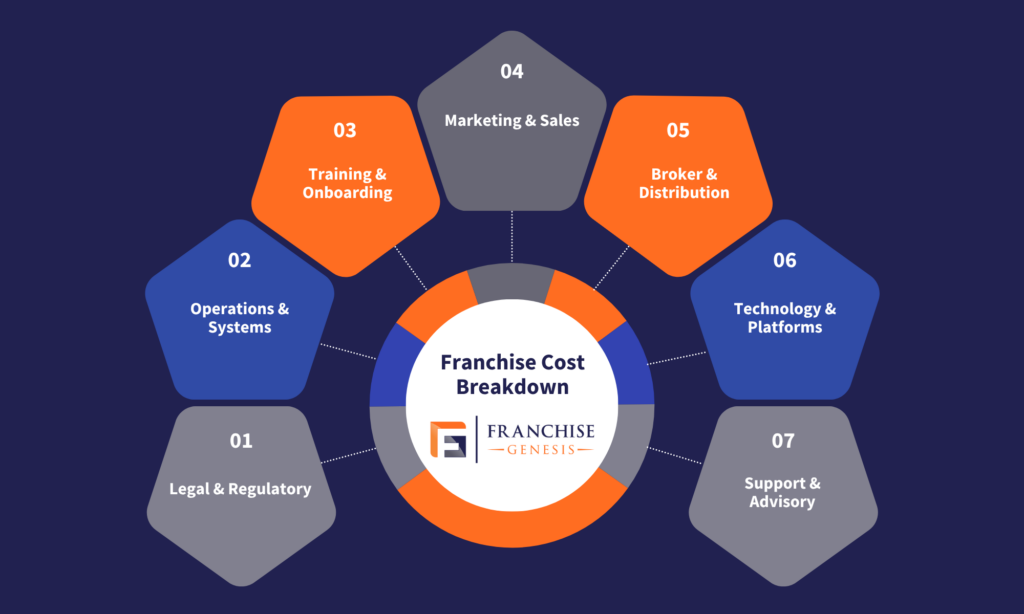
Legal and Regulatory Costs When You Franchise Your Business
This is the most visible and most misunderstood category. The Federal Trade Commission requires franchisors to provide a franchise disclosure document to every prospective franchisee before any agreement is signed in the United States. Legal costs typically include:
- Franchise disclosure document preparation by a franchise attorney
- Franchise agreement drafting
- Trademark registration to protect intellectual property
- State registrations and renewals
- Financial statements required for FDD compliance
- Ongoing legal updates and compliance guidance
At Franchise Genesis, legal fees for the franchise disclosure document and franchise agreement are included in the franchise development program. Clients do not need to hire a separate franchise attorney.
These are legal requirements, not optional expenses. They represent the permission to franchise, not the ability to do it well. The initial franchise fee structure and ongoing royalties also need to be defined during this phase, as both are governed by the franchise agreement and disclosed in the FDD as legal documents. Many founders stop budgeting here and that is where problems begin.
Operations and Systems Development Costs
To franchise a business successfully, operations must be transferable. A franchise system cannot scale on tribal knowledge. Operational costs often include:
- Franchise operations manual development
- Brand standards documentation
- Unit-level operational procedures
- Supply chain guidance for product-based concepts
- Technology workflows
- Quality control systems
These systems must be built before franchisees open, not after. When this work is delayed or outsourced piecemeal, costs increase and inconsistencies follow across every franchise location.
Training and Onboarding Infrastructure
Initial training is not a single event. It is a system that every franchise owner depends on to get their location running correctly. Common expenses in this category include:
- Initial training program design
- Training manuals and playbooks
- Learning management systems
- Ongoing training updates
- Franchisee onboarding workflows
- Support documentation for field teams
Without proper training infrastructure, franchisors end up providing expensive one-off support instead of scalable education. That cost compounds quickly as the franchise business grows.
Marketing and Franchise Sales Assets
The cost to franchise a business includes building an investor-facing brand. A franchise marketing plan and supporting marketing materials are not optional. A defined marketing strategy for attracting potential franchisees is just as important as the legal foundation. This category typically includes:
- Franchise sales brochures
- Franchise website or landing pages
- Lead funnels and CRM setup
- Email and nurture campaigns
- Broker-ready materials
- Brand positioning for investors
- Validation and disclosure coordination
Founders are often surprised to learn that marketing costs do not end once the FDD is complete. For many brands, that is where the real marketing investment begins.
Broker Networks and Distribution Access
Many franchisors plan to work with franchise brokers but underestimate the costs and preparation involved. This may include:
- Broker network memberships
- Conference and expo participation
- Sponsorship fees
- Broker education materials
- Ongoing relationship management
Access alone is not enough. Brands must be properly positioned and supported to succeed in these channels.
Technology and Platform Costs
Modern franchise systems depend on technology to monitor financial performance and support franchisees at scale. Common costs in this area include:
- CRM platforms
- Marketing automation tools
- Franchisee portals
- Document management systems
- Communication platforms
- Reporting and performance tracking tools
When these tools are selected independently without coordination, costs multiply and adoption suffers across the network.
Internal Support and Ongoing Advisory
Perhaps the most overlooked category. The cost to franchise a business does not end when the first franchise agreement is signed. Ongoing support expenses a business owner faces include:
- Franchisee questions and escalations
- Launch support for new franchise locations
- Operational troubleshooting
- Compliance monitoring
- System updates and refinement
- Strategic guidance as the franchise system grows
Ongoing royalties from franchisees fund this support infrastructure over time. But in the early stages, franchisors need to budget for this support before royalty income is large enough to cover it. Without built-in ongoing support, founders either burn out or hire reactively. Both are expensive outcomes.
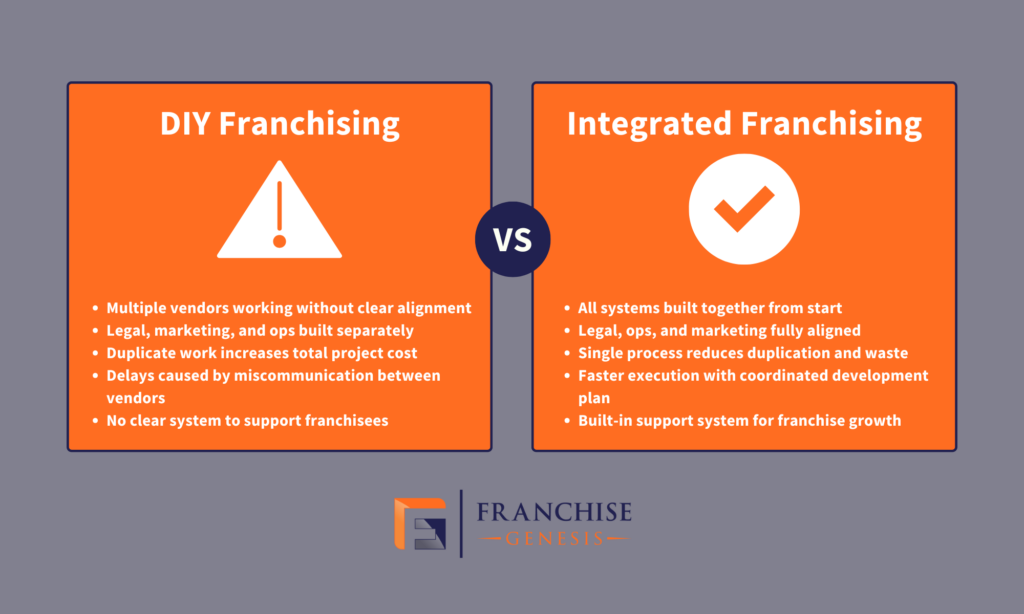
The Hidden Cost of “A La Carte” Franchising
Many founders searching “franchise my business” are initially drawn to lower upfront pricing that covers only part of the process, usually the legal document preparation. What they do not see are the hidden costs of assembling the rest later:
- Higher hourly rates
- Duplicate work
- Misaligned vendors
- Delays in franchise sales
- Early franchisee dissatisfaction
Franchising becomes more expensive not because it is complex, but because it is fragmented. A small business that approaches franchising without a full plan almost always spends more in the long run than one that builds the complete system from the start.
Why Integrated Franchise Development Lowers Total Cost
When franchising is approached as an integrated system, the economics shift in the franchisor’s favor:
- Legal, operations, marketing, and technology are aligned from the start
- Shared infrastructure reduces duplicative expenses
- Founders access negotiated rates instead of retail pricing
- Systems are built once, correctly, from the beginning
This is why integrated franchise development models allow founders to access enterprise-level resources at reduced rates, rather than sourcing each component independently at full cost. The result is a franchise model built for rapid growth rather than one that stalls under the weight of fragmented vendors and misaligned systems.
Build Your Franchise the Right Way with Franchise Genesis
Instead of asking: “What does it cost to franchise my business?”
The better question is: “What franchise development costs am I taking on if I do not build this system correctly?”
Franchising done right is not the cheapest path. It is the most predictable, defensible, and sustainable one.
A franchise consultant who covers the full development process, not just legal documents, is often the difference between a franchise system built for rapid growth and one that stalls before it finds its footing.
Franchise Genesis supports that full process through a single franchise development program. Clients are guided through gathering and organizing the information needed to develop the franchise disclosure document and franchise agreement before legal work begins. Legal fees for both documents are included in the program, so clients do not need to hire a separate attorney. From planning and documentation preparation to training systems and launch support, everything is coordinated in one place. Contact Franchise Genesis to start the conversation.
FAQs About the Cost to Franchise Your Business
How much does it cost to franchise your business?
Most businesses fall between $75,000 and $175,000 to franchise, depending on complexity, industry, and the level of support infrastructure required. Service-based businesses tend to sit at the lower end. Food and beverage concepts with complex operations typically sit at the higher end.
What makes a business ready to franchise?
A business is ready to franchise when it is consistently profitable, runs on documented operational procedures that others can follow, and has demand beyond its current location. If the business depends entirely on the owner’s personal involvement to operate, it needs more foundation before franchising is a viable path.
Why is franchising without a franchise consultant risky?
DIY franchising often leads to incomplete legal documentation, weak training systems, and poor franchisee support infrastructure. These gaps create legal exposure with the Federal Trade Commission and set up early franchisees to underperform, which damages the brand before it has a chance to scale.
How long does it take to see a return on franchise investment?
Most franchisors begin recouping their initial investment within two to three years, assuming the franchise system is well-built and franchisee sales move at a reasonable pace. Royalty payments from franchisees become the primary ongoing revenue stream once the network reaches a stable size. Brands with stronger unit economics and proven demand tend to reach that point faster.