
Why Determining if Your Business is Franchisable is the Critical First Step
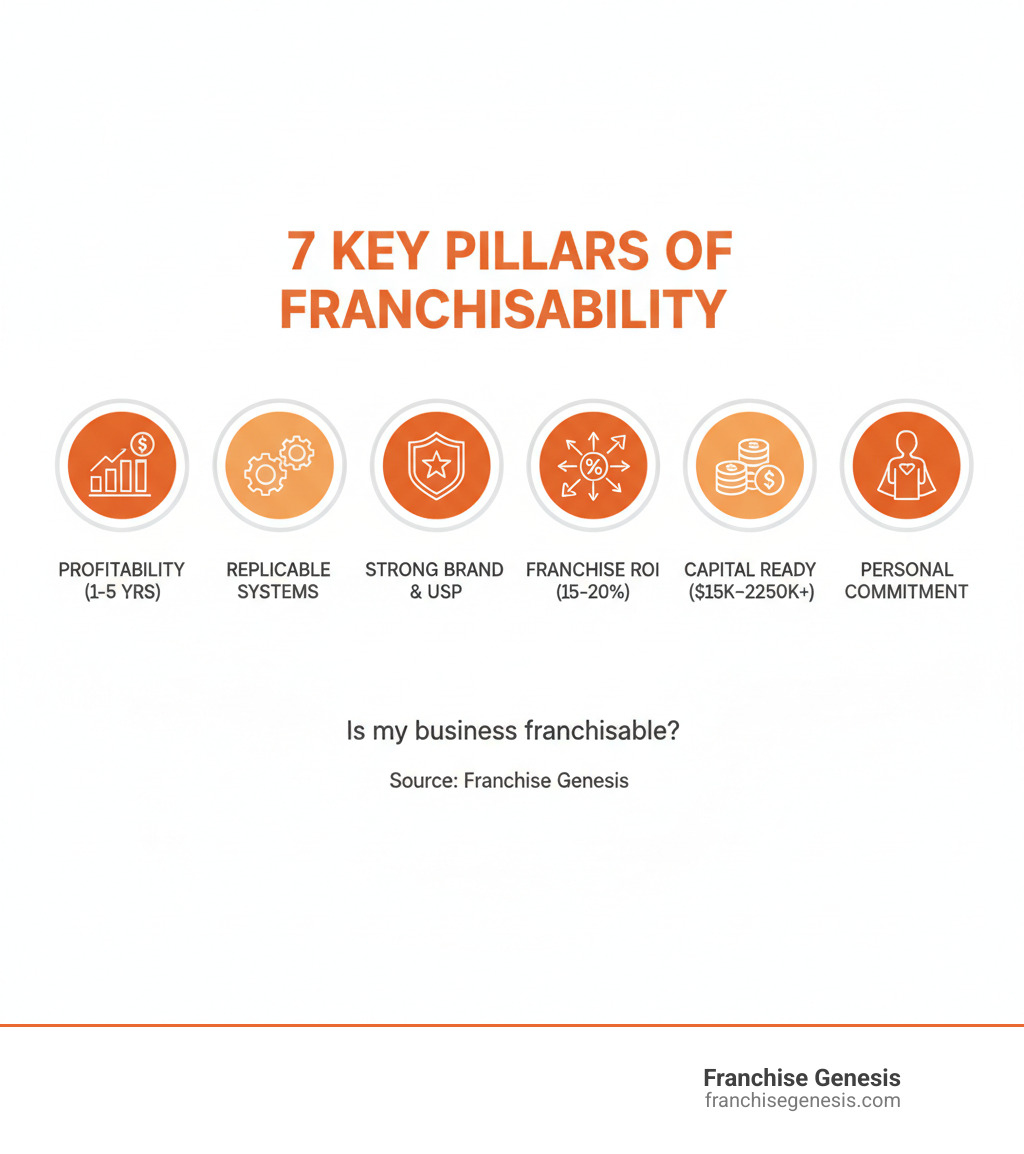
Is my business franchisable? If you’re asking this, you’re likely running a successful operation and considering your next move for growth. The answer depends on seven key factors:
- Proven profitability – Your business must demonstrate consistent financial success over 1-5 years
- Replicable systems – Operations must be documented and teachable to others
- Strong brand identity – Your business needs recognizable differentiation in the market
- Scalability – The model must work across different locations and markets
- Franchisee ROI potential – Future franchisees need a clear path to 15-20% returns by year 2-3
- Capital readiness – You’ll need $15,000 to $250,000+ to build the franchise infrastructure
- Your personal commitment – Franchising transforms you from operator to franchisor and coach
Franchising allows you to grow your brand without bearing all the costs and risks yourself. But here’s the reality: not every successful business is franchisable. The crucial consideration isn’t just whether your business is doing well—it’s whether someone else would choose to invest in duplicating your model rather than starting something similar independently. Many owners find their business is profitable but not replicable, or too dependent on their personal skills. Honest self-assessment is essential before investing significant time and capital.
I’m Monique Pelle Kunkle, Vice President of Operations at Franchise Genesis. I’ve guided dozens of business owners through this critical question. This guide is designed to give you clarity on whether franchising is your right next move.
Essential is my business franchisable terms:
The Foundational Pillars: Core Attributes of a Franchisable Business

When business owners ask “is my business franchisable?”, they’re really asking if their success can be replicated. Franchising isn’t about selling your current success—it’s about selling the promise that someone else can achieve similar results elsewhere. This requires an honest assessment of whether you’ve built something an investor would choose over starting their own similar business.
For a deeper understanding of this assessment, I recommend reading this article on How to Know If Your Business Is Ready for Franchising. For expert eyes on your situation, our Franchise Feasibility Study provides a comprehensive analysis.
What are the core attributes that make a business franchisable?
A proven business model with 1-5 years of consistent financial performance is the foundation. Your financials must show healthy profits and unit economics that can support royalties while still delivering attractive returns to franchisees. Brand strength is also key; you need a recognizable identity that creates credibility. Finally, you need a clear competitive advantage and a large, growing market to ensure room for expansion.
Why is a Unique Selling Proposition (USP) so critical?
Your USP answers the question: “Why would I pay you fees when I could start a similar business myself?” It helps you stand out from competitors, creates a defensible market position, and is essential for attracting franchisees. A strong USP justifies your franchise fees by demonstrating the value and competitive edge you provide—an advantage an independent operator couldn’t easily replicate.
The Replicability Test: Systems, Scalability, and Support

Here’s the hard truth about whether is my business franchisable: can someone else run your business as well as you do? If your operational knowledge is locked in your head, you can’t franchise. Successful franchises have bottled their magic into systems anyone can follow. Documented systems free up franchisees to focus on serving customers, not reinventing the wheel. Your business must also be genuinely scalable across different markets, and you must build robust franchisee support systems.
To help, we’ve developed resources on creating a Franchise Operations Manual and establishing effective Franchise Training & Success programs.
How does a business’s ability to be systemized affect its franchisability?
If you can’t systemize your business, you can’t franchise it. Systemization means turning every task into a clear, step-by-step procedure. This ensures consistency across all locations, creating a turnkey operation that reduces the franchisee learning curve. Good systems are also the framework for quality control. The foundation is documented processes—detailed manuals covering everything from customer greetings to marketing. This documentation process itself often reveals operational gaps that need refinement before you’re ready.
What kind of support systems are necessary for a franchisable business?
Once you franchise, your franchisees become your primary customers. They are investing in your concept and trust you to provide the tools for success. This includes comprehensive initial training, ongoing operational support (site visits, phone support, online portals), and marketing assistance (templates, strategies, brand-building). Many franchisors also provide technology platforms (POS, CRM) to streamline operations. Most importantly, building genuine franchisee relationships based on partnership and trust creates a thriving network. Learn more about Understanding the Key to Building a Thriving Franchise Network.
Financial & Legal Readiness: Is My Business Franchisable from a Numbers Perspective?

You can have a great concept, but if the numbers don’t work, franchising won’t either. When business owners ask me is my business franchisable, I immediately look at their financial and legal foundation. You need to prove your business is profitable enough to attract investors, and you need capital to build the franchise infrastructure.
For a detailed breakdown of costs, visit How Much Does It Cost to Franchise My Business?. Understanding the FDD Document is also essential, as it’s the cornerstone of franchise law.
What financial health indicators demonstrate viability for franchising?
From a potential franchisee’s perspective, sustained profitability is non-negotiable. Your business needs a 1-5 year track record of making money, supported by healthy cash flow. The real test is strong unit economics: can a single location cover all costs, pay royalties, and still provide the franchisee a healthy return on their investment? These indicators provide the proof that your business model can work for someone else. For more insights on financing, explore our resources on Franchise Capital Solutions.
What are the key costs and ROI considerations?
Becoming a franchisor requires a significant upfront investment. Costs for legal documentation, operations manual development, and marketing can range from $15,000 to over $250,000, depending on your growth goals. This is the investment required to build the system. For the model to be attractive, franchisees must see a clear path to a strong return. We look for at least a 15-20% cash-on-cash return for franchisees by their second or third year. As the franchisor, your revenue will come from initial franchise fees and ongoing royalties. The math must work for both parties for the relationship to be sustainable.
The Human Factor: Are YOU Ready to Become a Franchisor?

Here’s something many business owners don’t realize: you can have the perfect business model, but if you’re not ready to become a franchisor, the whole thing can fall apart. Asking is my business franchisable is also about you personally. Are you ready for a profound shift in your role?
Franchising transforms you from a hands-on operator into the architect of a system that helps other entrepreneurs succeed. It’s a different job entirely, requiring different skills and a different kind of commitment. To understand what it truly entails, we encourage you to explore our guide on Becoming a Franchisor.
How does the CEO’s role change when a business begins franchising?
The day you decide to franchise, your job description changes completely. The primary shift is from operator to coach. Instead of running the business, you’re teaching others how to run theirs. Your franchisees become your primary customers; their success and satisfaction are paramount to your growth. Your focus expands from one location to the entire system, requiring strategic thinking and a corporate team to handle sales, training, and support. This is a long-term commitment to building and nurturing a network.
What personal factors should an entrepreneur consider before franchising?
Your personal readiness is as crucial as your business’s. Do you have the right personality fit? Successful franchisors enjoy teaching, mentoring, and seeing others succeed. You must have a passion for teaching and support and, critically, a willingness to relinquish some control. You provide the framework, but franchisees run their daily operations. Your long-term vision must align with building a brand and a support system for a large organization, not just perfecting a single location. You’re not just expanding; you’re building an entirely new business as a franchisor.
Your 7-Step Franchise Readiness Checklist
After working through all the considerations, this 7-step checklist helps pull it all together. This is about honest assessment to understand where you stand today. Many businesses refine their model during the franchising process itself, so perfection isn’t the starting point.
Step 1: Assess your profitability and track record. You need at least 1-5 years of consistent profitability and positive cash flow.
Step 2: Define and protect your brand and USP. Articulate what makes you different and ensure your trade name is legally registered and protected.
Step 3: Document every operational process. Your operations must be standardized and teachable, ready to be codified in a comprehensive operations manual.
Step 4: Evaluate your scalability and market adaptability. Will your model work in different markets? Is the market large enough for expansion?
Step 5: Calculate potential franchisee ROI. The business must be profitable enough for a franchisee to earn a 15-20% return after paying you fees and royalties.
Step 6: Review your capital and budget for franchising. Do you have the $15,000 to $250,000+ needed to invest in building the franchise system?
Step 7: Honestly assess your personal commitment and goals. Are you ready to shift from operator to coach and dedicate yourself to franchisee success?
How can I determine if my business is franchisable today?
The best way to determine is my business franchisable is through a comprehensive readiness evaluation. Start with an honest self-assessment against the checklist above. Then, seek expert advice. A specialized franchise consultant provides an objective perspective you can’t get from inside your own business. Our Strategic Franchise Consulting services are designed for this. Perfection isn’t required. The goal is to balance readiness with opportunity. Have the core attributes in place—profitability, a replicable model, a strong brand, and personal commitment—and a plan to refine the rest.
Frequently Asked Questions about Business Franchisability
We understand that the journey to franchising can be filled with questions. Here are some of the most common inquiries we receive from business owners contemplating is my business franchisable.
How many locations do I need before I can franchise?
You don’t necessarily need multiple locations. What you do need is one incredibly solid, profitable prototype that serves as your proof of concept. This single location must demonstrate consistent profitability and have fully documented systems. While multi-unit experience is a plus, what potential franchisees really want to see is a proven, replicable model that makes money.
Can I franchise a service-based business?
Absolutely. Many of the fastest-growing franchises today are service-based (e.g., cleaning, fitness, home care). The key is having a replicable service delivery model that can be standardized and taught. For service businesses, strong systems and training are crucial to ensure consistent quality and customer experience.
What are the biggest mistakes to avoid when deciding to franchise?
- Underestimating costs: Developing a proper franchise system requires a significant investment of $15,000 to $250,000+.
- Lacking documented systems: You can’t franchise knowledge that only exists in your head. Every process must be written down.
- Not having a protectable brand: Your trademark must be registered. Your brand is your most valuable asset.
- Failing to provide adequate franchisee support: Your franchisees are your new primary customers. They need comprehensive training and ongoing support to succeed.
- Thinking it’s a get-rich-quick scheme: Franchising is a long-term growth strategy that requires patience and dedication to franchisee success.
Conclusion
You’ve made it to the end of this guide, and if you’re still here, the question is my business franchisable has become more than just a passing thought. We’ve covered the essentials: a proven model, replicable systems, a path to profitability for franchisees, and your own personal readiness for this change.
Here’s something crucial to understand: franchising is not simply an extension of your current business. It’s about building something fundamentally different—a new business where you become the architect of other people’s success. Your role changes from operator to coach, from doing to teaching, from controlling to empowering.
If this challenge excites you, you’re likely on the right path. But you don’t have to steer this journey alone. At Franchise Genesis, we partner with business owners to transform their concepts into thriving franchise systems. We provide the expertise, support, and honest guidance you need to steer every stage of this process.
Are you ready to take the next step toward strategic growth and find what’s truly possible for your brand?