SEO for franchises means optimizing one brand across many franchise locations so each one ranks in its own market while the brand grows stronger overall. Single-business SEO has one website, one set of keywords, and one audience. A franchise system has dozens or hundreds of franchise locations, each chasing the same potential customers in a different city, sometimes competing against each other in the same search results.
A franchise brand can spend heavily on national advertising and still lose a nearby customer to a single independent shop that simply keeps its Google listing up to date. National recognition does not build a local online presence on its own, and it does not put a specific location on the map when someone searches at street level. That gap between brand fame and local visibility is the problem SEO for franchises is built to close.
Why Franchise SEO Is a Different Challenge
A franchise operates as one company nationally and as a separate competitor in every local market at the same time. The corporate site builds authority for the franchise brand, while each individual franchise location needs to show up when someone nearby searches. Balancing those two jobs is the core of any franchise SEO strategy.
Three problems make this harder than standard search engine optimization.
Duplicate Content
When a franchise business spins up forty location pages from one template and changes only the city name, a search engine sees forty near-identical pages and struggles to rank any of them.
Internal Competition
This is when two nearby locations rank against each other for the same query and split traffic that should belong to one.
Inconsistency
This can happen when each franchise owner manages their own listings, hours, and phone numbers with no shared standard, and the brand looks different in every market.
Letting each location handle SEO alone tends to produce these problems at scale. A coordinated approach, with shared standards set at the brand level and local detail filled in per location, prevents them.
SEO Strategies for Franchise Locations
Master Local Search With Google Business Profile
Local search is where franchise revenue is won or lost. When someone searches for a service near them, Google often answers with a map and three local listings before any standard website appears. A franchise location that owns that space gets the phone calls and the visits. One that ignores it hands them to a competitor.
Every individual franchise location needs its own Google Business Profile, claimed and verified under a shared brand standard. Google names three factors that decide local ranking: relevance, distance, and prominence. You cannot change how far a searcher sits from a location, but you control relevance and prominence through a complete, accurate profile.
Accurate information is the foundation. The business name, address, and phone number must match across the profile, the location page, and every local listing, because mismatches confuse both customers and search engines.
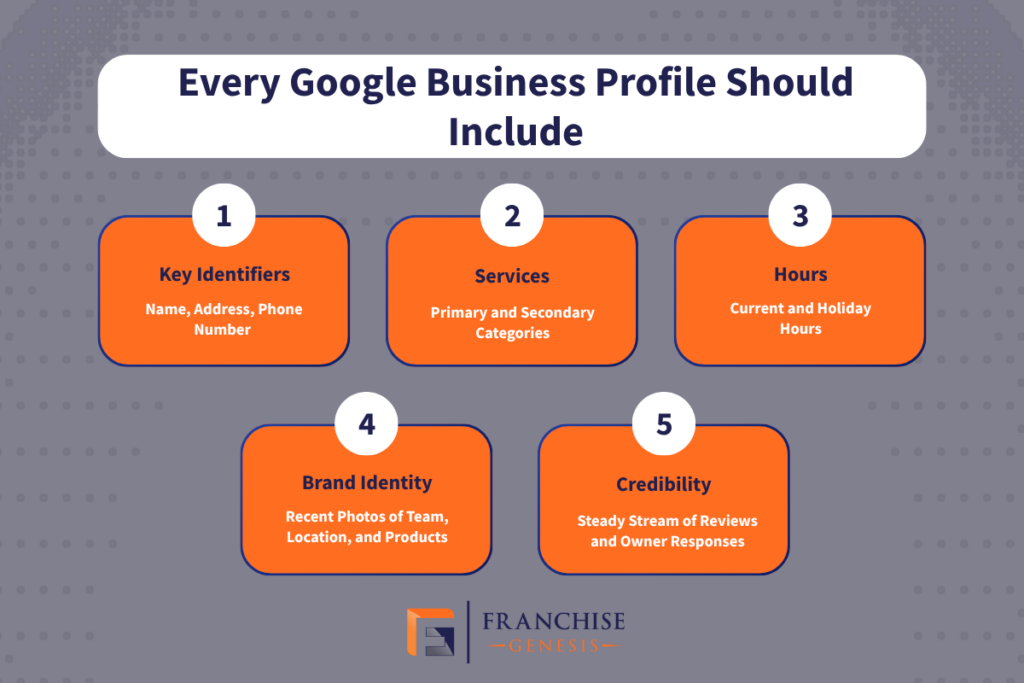
A profile built this way feeds Google Maps visibility and local search results, and it turns nearby searches into phone calls and foot traffic.
Build Location Pages That Rank Without Duplicating
A location page earns its ranking when it gives a search engine and a visitor real reasons to care about that specific location. A template with the city name swapped in does the opposite. It creates duplicate content, which suppresses rankings across every page built the same way.
A location page should have:
- The details and unique needs that only that location has.
- The neighborhoods and service areas it covers.
- Reference to local landmarks.
- The actual business address, and parking or access notes.
- The services and offers that apply to that market.
- Staff names where it helps
- Reviews from local customers.
A page like this reads as written for one place because it was, and search engines reward that.
Schema markup handles the technical half of the job. LocalBusiness schema tells a search engine that this is a local business at a fixed address, with set hours, a phone number, and a defined service area, in a format it reads directly. That improves how the page appears in search engine results. Adding location schema across a large system is the kind of repeatable standard a brand sets once and applies everywhere.
Unique pages also serve the visitor. Someone who lands on a clear location page with the right contact information and a visible call to action does not bounce back to the results to find a competitor. Better user experience at the location level lifts the conversion rate, which is the number that pays for the SEO work.
Grow Brand Authority With Content Marketing
Local tactics get individual locations found. Brand-level content is what makes the whole system stronger, because authority earned by the corporate site lifts every location under it.
Content marketing on the main franchise site should target the broader, higher-intent searches that sit above any single market. Useful blog posts, service guides, and resource pages answer the questions potential customers ask before they choose a brand, and they build brand awareness and organic traffic that no individual location page could earn alone. A national brand ranking for the questions in its category passes credibility down to every local page connected to it.
A search engine weighs the authority of a whole domain when it ranks individual pages. A franchise site publishing genuinely useful content gives its location pages a stronger base to rank from. Social media and other digital marketing reinforce this by sending signals and traffic that support overall online visibility, even though they are not direct ranking factors.
Content built this way becomes an asset every new franchisee inherits on day one. A location that opens into a brand already ranking for its category and target audience starts ahead of an independent competitor opening cold. That head start is part of what a franchisee is buying, and it is worth saying so in the sales conversation.
Manage Reviews and Measure What Works

Reviews and measurement form the loop that keeps a franchise SEO strategy honest. Without them, a brand is guessing.
Online reviews shape both rankings and trust. Positive reviews signal prominence to Google, one of its three local ranking factors, and they give a searcher a reason to pick one location over another. A negative review is not a crisis if it is handled well. A calm, specific, public response shows future customers how the brand treats problems, and it often matters more to a reader than the original complaint. A franchise system needs a shared process for requesting and responding to reviews, not forty operators improvising.
Measurement tells you what is working at each location. Google Search Console shows which queries surface each page, where impressions turn into clicks, and which markets are gaining or losing ground. Pairing that data with conversion signals, the phone calls and form fills each location generates, connects SEO effort to revenue, and exposes the real conversion rate market by market. A brand that watches these numbers as a standing best practice can repeat what works in one location across the system.
Run this as a repeatable program reported the same way everywhere. Consistency in measurement is what lets a franchisor compare locations fairly and spot the next opportunity early.
Build Franchise SEO That Scales
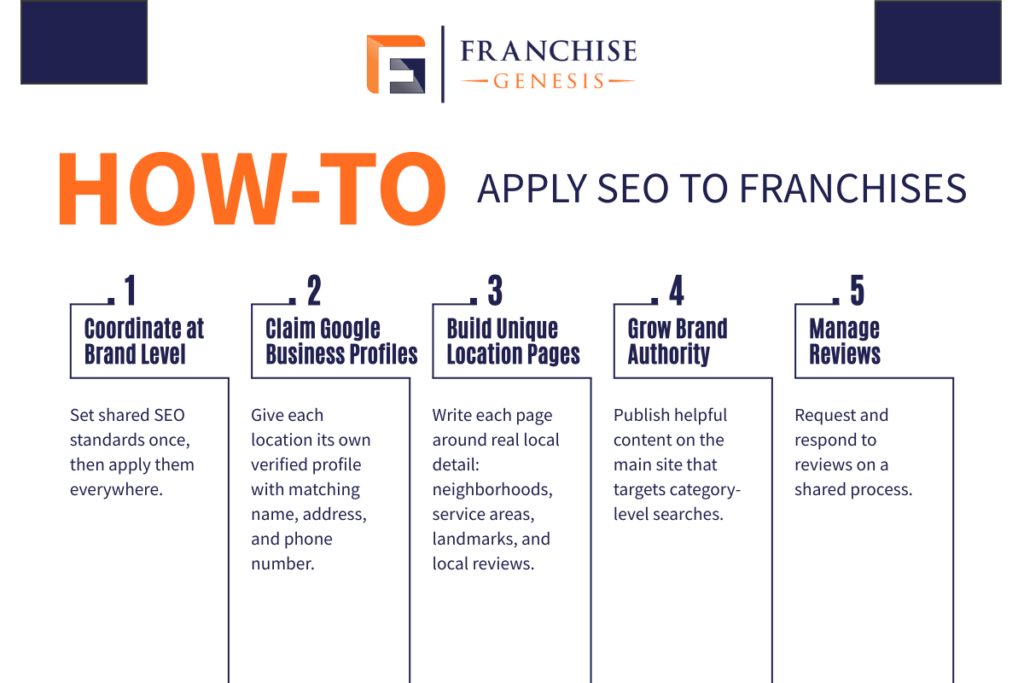
Franchise SEO comes down to five connected pillars.
- Understand the multi-location challenge first.
- Claim and optimize a Google Business Profile for every location.
- Build location pages unique enough to rank on their own.
- Grow brand authority with content that the whole system shares.
- Manage reviews and measure results as one program.
Handled together, these turn scattered locations into a brand that shows up everywhere its customers are searching.
The reason this works is coordination. Search engine optimization left to each location produces duplicate content, internal competition, and inconsistent listings. Set at the brand level and executed locally, it compounds, and every new franchise location opens into a system already built to be found.
Before local SEO can work for a franchise system, the system itself needs to be built correctly. Franchise Genesis guides business owners through every stage of the franchise development process, from feasibility through the launch of your first franchisee. Contact Franchise Genesis to get started.
Frequently Asked Questions
What is SEO for franchises?
SEO for franchises is the practice of optimizing one brand across many franchise locations so each location ranks in its own local search results while the overall brand grows stronger. It combines brand-level work on the main site with local search optimization at each individual franchise location.
Can each franchise location handle its own SEO?
It can, but doing so usually creates problems at scale. Without shared standards, locations produce duplicate content, compete against each other for the same queries, and publish inconsistent listings with mismatched names, addresses, and phone numbers. A coordinated franchise SEO strategy set at the brand level avoids these issues.
What is the single most important step for local franchise rankings?
Claiming and optimizing a Google Business Profile for every location. Local search often shows a map and three local listings before any standard website, so an accurate, complete profile is what puts a location in front of nearby potential customers and turns searches into phone calls.
Does franchise SEO matter before I open locations?
Yes. A franchise system that builds search visibility into its standards from the start gives every new franchisee a head start. A location that opens into a brand already ranking for its category competes from a stronger position than an independent business opening cold.