
Quick Answer: Licensing typically gives someone the right to use a specific asset, such as your trademark, brand or product. Franchising goes much further. It gives someone the right to operate a business using your brand, systems and methods, usually with ongoing support and specific legal requirements. The important distinction is that simply calling an arrangement a “license” does not make it one. Federal law looks at how the relationship actually works to determine if you have created a franchise.
The Core Difference in One Idea
Strip away the detail and the split comes down to scope. In the licensing vs franchising debate, licensing transfers an asset and franchising transfers a whole business.
When a company grants a license, it hands over the right to use a specific piece of intellectual property and little else. When a company franchises, it hands over a proven business model, the brand, the operating system, and a standard of brand consistency the other party has to maintain. One is a narrow permission. The other is a full operating relationship, and that gap explains almost every practical and legal difference between the two.
How Licensing Works
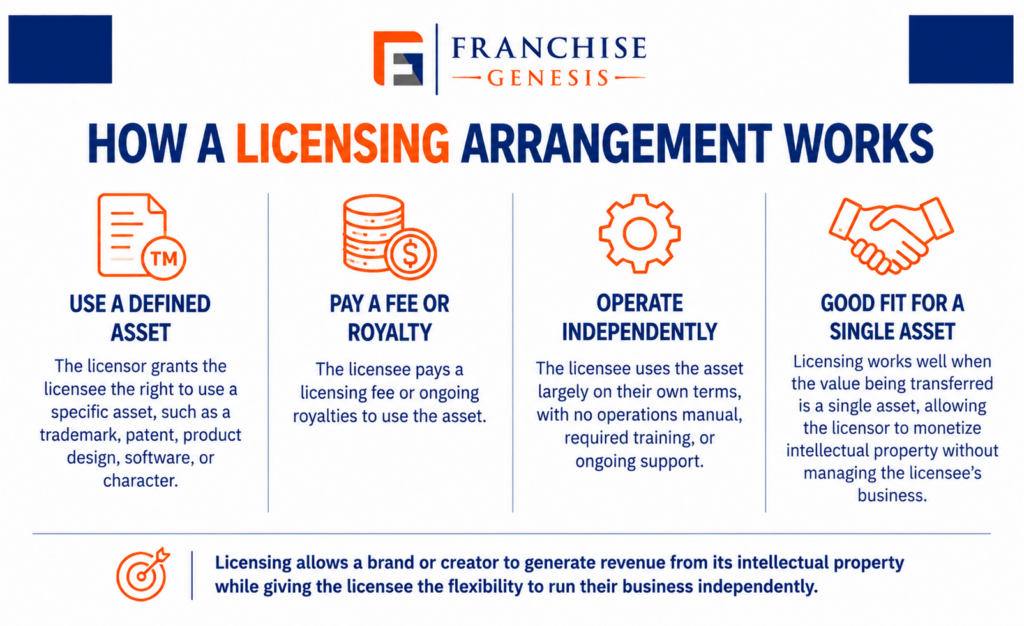
Licensing is a business arrangement where the licensor grants the licensee the right to use a defined asset. That asset might be a trademark, a patent, a product design, software, or a character. The licensee pays a licensing fee or a royalty and then puts the asset to use largely on their own terms.
The trait that defines the licensing model is light control. A trademark license lets the licensee attach a brand name to their product, but the licensor rarely dictates how the licensee’s business runs. There is no operations manual, no required training, and usually no ongoing support beyond protecting the intellectual property rights themselves. The licensor’s interest ends at the asset, not the licensee’s business.
That makes a licensing arrangement a good fit when the value being transferred is a single asset rather than an operating system. A clothing brand licensing its logo to a manufacturer, or a software firm licensing its code under a license agreement, both monetize intellectual property without taking on responsibility for how the other party operates.
How Franchising Works
Franchising grants far more than the use of an asset. A franchisor gives a franchisee the right to operate an entire business under an established brand, using the franchisor’s proven business model, business system, and brand standards. In return, the franchisee pays an initial franchise fee and ongoing royalties, and agrees to run the business the franchisor’s way. This franchise model is the standard path for business expansion in the United States when brand consistency matters.
Obligations run in both directions. The franchisor delivers initial training, a marketing plan and coordinated marketing campaigns, and ongoing support, and enforces brand consistency across every franchise location. The franchisee follows the operations manual, meets the brand standards, and protects the trade secrets behind the concept. A franchise agreement binds the whole franchise relationship, and before any money changes hands the franchisor must give every prospective franchise owner a franchise disclosure document.
That heavier structure is the point of the franchising model. It lets an owner grow through other operators’ capital while holding the brand and the customer experience consistent, which a loose license cannot do.
Side by Side
The contrast is easiest to see across the details owners care about most.
Licensing | Franchising | |
What transfers | A single asset, such as a trademark or product | An entire business and its operating system |
Control over business operations | Minimal | Extensive, through brand standards and a franchise agreement |
Ongoing support | Rarely part of the deal | A core franchisor obligation |
Paperwork | A licensing agreement | A franchise disclosure document plus a franchise agreement |
Regulated as a franchise | No | Yes, under federal and state franchise law |
Payment | A licensing fee or asset royalty | An initial franchise fee plus ongoing royalties |
Best for | Monetizing one asset | Replicating a whole business with brand consistency |
What You Call It Doesn’t Determine What It Is
Here is where owners get into trouble. Calling an arrangement a license does not make it one. The classification is set by federal law, based on what the relationship actually contains.
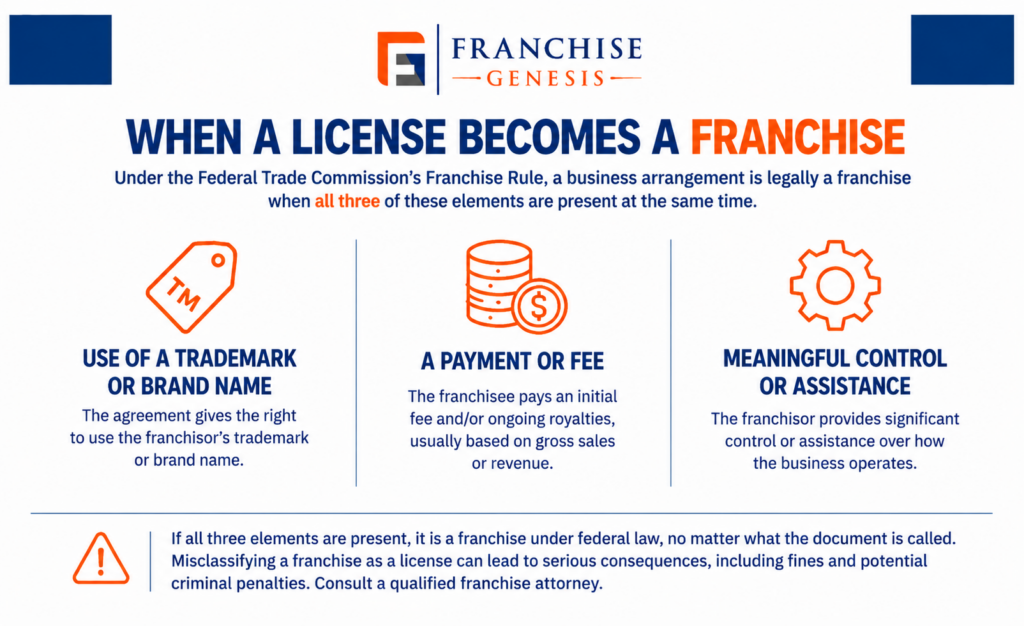
Under the Federal Trade Commission’s Franchise Rule, a business arrangement is legally a franchise when three elements are present at once: the use of the franchisor’s trademark or brand name, a required payment or fee, and meaningful control or assistance over how the business operates. Hit all three and franchise law applies, no matter what the document is titled.
That’s the risk in trying to structure a franchise as a license simply to avoid franchise regulatory requirements. An owner who licenses their brand name, charges a fee, and then directs how the licensee runs the business has built a franchise in the eyes of the law, even if the paper says licensing agreement. Skipping the franchise disclosure document in that case can bring serious consequences, and in some states the penalties for an unlawful franchise arrangement include fines and even criminal penalties. Because the rules can vary by state and depend on the specifics of the arrangement, this information is general in nature and should not replace advice from a qualified franchise attorney.
Choosing the Path That Fits Your Business Goals
The right structure depends on what you are ultimately trying to grow.
Licensing can make sense when you want to generate revenue from a specific asset, such as your brand, trademark, product, or intellectual property, without becoming deeply involved in how another business operates. It is generally simpler and less costly to establish than a franchise relationship, but that simplicity comes with a trade-off: you typically have less control over how the brand is represented and how consistently customers experience it.
Franchising is designed for something bigger: replicating a successful business model across multiple locations while maintaining a consistent brand and operating system. It requires more structure from the franchisor, including legal documentation, training, operational standards, and ongoing support. In return, franchising provides a framework for protecting the brand, creating consistency, and turning a successful business into a scalable system. Our guide on how to franchise your business explains what it takes to build that system, while our guide on how franchise royalty fees are calculated looks at how the ongoing revenue model typically works.
The key is to choose the structure that fits your business goals while understanding the legal requirements that come with it. The decision should be based on how the relationship will actually operate—not simply on which label appears easier. Franchise Genesis helps business owners evaluate their options and build a structure designed for sustainable growth. If you are considering licensing versus franchising, contact our team to discuss which approach makes the most sense for your business.
Frequently Asked Questions
What is the main difference between franchising and licensing? Licensing grants the right to use a specific asset, such as a trademark or product, with little control over the licensee’s business. Franchising grants the right to run an entire business under your system, with a franchise agreement, ongoing support, and legal obligations behind it.
Is a trademark license the same as a franchise? Not by itself. A trademark license becomes a franchise when it is combined with a required fee and real control over how the licensee operates. When all three elements are present, franchise law applies regardless of what the agreement is called.
Is licensing cheaper than franchising? Usually, yes. A licensing arrangement is simpler and faster to set up because it does not require a franchise disclosure document or the same ongoing support obligations. That lower cost comes with less control over how your brand is used.
Can I license my business instead of franchising it to avoid franchise law? Only if the relationship genuinely lacks one of the three franchise elements. If you license your brand name, charge a fee, and control how the business runs, you have created a franchise under federal law, and trying to avoid the rules can lead to penalties.
Do I need a franchise disclosure document for a license? Not for a true license. You need one when the arrangement legally qualifies as a franchise. Because that classification can be easy to trigger without realizing it, a franchise attorney should review any arrangement that grants your brand plus a fee plus operational control.
Which is better for business expansion, licensing or franchising? It depends on your goals. Licensing suits monetizing a single asset with minimal involvement. Franchising suits replicating a whole business with consistent brand standards across many locations.