
Quick Answer: Most franchise royalty fees are calculated as a percentage of gross sales, collected weekly or monthly. Some franchisors charge a fixed royalty fee instead, while others combine the two by applying a percentage with a minimum amount so the franchisor still collects when a location has a slow month.
Introduction
Two franchise systems can both charge the same royalty rate and collect very different amounts of money. The percentage written into the franchise agreement is only half the answer. What that percentage gets applied to, and how often it is collected, is the other half.
A franchise royalty fee is the ongoing payment a franchisee makes to the franchisor for the right to operate under the brand, use its proprietary business systems, and receive continued support. It is separate from the initial franchise fee, which is a one-time payment made at signing.
For a business owner considering franchising, the royalty rate is the engine of the entire revenue model. Set it too low, and the franchise system cannot fund the support it promised its franchisees. Set it too high, and the franchise opportunity stops attracting the caliber of candidate the brand needs. Getting it right requires understanding what these fees are, how they are calculated, what revenue they are applied to, what they pay for, and how to set a rate the system can live with for the next decade.
What a Franchise Royalty Fee Is and What It Is Not
The royalty fee is an ongoing fee paid for continued use of the trademark, the brand recognition behind it, and the proprietary business systems that make the concept repeatable. It also pays for the ongoing support the franchisor delivers after the doors open.
Owners new to franchising tend to blur it together with the other fees in the model, and those distinctions matter when it comes time to build the disclosure documents.
The initial franchise fee helps offset the franchisor’s costs of recruiting, onboarding, training, and supporting a new franchisee. Depending on the franchise system and the costs involved in awarding a franchise, a portion of that fee may contribute to the franchisor’s revenue after expenses such as broker commissions, onboarding, and training costs are covered.
The marketing fee is a separate ongoing fee that typically funds brand advertising and promotional materials. The amount and structure vary by franchise system, and these fees are generally disclosed in the franchise disclosure document. It flows into an ad fund rather than the franchisor’s operating account, and franchisors are generally expected to spend it as disclosed.
Technology and software fees usually arrive as a flat monthly amount covering the point-of-sale system, scheduling tools, and whatever platform the franchise business runs on.
One more distinction is worth drawing. A licensing fee paid under a license agreement is not the same thing as a franchise royalty fee. A license agreement grants the use of intellectual property and little else. A franchise relationship involves the franchisor exercising control over the business model and providing ongoing support, and that combination is what triggers franchise law in the United States.
Where the Royalty Fee Is Disclosed
Item 6 of the franchise disclosure document lists every recurring fee a franchisee will owe, including the royalty fee, the marketing fee, and any annual fee or technology charge. The franchise agreement sets the binding terms. Prospective franchisees can review the FTC’s Franchise Rule for more information on the disclosure requirements franchisors must follow.
The Three Ways Franchisors Calculate Royalty Fees
| Structure | How it is calculated | Best suited for | Trade-off |
|---|---|---|---|
| Percentage of gross sales | A set royalty rate, commonly 4% to 8%, applied to reported sales each period | Most franchise systems, including foodservice and service brands with variable volume | Franchisor revenue rises and falls with unit performance |
| Fixed royalty fee | A flat amount, identical every period regardless of sales | Systems with predictable revenue per unit, or brands where sales reporting is hard to verify | Predictable for both sides, but the franchisor never shares in a location’s upside |
| Percentage with a minimum | A percentage of gross sales, with a floor the franchisee owes even in a slow period | Newer systems protecting cash flow, and territories with seasonal swings | Protects the franchisor, but a struggling franchise location feels the minimum amount the hardest |
Percentage of Gross Sales
This is the default across most of franchising, and the arithmetic is simple. A location doing $80,000 in monthly gross sales at a 6% royalty rate owes $4,800 for that month. At $40,000 in sales, the same location owes $2,400.
Higher royalty rates are often associated with franchise systems that provide extensive ongoing support, generate leads, or supply proprietary products, although rates ultimately vary by industry and business model. A lower rate tends to appear where the franchisee carries more of the operating burden themselves.
Fixed Royalty Fee
A fixed royalty fee is a flat fee billed on a monthly basis or against annual sales targets. It is simple to administer and easy for a franchisee to budget around. It also quietly rewards high performers, because a location that doubles its revenue pays the franchisor nothing extra.
Percentage With a Minimum Amount
The hybrid applies a percentage of gross sales but sets a floor. If the calculated royalty falls below that minimum, the franchisee owes the minimum. Many franchisors do not apply minimum royalty requirements immediately after opening, instead allowing new franchisees time to build revenue and establish their operations. Emerging franchisors often reach for this structure because it makes early cash flow predictable while the system is still small. It needs to be set carefully, since a minimum that ignores ramp-up reality can bury a new location in its first year.
A master franchise arrangement adds a layer to all of this. The master franchisee typically collects royalty payments from sub-franchisees in their territory and remits an agreed share upstream to the franchisor.
Gross Sales, Net Sales, or Gross Profit?
The most consequential line in the royalty clause is not the percentage. It is the definition of the revenue that percentage applies to.
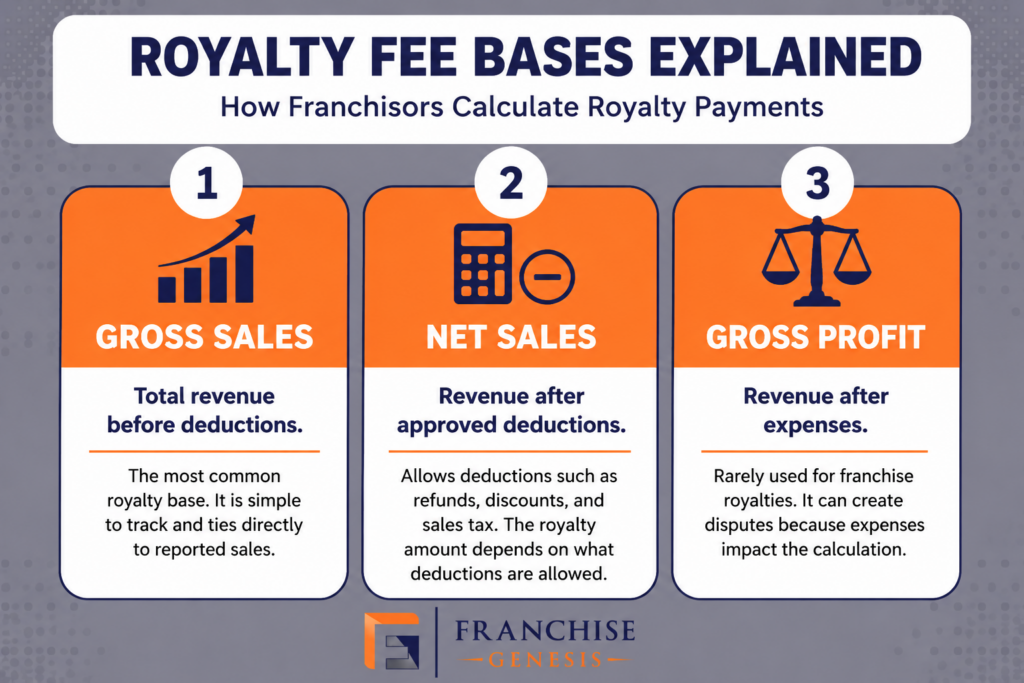
Franchisors also need to decide how to treat related revenue such as supplier commissions and vendor rebates. Whether that commissionable revenue counts toward the royalty base, and whether the franchisor keeps it outright, belongs in the disclosure rather than in the fine print.
Why Vague Definitions Create Disputes
Ambiguity about what counts as reportable revenue is one of the most common sources of disputes between franchisors and franchisees. Clearly defining the revenue base, permitted deductions, reporting deadlines, payment methods, and audit rights helps reduce the risk of future disagreements. Define the revenue base precisely. Define the permitted deductions precisely. Define the reporting deadline, the payment method, and the audit right. A franchise agreement that leaves any of those open leaves money and goodwill on the table.
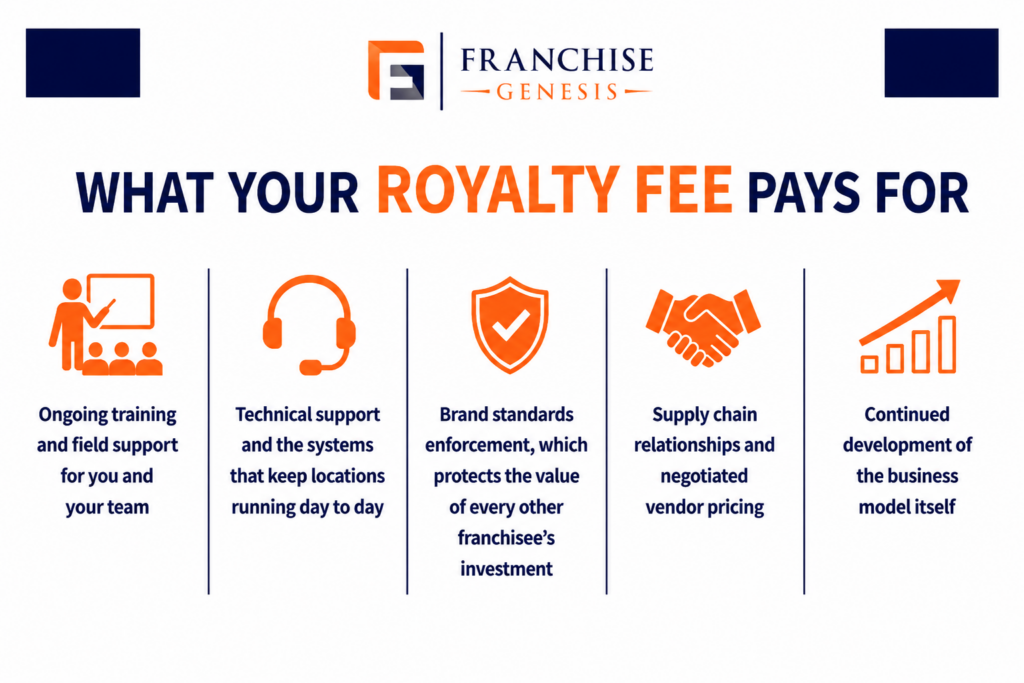
What Franchisees Are Actually Paying For
A royalty fee that feels like a tax to the franchisee is a franchise system with a problem. The fee should map to something the franchisee can point at.
On the franchisor side, ongoing royalty revenue helps fund:
Here is the part owners need to hear plainly. Royalty payments are the only recurring revenue a mature franchisor can count on. Initial franchise fees dry up the moment unit sales slow, and a franchisor living on them is one soft quarter away from trouble. Royalty revenue from a healthy franchise system compounds as units open and mature.
That reality shows up in franchise sales too. Every serious candidate asks what they get for the royalty. A franchisor who can answer specifically closes candidates on value. A franchisor who cannot clearly explain the value of the royalty may discount the rate to win candidates, then find themselves unable to fund the support those franchisees expect.
How to Set the Right Royalty Rate for Your Franchise System
Start With Unit Economics, Not Competitor Benchmarks
Build the franchisee’s profit and loss at a realistic volume, not best-case volume. Subtract the royalty fee and the marketing fee. Confirming what is left gives the franchisee a return that justifies their initial investment and the years of work behind it. If the model only clears that bar at peak performance, the rate is too high, and the system will struggle to retain owners. Not sure whether your concept can carry a royalty at all? Start with our franchise feasibility questionnaire.
Then Check The Benchmarks
Royalty rates cluster by category. Food and beverage brands commonly land around 4% to 6%. Home service and personal service brands often run 6% to 8% or higher, partly because unit revenue is lower and partly because the franchisor carries more of the lead generation. Treat these as ranges to sanity-check against, not numbers to copy. A rate that works for a sandwich franchise doing volume in a food court does not automatically work for a restoration business running trucks. Restaurant owners weighing this decision can read our full guide on how to franchise a restaurant, which walks through where the royalty structure fits into the wider process.
Decide How Sales Are Reported and Collected
Weekly or monthly reporting, automated ACH draft, and a contractual right to audit. Collection mechanics quietly break more franchise systems than the royalty rate itself does. A franchisor chasing late payments across forty locations is not a franchisor building anything.
Plan for the Ramp
Some franchisors waive or reduce minimum royalty requirements for the first six to twelve months of a new franchise location, giving franchisees time to build revenue and establish operations. Franchisors may also offer reduced initial franchise fees to certain groups, such as veterans or multi-unit developers. Any variation in fees or royalty terms must be disclosed in the franchise disclosure document and written into the franchise agreement.
The mistake we see most often is franchisors treating the royalty rate as a detail to settle once the FDD is nearly drafted. The rate needs to be designed alongside the support model it exists to fund.
Franchise Genesis Helps Build the Right Royalty Structure
Franchise royalty fees are more than a number in a franchise agreement. The right structure helps fund the support franchisees need while keeping the opportunity financially attractive for future owners.
Franchise Genesis helps business owners evaluate their franchise model, build the right fee structure, and create a system designed for long-term growth. If you are developing a franchise and need guidance on royalty structure, contact our team to discuss your goals, unit economics, and franchise strategy.
Franchise Genesis works with business owners through the full path from feasibility to franchise sales, including the fee structure that determines whether a system can actually support the franchisees it recruits. If you are building a franchise and trying to land on the right royalty structure, contact our team to discuss your goals, unit economics, and long-term franchise strategy.
Frequently Asked Questions
What is a typical franchise royalty fee? Most franchise royalty fees fall between 4% and 8% of gross sales. Food and beverage brands tend toward the lower end of that range, while service brands often sit at the higher end.
How is a franchise royalty fee calculated? The most common method is a percentage of gross sales applied to the sales a location reports each week or month. Other franchisors charge a fixed royalty fee, a flat amount owed regardless of sales, or a percentage with a minimum amount.
What is the difference between a franchise fee and a royalty fee? The initial franchise fee is a one-time payment made at signing that covers onboarding and initial training. The royalty fee is an ongoing payment made for continued use of the brand and the support the franchisor provides. Both are defined in our franchise terms glossary.
Are royalty fees based on gross sales or net sales? Both structures exist, and the franchise agreement defines which applies. Gross sales is the more common base because it is simpler to audit. Net sales allow defined deductions such as refunds and sales tax, which reduces the royalty base.
How often are royalty payments made? Weekly and monthly are both common. Most franchisors collect by automatic draft rather than invoicing.
Can a franchisor change the royalty rate after the agreement is signed? For most franchise agreements, the royalty rate remains fixed for the term of the agreement unless the contract specifically allows changes. Different royalty terms may apply when a franchise renews its agreement or when new franchisees join the system. The rate is fixed for the term of that agreement. A franchisor can set different terms for new franchisees going forward, as long as the change is properly disclosed.