
Quick Answer: There are two ways to start a handyman franchise. You can buy into an existing brand as a franchisee, or, if you already run a successful handyman business, you can franchise your own operation and become the franchisor. This guide covers both, with the focus on the second path, turning the handyman business you already own into a franchise system other owners can run.
Introduction
Homeowners consistently need repairs and upkeep, and many have less time or fewer skills to handle that work themselves. That steady demand is why the handyman trade has become one of the steadier franchise categories and why owners of successful handyman businesses are increasingly looking at franchising as their next move.
Starting a handyman franchise means one of two things. For someone new to the trade, it means buying into an established brand and running a location as a franchisee. For an owner who already runs a profitable handyman business, it means something more ambitious, building a franchise system of your own and licensing it to other operators.
This post covers the first path briefly, because it is worth understanding, then spends most of its time on the second. If you have already built a handyman business that works, franchising is the way to expand it using other people’s capital instead of your own, and it is the path Franchise Genesis helps owners navigate.
Path One: Buying Into a Handyman Franchise
If you are new to the trade or want a proven system from day one, buying a franchise is the faster route. You pay an initial franchise fee, receive training and a defined territory, and operate under an established brand in exchange for ongoing royalties.
The steps are straightforward: research brands that fit your budget and market, request and read the franchise disclosure document closely, talk to current franchisees before you sign, review the franchise agreement with qualified counsel, complete training, and launch. One common misconception is worth clearing up here. You do not need to be the best handyman in town to own one of these businesses. The owner’s real job is running the business, hiring skilled technicians, managing schedules, and handling sales, not swinging a hammer.
That path suits a lot of people. But if you already own a handyman business that runs well, the more valuable opportunity is usually the other direction.
Path Two: Franchising the Handyman Business You Already Own
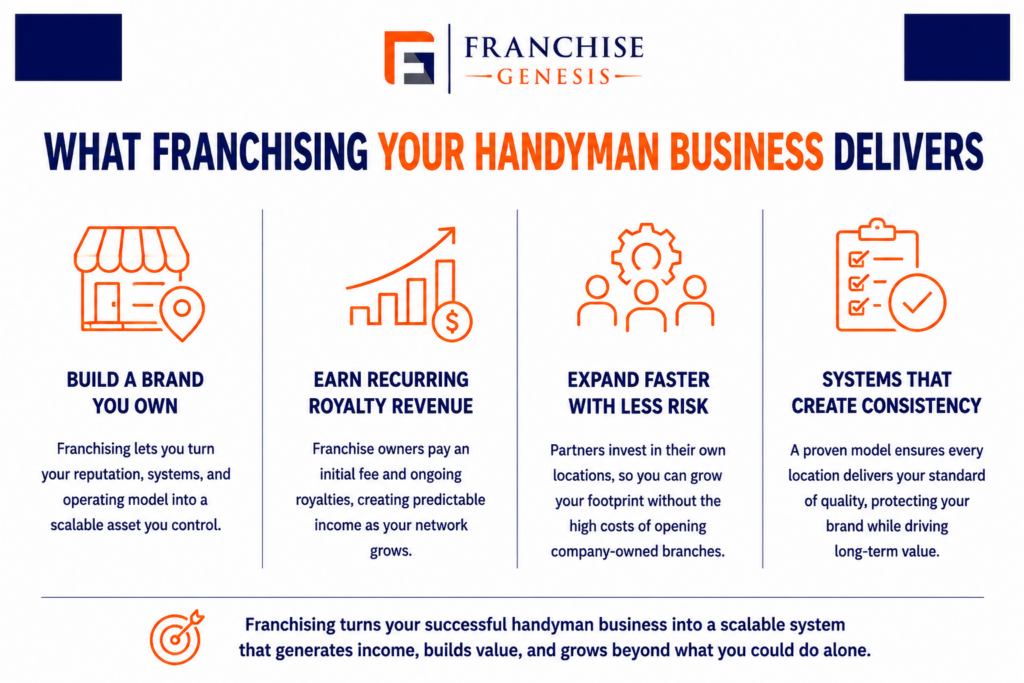
Every established handyman brand started as one local operator who decided to build a system instead of opening one more location. If your business is profitable and runs without you doing the repairs yourself, you may be positioned to do the same. Franchising your business means licensing your brand, your systems, and your operating model to other owners who open their own locations under your name, pay you an initial fee and ongoing royalties, and run their units to your standard.
The payoff is real. Instead of buying a territory, you build a brand you own, earn recurring royalty revenue as units open, and expand faster than you could by adding company locations one at a time. The rest of this guide walks through what that takes.
Is Your Handyman Business Ready to Franchise?
A profitable business is not automatically a franchisable one. Before investing in franchise development, check your business against the criteria that make franchising viable.
- Profitable and proven. Your business should show consistent profits, ideally over two to three years, with financials that back it up. Franchisees need evidence they can earn a return after paying your fees.
- Repeatable. The business has to run on documented systems rather than your instincts. If the operation lives in your head, it cannot be handed to someone else yet.
- Teachable. Someone without your background should be able to learn to run it and reach your standard. Handyman work is well suited to this, since the operating model is trainable.
- In demand beyond your market. Your success cannot depend on your personal reputation or one local factor. The concept has to work in other territories.
- Runs without you. This is the one owners miss most. A business that needs you on site every day is a job, not a franchisable system. Making it run without you comes first.
A franchise feasibility assessment gives you an objective read on where you stand and what to fix before moving forward. Judging this from the inside is hard, because every owner is close to their own business.
Build the Systems and Protect the Brand
Once your business is ready, the first real construction work is documentation and protection, and it comes before the legal paperwork.
Your operations manual is the foundation. Every process that makes your handyman business work has to be written down in a form a franchisee can follow. That means scheduling and dispatch, pricing and estimates, hiring and training technicians, service standards, vendor and supplier relationships, and quality control. The rule is simple. If a process is not written down, it cannot be taught, enforced, or replicated across a franchise network. A brand standard that lives only in your head does not survive the first franchisee.
Protecting your intellectual property comes next. Your brand name, logo, and proprietary systems are the assets you are licensing, so register your trademarks with the United States Patent and Trademark Office before you grant anyone else the right to use them. Federal registration protects the brand across every state and gives you standing to enforce it. Handling this early also strengthens your position with prospective franchisees, who want confidence in the brand they are buying into.
Build the Legal Foundation
Franchising in the United States rests on two documents, and this is where professional help is not optional.
The franchise disclosure document is a federally required legal document. Under the FTC Franchise Rule, you must give a prospective franchisee the FDD at least 14 calendar days before any agreement is signed or money changes hands. It covers your business background, the fees and total investment, the obligations on both sides, litigation history, and financial statements. Some states add their own registration or filing requirements on top of the federal rule, and the North American Securities Administrators Association keeps resources on which states those are.
The franchise agreement is the binding contract that governs each franchisee relationship. It sets the territory, the franchise fee and ongoing royalties, brand standards, the term, and the obligations of both parties. If you want to understand how the royalty side is structured, our guide on how franchise royalty fees are calculated covers it in detail.
Both documents must be prepared by a qualified franchise lawyer. A template pulled off the internet is a serious liability, because the requirements are technical and vary by state.
Recruit and Support the Right Franchisees
With the system and legal foundation in place, the work shifts to filling the network, and fit matters more than speed.
Franchise sales does not start with advertising. It starts with a clear brand story and proof the model works. Lead with that evidence, then use a structured discovery process that lets both sides evaluate alignment before anyone signs. The wrong franchisee is worse than an empty territory, because a poorly matched owner creates inconsistency across the network that is slow and difficult to reverse.
After they sign, your support is what the royalty fee funds and what keeps the system strong. The initial training program sets the standard for the whole network and ties directly to your operations manual. Ongoing support after launch, covering marketing, operations, hiring, and quality, keeps franchisees profitable and brand standards consistent. A profitable franchisee is also your best sales tool, because their results recruit the next candidate more convincingly than any campaign.
What the Process Looks Like
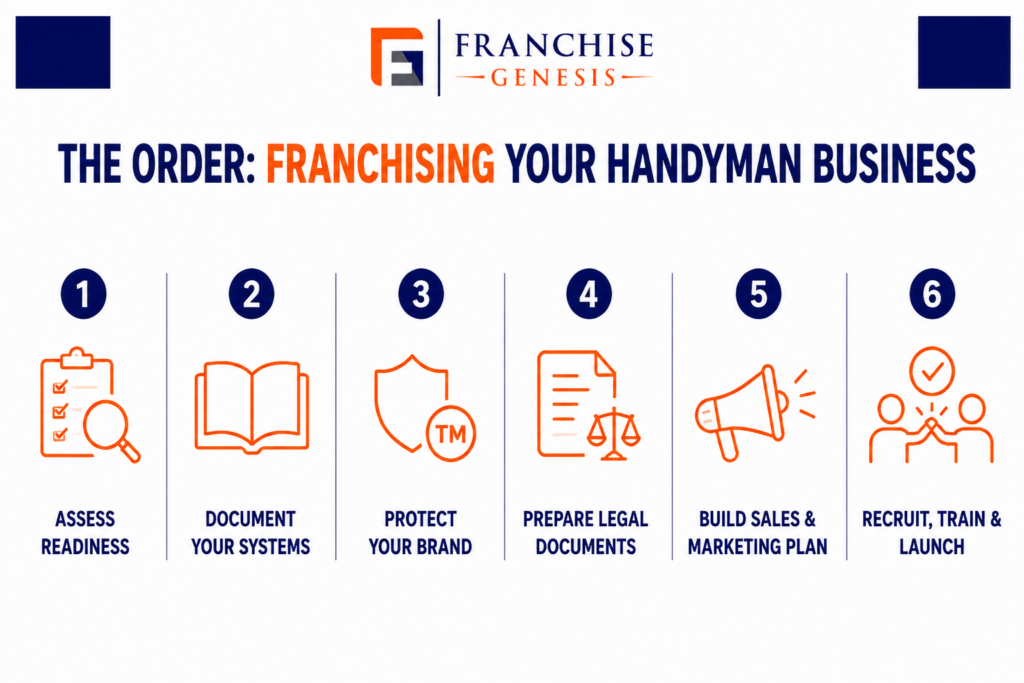
Put in order, franchising your handyman business runs from readiness to launch in a clear sequence. You assess if the business is ready and document your systems in an operations manual, protect your trademarks, prepare the FDD and franchise agreement with counsel, build your franchise sales and marketing plan, then recruit, train, and launch your first franchisee. How long it takes depends heavily on how much of your business is already documented. Owners with strong systems already written down move faster than those starting from a business that lives in their head.
The process has many moving parts across legal, operations, and marketing & sales, and they have to be coordinated rather than handled one at a time. Our guide on how to franchise a restaurant walks through the same development process in another industry, the trade differs, but the path rhymes.
Turn Your Handyman Business Into a Franchise That Scales
Franchising the handyman business you have already built is a genuine undertaking. It asks you to document what you do, protect your brand, build a legal foundation with qualified counsel, and recruit owners who will run your system well. Navigating that without guidance is one of the most common reasons emerging brands stall.
Franchise Genesis bridges the gap between a successful handyman business and a thriving franchise network across three areas.
Franchise Genesis bridges the gap between a successful handyman business and a thriving franchise network across three areas:
- Feasibility and strategy. We assess whether your business is ready to franchise and build the franchise development plan that turns one location into a system others can run.
- Legal and operational buildout. We coordinate the franchise disclosure document and franchise agreement with qualified counsel, and help build the operations manual that becomes the backbone of your system.
- Franchise sales and recruitment. We build the marketing and discovery process that attracts and qualifies the right owner-operators for your brand.
We have guided business owners across industries from a single location toward franchise networks that grow across markets. If your handyman business is ready to scale, contact Franchise Genesis to start the conversation.
Frequently Asked Questions
Can I franchise my own handyman business instead of buying one? Yes. If your business is profitable, runs without you doing the repairs, and can be documented into repeatable systems, you may be able to franchise your own brand. This is the path Franchise Genesis helps owners navigate.
How do I know if my handyman business is ready to franchise? Look for consistent profitability over two to three years, documented systems that run without you on site, and demand for the concept beyond your local market. A franchise feasibility assessment gives you an objective read.
How much does it cost to franchise my handyman business? Costs vary by scope but typically include legal fees for the FDD and franchise agreement, operations manual development, trademark registration, and franchise sales and marketing. A franchise development firm can give you a realistic estimate once it understands your business.
Do I need a franchise disclosure document to franchise my business? Yes. Franchisors must provide the FDD to prospective franchisees at least 14 calendar days before any agreement is signed or payment is collected, and certain states require registration before franchises can be offered there.
Do I need to be a skilled handyman to own a handyman franchise? No. On either path, the role is running the business, hiring technicians, managing schedules, and handling sales, rather than repairing work yourself.
How long does it take to franchise a handyman business? It depends on how much of your business is already documented. Owners with strong existing systems move considerably faster than those starting from scratch.