
Why a Franchise Financial Model is Your Most Critical Growth Tool
A Franchise financial model is a tool that projects your franchise system’s financial performance. It tracks revenue streams, costs, and profitability over time to help you make strategic decisions about expansion, pricing, and capital needs.
Key components of a franchise financial model include:
- Revenue projections: Initial franchise fees, ongoing royalties, marketing funds, and supply chain profits.
- Cost structure: Franchise development, legal/FDD, franchisee support, marketing, and technology.
- Core financial statements: Profit & Loss, Cash Flow Statement, and Balance Sheet.
- Growth assumptions: Unit expansion rate, franchisee success metrics, and breakeven points.
- Scenario planning: Best-case, worst-case, and most-likely outcomes.
Without a solid financial model, you’re guessing whether your franchise system will be profitable for you and your franchisees. It’s your roadmap to avoid common pitfalls and ensure financial viability.
A well-built financial model helps you:
- Determine if your concept is financially viable as a franchise.
- Set appropriate franchise fees and royalty rates.
- Forecast cash flow needs and secure funding.
- Avoid underestimating support costs.
- Comply with FDD disclosure requirements.
I’m Monique Pelle-Kunkle, Vice President of Operations at Franchise Genesis, and I’ve helped scale businesses from single locations to 100+ franchise units by building robust Franchise financial models that align franchisor profitability with franchisee success. In this guide, I’ll walk you through exactly how to build a financial model that becomes your roadmap for sustainable franchise growth.
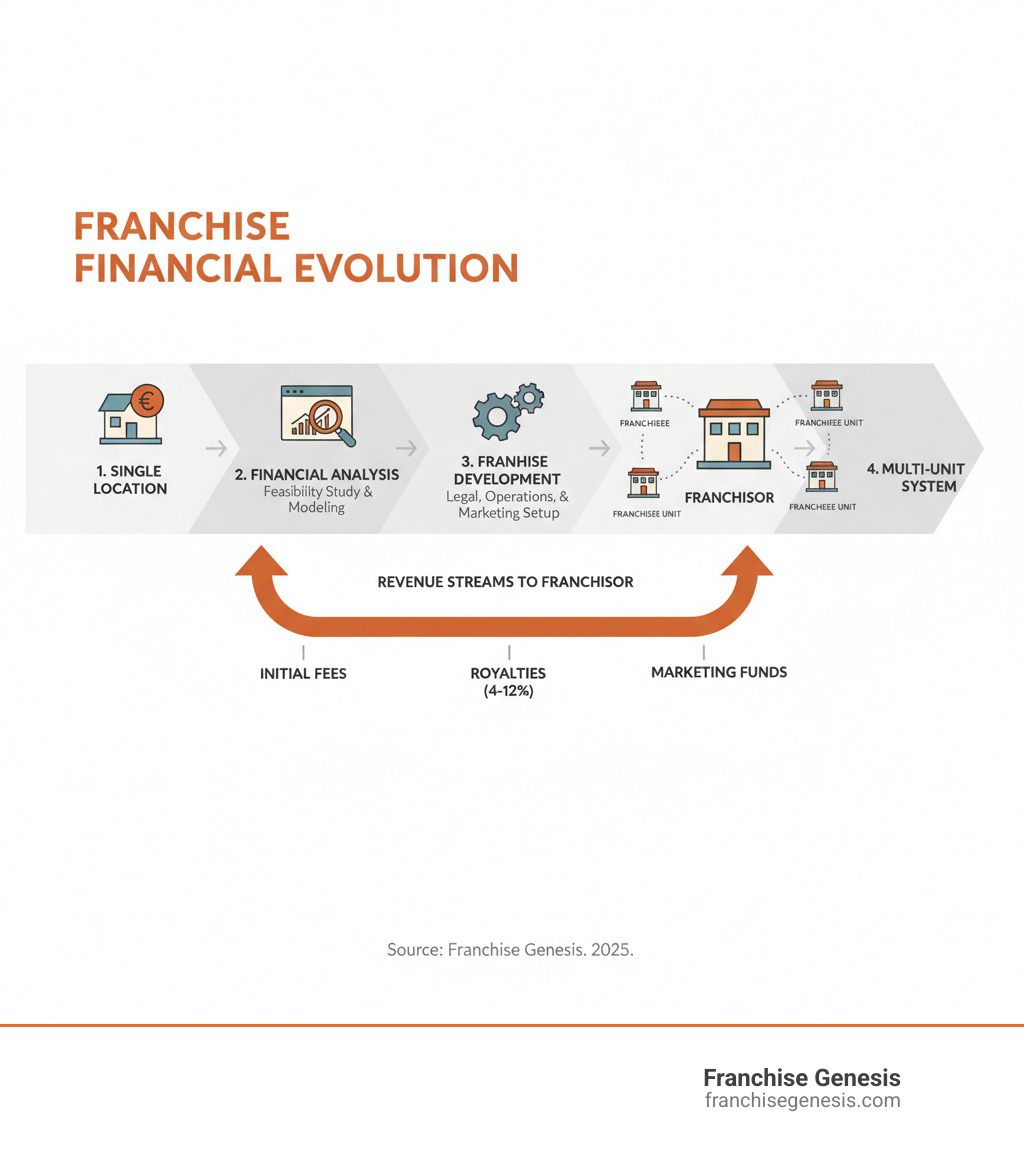
Franchise financial model terms explained:
The Franchisor’s Blueprint: Core Components of a Financial Model
Your Franchise financial model is the blueprint for your franchise empire. It provides a system-wide view of how your network will generate revenue, incur costs, and scale profitably. As a franchisor, you shift from analyzing a single location’s P&L to modeling how hundreds of units will perform collectively. This requires a new way of thinking about money, focusing on the entire franchise ecosystem’s financial health to ensure it’s profitable for you and successful for your franchisees.
More info about the costs of franchising.
Franchisor Revenue Streams
Understanding your revenue streams is the foundation of any solid Franchise financial model. Your primary sources of income as a franchisor include:
- Initial franchise fees: This is the upfront payment a new franchisee makes, typically ranging from $20,000 to over $50,000. It covers your initial costs for training, site selection, and launch support.
- Ongoing royalties: This is your most important long-term revenue stream, usually 4% to 12% of each franchisee’s gross sales. As the U.S. Small Business Administration explains, these recurring payments fund your ongoing operations and support.
- Marketing and advertising fund: Franchisees often contribute 1-3% of sales to a collective fund. This gives you significant buying power for national brand-building campaigns that benefit all locations.
- Supply chain profits: If your model includes proprietary products or equipment, you can generate revenue while maintaining brand consistency and quality control across all units.
Getting these revenue projections right is crucial for planning your growth and avoiding cash flow shortages.
A guide to franchise feasibility studies.
Franchisor Cost Structure
A comprehensive Franchise financial model must account for the significant costs of building and maintaining your system.
- Franchise development costs: These are upfront investments in market research, business planning, and creating your operations manuals and systems.
- Legal and FDD costs: Preparing your Franchise Disclosure Document (FDD) and franchise agreement with experienced franchise attorneys is a substantial, non-negotiable expense. You’ll also have ongoing costs for annual accounting audits.
- Franchisee support staff: Many new franchisors underestimate the cost of field consultants, trainers, and administrative staff. These roles are essential for franchisee success and satisfaction.
- Corporate marketing and advertising: This is separate from the franchisee marketing fund and covers your efforts to recruit new, qualified franchise candidates.
- Technology infrastructure: Modern franchise systems require CRM for lead management, operational software for franchisees, and reporting tools to track system-wide performance.
Understanding these costs helps you calculate your breakeven point—one of the most important outputs of your financial model.
The Three Core Financial Statements
Every Franchise financial model is built on three interconnected financial statements that enable smart decision-making.
- The Profit & Loss (P&L) Statement shows if your franchise system is profitable by listing all revenues and subtracting all expenses to find your net profit or loss.
- The Cash Flow Statement answers a critical question: do you have enough cash to operate and grow? As TD Bank’s guide explains, positive cash flow is vital, as you can be profitable on paper but lack the cash to pay your bills.
- The Balance Sheet provides a snapshot of your financial health, showing what you own (assets), what you owe (liabilities), and your equity. A strong balance sheet demonstrates stability to investors and franchisees.
Together, these statements tell the complete financial story of your franchise system—past, present, and future.
Understanding cash flow statements.
Building Your Franchise Financial Model: Inputs, Assumptions & Projections

Building your Franchise financial model transforms your vision into actionable numbers. This process requires attention to detail, but a well-built model becomes your most trusted advisor, turning raw data into strategic decisions for every major step you take as a franchisor.
Explore franchise financing trends.
Essential Inputs for Your Franchise Financial Model
The reliability of your Franchise financial model depends on the quality of your inputs. These are the critical data points to focus on first.
- Unit growth rate: Your planned pace of franchise expansion.
- Franchisee success metrics: Key performance indicators for a typical unit, such as average unit volume (AUV), which directly impact your royalty income.
- Royalty percentage: The ongoing percentage of franchisee sales (typically 4-12%) that becomes your primary revenue stream.
- Initial franchise fee: The upfront payment from new franchisees.
- Corporate overhead: Your fixed costs as a franchisor, such as leadership salaries and office rent.
- Support costs per unit: The annual cost to support each franchise location, including field staff and technology.
- Cost to develop each unit: The franchisee’s investment, which you must disclose in Item 7 of your FDD.
- Franchisee variable expenses: Costs like goods sold and local marketing. Franchisee profitability is critical to your long-term success.
Making Realistic Assumptions & Scenarios
Once you have your inputs, the next step is to make realistic assumptions and develop different scenarios to separate fantasy from achievable reality.
- Your best-case scenario assumes optimal conditions, rapid growth, and high sales, representing your aspirational goals.
- Your worst-case scenario prepares you for headwinds like slower growth or economic downturns, helping you identify potential cash flow gaps.
- The most-likely scenario reflects a balanced, conservative view and becomes your primary planning tool for strategic decisions and investor presentations.
We also conduct a breakeven analysis to pinpoint when the franchisor and individual franchisee units will become profitable. Sensitivity analysis tests how changes in key assumptions—like a 1% change in the royalty rate—affect your overall projections, revealing which variables have the biggest impact.
Leveraging Technology and Software
Building a Franchise financial model is manageable with the right technology.
- Spreadsheet software like Excel or Google Sheets are powerful starting points. Good templates can handle complex projections and automatically update system-wide financials as you add units.
- Specialized modeling tools offer features custom-built for franchising’s complexities, such as royalty tracking and consolidated reporting, which your standard bookkeeping software won’t have.
- A clear financial dashboard is essential. It transforms columns of numbers into intuitive charts, allowing you to monitor key performance indicators and system health at a glance.
- The most powerful models incorporate real-time data analysis, turning your model into a living document that reflects actual business conditions and helps you spot trends early.

With the right tools, accurate inputs, and realistic assumptions, you’ll have a powerful compass guiding every decision on your franchising journey.
Key Differences: Modeling for a Franchisor vs. a Franchisee
A Franchise financial model must account for two distinct financial perspectives: the franchisor’s and the franchisee’s. As a franchisor, you focus on system-wide growth; the franchisee focuses on unit-level success. Your model must prove that both can be profitable. This balance is critical for attracting quality franchisees and building a sustainable system.
Here’s how the two perspectives compare:
| Feature | Franchisor Model | Franchisee Model |
|---|---|---|
| Primary Focus | System-wide growth, brand equity, royalty income | Unit-level profitability, local market success |
| Main Revenue | Initial fees, ongoing royalties, marketing funds | Sales of goods/services to customers |
| Key Costs | FDD legal, support staff, corporate marketing | Rent, payroll, COGS, local marketing, royalties |
| Investment | Franchise development, infrastructure | Initial build-out, working capital, equipment |
| Goal | Expand brand, increase system value, royalty flow | Personal income, ROI on unit, operational profit |
| Valuation | Enterprise value of the entire franchise system | Value of individual franchise unit |
Learn about franchise investment options.
Focus on System-Wide Growth
As a franchisor, your Franchise financial model must focus on the big picture of system growth and value.
- Unit expansion drives growth, bringing in initial fees and adding to your royalty base. It allows you to expand your footprint using franchisee capital.
- Brand equity grows as your system expands, creating a virtuous cycle: a stronger brand attracts better franchisees, who open successful locations, further strengthening the brand.
- Economies of scale increase your negotiating power with suppliers and improve the efficiency of your marketing and technology investments.
- Support infrastructure investment is crucial. Your model must account for adding staff like field consultants and trainers as you scale to maintain quality support.
- Long-term valuation is the end goal. Your franchise system is an asset with significant enterprise value, and your model should demonstrate how that value increases over time.
Focus on Unit-Level Profitability
Franchisee profitability is paramount. If your franchisees aren’t making money, your system cannot grow. Your financial model must therefore be deeply concerned with the economics of a single unit.
- Single-unit economics must show a healthy profit margin after all expenses, including royalties. We build a detailed P&L for a typical franchisee.
- Local market costs for rent and labor vary significantly, and your model should account for these regional differences.
- Franchisee ROI is a primary concern for candidates. Our research shows owner-operators look for at least a 15% return, while area developers seek 20% or more.
- Debt service must be considered, as many franchisees need financing. The model should ensure they have positive cash flow after loan payments.
- Owner’s discretionary income is the bottom line for the franchisee. It must be enough to justify their risk and effort.
At Franchise Genesis, we build your Franchise financial model to address both perspectives, ensuring the unit-level economics are compelling enough to attract successful franchisees and drive your system-wide growth.
Using Your Model for Growth, Funding, and Compliance
Your Franchise financial model is a strategic command center that guides expansion, helps secure capital, and ensures regulatory compliance. It’s the tool you use to future-proof your brand for sustainable success.

Get help with franchise acquisition financing.
Securing Funding and Attracting Investors
When raising capital, your Franchise financial model is your most persuasive tool. It speaks the language of lenders and investors.
- A well-built model demonstrates viability with data-backed projections, showing that your concept is a sound investment.
- It can project investor returns using metrics like Internal Rate of Return (IRR), giving investors a transparent view of their potential profit.
- It provides the 5-year financial projections that banks and investors require, building a compelling business case for either equity or debt financing.
- It also helps franchisees secure their own financing, particularly SBA loans, by providing the detailed unit-level projections they need.
Common Pitfalls in Your Franchise Financial Model
Promising franchise concepts can stumble due to flaws in their financial model. Here are the mistakes to avoid.
- Ignoring FDD requirements: Your financial projections must align with the legal disclosure requirements of your Franchise Disclosure Document, especially if you make Financial Performance Representations.
- Underestimating support costs: This is the most common error. New franchisors often calculate royalty income without fully accounting for the cost to train, support, and service franchisees, leading to strained resources and franchisee dissatisfaction.
- Unrealistic growth projections: Be honest about your capacity for expansion. Planning for overly aggressive growth without the infrastructure to support it sets you up for failure.
- Poor cash flow management: A business can be profitable on paper but fail due to a lack of cash. Your model must track not just profit, but the timing of cash moving in and out of the business.
- Confusing franchisee vs. franchisor profit: Your model needs distinct sections for your profits and the projected profits of a franchisee. The two are not the same.
Regulatory Disclosures (FDD)
Your Franchise financial model plays a legally critical role in your Franchise Disclosure Document (FDD).
Your model is the backbone for Item 19, which covers Financial Performance Representations (FPRs). While optional, many franchisors provide FPRs to help sell franchises. If you do, they must have a reasonable basis and clear assumptions, all derived from your financial model.
Legal compliance is not optional. Any financial claims you make to prospective franchisees must be consistent with your FDD and underlying model. Transparency with candidates builds trust. A well-supported FDD helps potential franchisees make informed decisions and attracts serious, qualified partners who appreciate your professionalism.
Franchise royalties explained by the SBA.
Frequently Asked Questions about Franchise Financial Models
Here are answers to the most common questions we hear from business owners considering franchising.
How detailed should my initial franchise financial model be?
Your initial Franchise financial model should focus on the key drivers of your business. Project major revenue and cost categories for both the franchisor and a typical franchisee unit, including initial fees, royalties, corporate overhead, and unit-level operating costs. The goal is to conduct a Franchise Feasibility Study to determine if your concept is financially viable as a franchise. You don’t need to account for every small expense at first; focus on the details needed for strategic decisions. Your model will become more granular as your system grows.
Can I use a template for my franchise financial model?
Yes, templates are an excellent starting point for a Franchise financial model, providing a structured framework that saves time. However, customization is essential. No template can perfectly capture your unique business model, revenue streams, and cost structure. Use the template as a flexible tool, but adapt it to reflect your specific metrics and market conditions. A customized model is far more valuable than a generic one.
How often should I update my financial model?
Your Franchise financial model is a living document that should be updated regularly. We recommend a comprehensive update annually at a minimum, with quarterly reviews during periods of rapid growth. You should also update the model whenever you make major strategic shifts, like changing your royalty structure or expanding into new territories. Regular updates ensure your model remains an accurate roadmap for your financial future, reflecting actual performance and evolving business conditions.
Conclusion
Your Franchise financial model is the foundation of your franchise system—a financial GPS for every major decision. It answers critical questions about viability, fees, and your capacity to scale. Without it, you’re navigating your growth in the dark.
This guide has covered the essentials: from core components and projections to its role in funding and FDD compliance. A solid model empowers you to make informed decisions that drive sustainable growth by ensuring your profitability aligns with franchisee success.
At Franchise Genesis, we specialize in building these realistic and ambitious financial models, helping business owners transform a single successful location into a thriving franchise system. You’ve built a business worth replicating. Now, let’s create the financial foundation to support your expansion.
Ready to franchise your business? Let’s work together to build a financial model that turns your expansion vision into reality. Your roadmap to franchise success starts here.