
At a Glance: Franchising lets one company license its brand and business model to independent owners who run locations under the same system. Learning how franchising works comes down to a few things: the franchise disclosure document, the franchise agreement, the initial franchise fee, and the day-to-day operations every owner follows. Reading the documents, researching real franchise opportunities, and spending time inside the franchise community teach you about the model faster than anything else.
How Does Franchising Actually Work?
At its core, franchising is a licensing relationship. One company grants independent operators the right to run a business under its brand and proven system. The company that owns the system is the franchisor. The operator who buys in and runs a location is the franchisee.
The exchange is straightforward. A franchisee pays an initial franchise fee to join, then pays ongoing royalties while following the franchisor’s playbook. In return, the franchisee steps into an established brand, a documented operation, and often a shared supply chain, instead of inventing a business from nothing. That head start and the ongoing support is the competitive advantage franchising offers over launching an independent concept.
Franchised businesses make up a large share of the United States economy. Franchise output is expected to climb past $921 billion in 2026, supported by close to 8.9 million jobs. Those numbers stretch across various industries, from food and fitness to home services and childcare franchise brands.
The Two Sides of a Franchise: Franchisor and Franchisee
Understanding franchising starts with knowing the roles of the franchisor and franchisee. While both work toward the success of the brand, each has distinct responsibilities and plays a different part in building and growing the business.
| Category | Franchisor | Franchisee |
|---|---|---|
| Owns | The brand, system, and trademarks | A license to operate one or more locations |
| Day-to-day | Builds the system, trains and supports the network | Runs the day-to-day operations of the business |
| Pays | The cost to develop and back the brand | An initial franchise fee, all start-up costs, plus ongoing royalties |
| Aim | A consistent, growing franchise system | A profitable business under a proven model |
A franchisor often begins with a single company-owned store before opening the model to others. A franchisee might start with one unit and grow into a multi-unit franchisee. Both are after the same result, which is a brand that performs the same way for every owner in it.
Ways to Learn Franchising Before You Commit
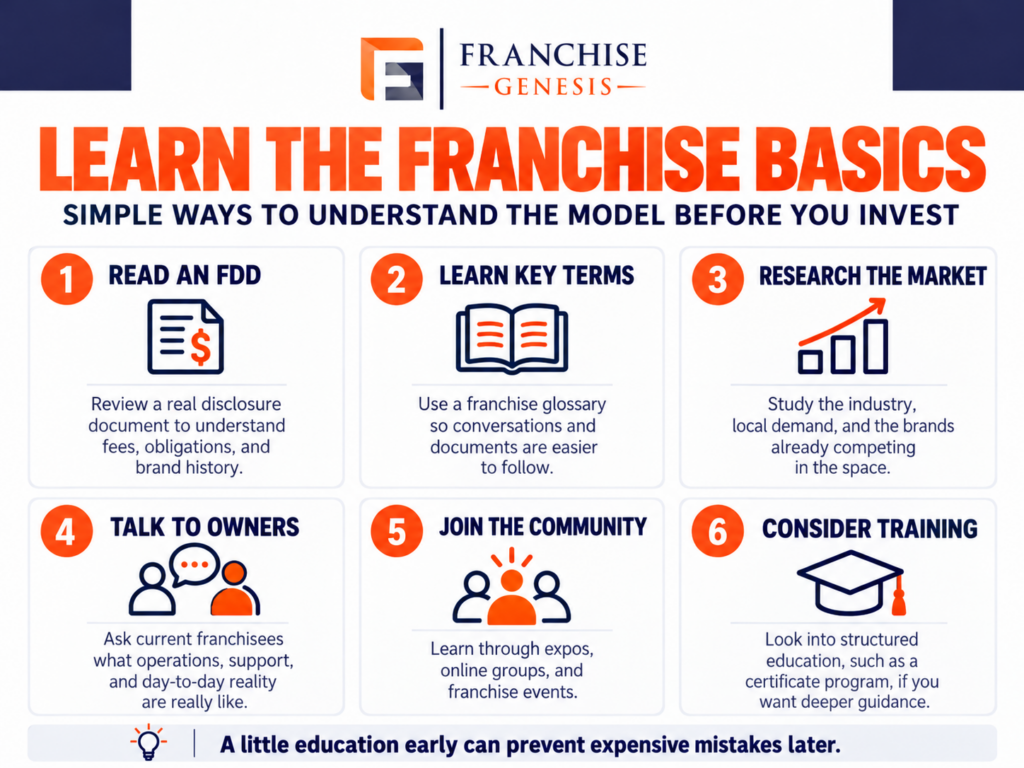
Franchising has its own vocabulary and its own legal requirements, so a short education upfront saves money later. These steps provide a prospective franchisee or a future franchisor with a practical understanding of how the franchise model works.
- Read a real franchise disclosure document end to end, because it spells out the costs, obligations, and history of an actual franchise business.
- Learn the vocabulary with a reference like this franchise terms glossary so conversations and legal documents make sense.
- Run market research on the industry you want to enter and the brands already in it.
- Ask current franchise owners what their day-to-day operations and support really look like.
- Spend time in the franchise community through expos, online groups, and events.
- Speak with a franchise consultant about your business and whether franchising is the right next step for growth.
Previous experience in business is useful, but it is not a requirement. A well-structured franchise system provides the processes, training, and support needed for motivated individuals to operate a business successfully without having to build it from the ground up. This is one of the reasons franchising appeals to professionals looking to transition from corporate careers into business ownership.
The Paperwork: FDD, Franchise Agreement, and State Rules
Two legal documents sit at the center of every franchise, and knowing what each one holds is a real part of understanding the model.
The franchise disclosure document, or FDD, is a legally required document a franchisor must provide to every prospective franchisee. Under Federal disclosure requirements prospective franchisees must receive the FDD at least 14 calendar days before signing a binding agreement or making any payment to the franchisor or its affiliate in connection with the proposed franchise sale. Organized into 23 standardized sections, the FDD provides essential information about the franchise system, including its operations, financial obligations, legal history, and the responsibilities of both parties.
A few of those items carry more weight than the rest, and they are the ones worth reading first.
- Item 7 estimates the full cost to open a unit, covering the franchise fee, buildout, equipment, signage, and the capital needed to run the business through its early months.
- Item 5 and Item 6 lay out the initial franchise fee and the ongoing royalties and other recurring fees a franchisee pays.
- Item 1, Item 2, Item 3, and Item 4 cover the franchisor’s background, business experience, litigation history, and any bankruptcy.
- Item 19 is where a franchisor may share financial performance figures, and because that item is optional, its absence tells a candidate something too.
- Item 20 reports how many outlets have opened, closed, or changed hands, which signals whether the system is growing or churning, and it lists contact information for current and former franchisees.
- Item 21 holds the franchisor’s audited financial statements, a read on whether the company behind the brand is financially sound.
Reading the FDD well usually takes more than reading it by yourself. Most buyers go through it with a franchise attorney and call the current and former franchisees named in Item 20, since those conversations surface what the paperwork cannot.
The franchise agreement is the binding contract that turns the FDD’s terms into enforceable obligations. It sets the territory, the term and how renewal works, the brand standards, and the responsibilities on both sides.
A handful of states have some additional regulations. New York and Rhode Island are two of the registration states, where a franchisor registers before offering franchises at all. The franchise registration states differ on where that extra legal requirement applies.
What Getting Started Costs
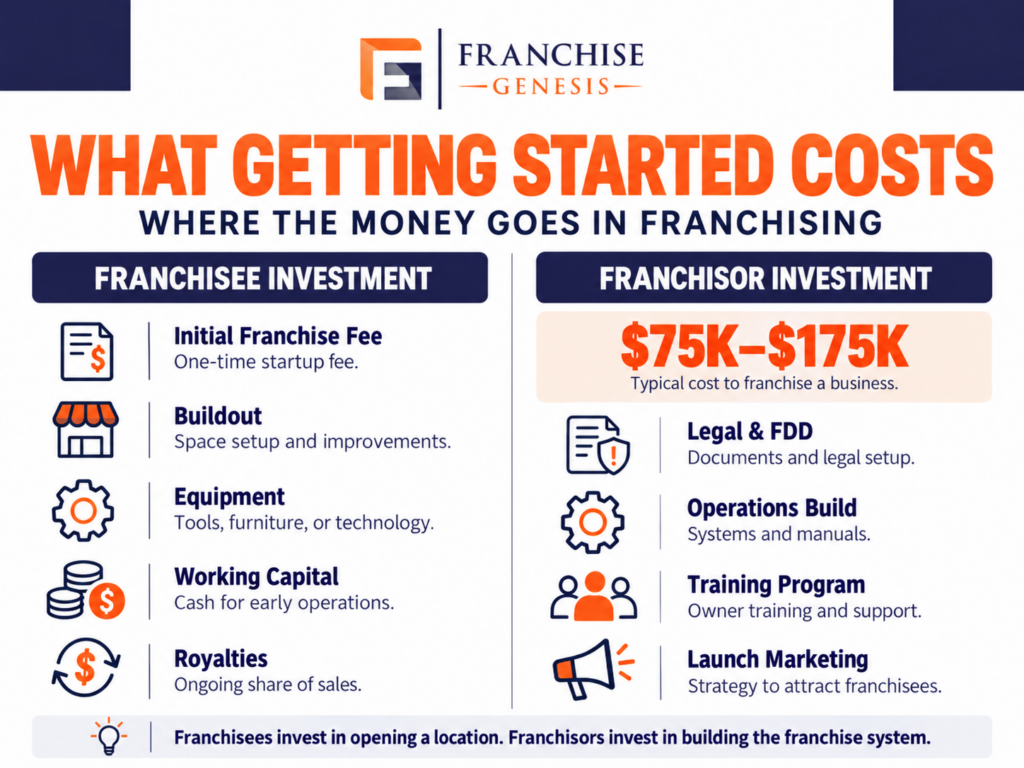
Cost comes up early on both sides. A franchisee’s investment usually covers the initial franchise fee, buildout, equipment, and working capital. The franchise fee is usually a flat fee paid once at the start, while royalties continue as a share of sales.
A business owner franchising their own brand is investing in the system instead. Franchising a business typically runs between $75,000 and $175,000, shaped by the legal work, the operations build, the training program, and the marketing strategy behind the launch.
The Path to Franchising
Franchising your business involves creating a system that other owners can follow.
It opens with a feasibility check, confirming the business model is profitable, in demand, and repeatable without the founder actively working on it. Next comes a business plan for the system itself, setting the fee structure, territory approach, and support each franchise partner receives. From there, the franchise disclosure document and franchise agreement are drafted with franchise attorneys, and a franchise operations manual captures the day-to-day operations so every location holds the same standards. During the final stage, the training program is built and the plan to attract the right franchise candidates. Start to finish, most projects land in the 4-to-6-month range.
Getting Started With Franchise Genesis
Learning how franchising works is step one. Turning that knowledge into a launched franchise concept is where a development partner earns its place.
Franchise Genesis is set up to carry a brand through all three stages with one turnkey package: build, launch, and scale. The build covers the FDD, franchise agreement, operations manual, and training, with outside franchise attorneys and their fees folded into the price of our turnkey package. Once the franchise system is established, the focus shifts to building brand awareness and attracting qualified franchise candidates. National franchise expos, targeted media exposure through Franchise Journal’s audience of more than 500,000 subscribers, and a network of over 100 active franchise consultants help introduce the brand to prospective owners. Supporting these efforts is more than a century of combined franchising experience across industries including food, fitness, retail, education, beauty, and pet services. This expertise is backed by a proven track record of franchise growth, including helping a brand expand to more than 100 locations in its first year.
Thinking about turning your own business into a franchise? Reach out to Franchise Genesis to walk through your concept and the steps ahead.
Frequently Asked Questions
Where should a beginner start with franchising? Begin with a real franchise disclosure document, a glossary of franchise terms, and research on the industry you want to join. Conversations with current franchise owners and a visit to a franchise expo fill in the real-world detail the documents leave out.
Who is the franchisor and who is the franchisee? The franchisor owns the brand and system and supports the network of owners. The franchisee licenses the right to operate a location and handles its day-to-day operations. One grows the system, the other runs the business.
Which documents matter most before buying or building a franchise? The franchise disclosure document discloses the costs, obligations, and history of a franchise opportunity, and the franchise agreement is the contract that governs the relationship. Fourteen states require a franchisor to register before any franchise can be offered there.
How long does franchising a business take? Preparing a business to legally offer franchises usually takes about 4 to 6 months. The timeline moves with the complexity of the business model and how quickly the owner makes decisions.